
Jerry Dyer is running for Fresno mayor. As police chief, he’s long been a political force
Maybe Jerry Dyer has always been a politician.
In nearly 20 years as Fresno’s police chief, he was front-and-center giving crime updates and doing public safety ads. There’s a Jerry Dyer bobblehead and a statue honoring him at The Big Fresno Fair.
“Jerry is one of a handful of police chiefs who left an indelible mark in California. Jerry Dyer is considered a legend among police chiefs in California. Few hold that distinction,” said Ronald Lawrence, the president of the California Police Chiefs Association. “Jerry’s role there really has elevated the reputation of Fresno as a fantastic city and a safe city.”
Dyer was able to achieve many of those things because of his ability to navigate politics, Lawrence said.
As past president of the California Police Chiefs Association, Dyer worked with former Gov. Jerry Brown and state legislators to find a solution for prison realignment.
Dyer also survived the tenure of three Fresno mayors and their city managers.
Naming Dyer chief was “one of the easiest decisions I ever made,” said former mayor Alan Autry.
And when Dyer first met with Ashley Swearengin in 2006 before he decided against a mayoral run in 2008, it was Swearengin who felt like the political newcomer.
“I felt like the pipsqueak approaching the Goliath of Fresno politics,” said Swearengin, who went on to become Dyer’s boss for eight years.
Dyer also campaigned for and against city ballot measures and endorsed numerous candidates over his police chief tenure. Once, he considered running for sheriff.
Nearly 20 years later, he’s no longer police chief, and perhaps the inevitable has arrived: Dyer is running for political office, mayor of Fresno.
For the first time, his name will appear on a ballot and voters will decide his future.
Dyer signed off as chief over the radio on Oct. 16. He’s running for mayor in a field of eight candidates, most notably Fresno County prosecutor Andrew Janz.
So far, Dyer has raised hundreds of thousands of dollars and garnered support from many big Fresno names. His campaign also has been met with loud opposition from people who say his failures as a police chief make him unfit to be mayor.
Navigating politics
Despite skillfully working with three mayors and their administrations, Dyer said he wishes he would’ve stayed out of the campaigns in favor of Measure G and against Measure P.
Dyer supported Swearengin’s campaign to privatize the city’s trash services in Measure G, resulting in hard hits from the Fresno Police Officers Association, which took out ads reading “Dyer’s been duped” that depicted him as a puppet and Swearengin as the puppet master.
In 2018, Dyer joined Mayor Lee Brand in opposing Measure P, a sales tax initiative to benefit city parks and arts. Opposing Measure P pitted Dyer against his two former bosses – Autry and Swearengin.
Autry joked that he and Dyer put aside their differences on Measure P during a wrestling match at Roeding Park.
“I put him in a rear-naked chokehold, and he tapped out and promised he’d never go against the parks again,” Autry said. “I’m satisfied with that and pretty sure he’ll keep his word.”
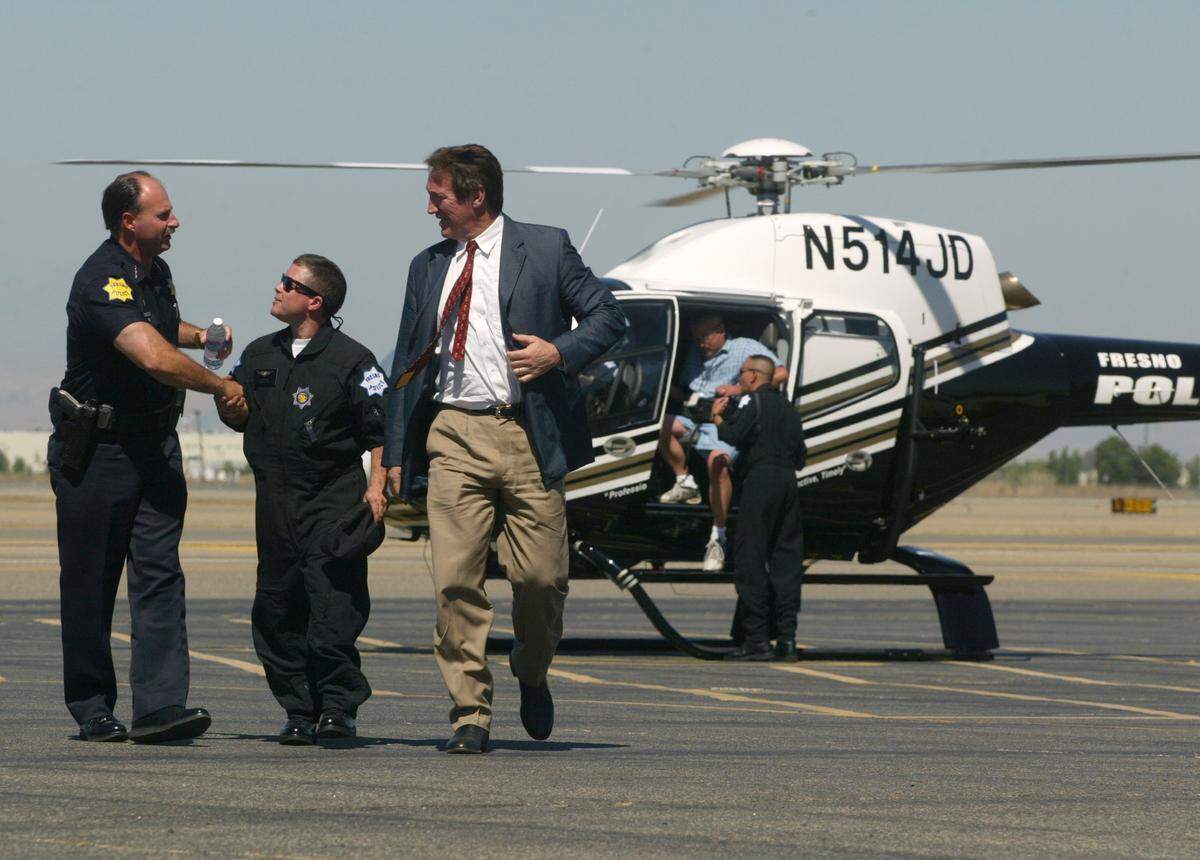
Swearengin said she’s still scratching her head about Measure P, but she doesn’t think the opposition will keep her and Dyer from working together in the future.
As chief, Dyer often endorsed Fresno County candidates running for a multitude of offices, such as county supervisor, city council member, district attorney, school trustee and more. But, he said, his attitude has changed.
“In today’s environment, it has become much more hateful in the world of politics, and people have become much more divided,” he said. “It used to be a time where you could agree to disagree on the issues, but that’s no longer the case. And if you would endorse a candidate, at the end of the day, into the election, everybody would shake hands and it would be OK. It’s not like that anymore.”
Opposition
In his run for mayor, Dyer has faced sharp criticism and opposition from more than his opponents.
Protesters showed up to the news conference announcing his mayoral run. Their shouting forced the news conference indoors at Manchester Center. They shouted “child molester,” “murderer,” and “liar Dyer.”
Dee Barnes, a longtime civilian employee in the police department, launched a political action committee against Dyer. The former president of the Fresno City Employees Association said she thinks Dyer will continue to lead Fresno down its current path rather than paving a new one for the city.
“People are not coming out against Dyer because they’re haters,” she said. “I really, truly believe he is wrong for Fresno. He’s bad for Fresno. We need major changes in this city and its leadership.”
Juan and Amy Arambula are the best known donors to the PAC – and they’ve donated the most money at nearly $100,000. Although the arrest of their son, Assemblymember Joaquin Arambula, D-Fresno, factored into their opposition of Dyer, they said it wasn’t the main reason or the only reason.
Juan Arambula said Dyer broke his promise to stay out of the Measure P fight. The Arambulas also disagree with Dyer’s policing strategies, saying he put too many officers on special tactical units rather than focusing on community policing.
“On a personal level, he seems to feel like he can do or say anything because nothing will happen to him,” Juan Arambula said. “We just don’t believe that’s the kind of character that our mayor should have.”
Controversies
While campaigning for mayor, Dyer’s past has resurfaced.
Shortly after Dyer was sworn in as police chief in July 2001, The Bee published a story with the headline “Cops twice probed allegation Dyer had affair with girl, 16.”
The Bee reported Dyer twice faced accusations that he had sex with an underage girl in the mid-1980s. The girl turned 16 in 1985 – when Dyer was 26, married and working as a Fresno Police officer.
In interviews in 2001, Dyer declined to discuss the alleged sexual relationship.
Now during his campaign, he again has declined to discuss the allegations. This time, he said his wife, Diane, asked him not to talk about it.
“One of the things that I’ve committed to my wife is that I would not make that an issue in this campaign,” he said. “Now others may. But I’m trying not to participate in that. And I made that commitment to her.”
His campaign launch was met with the protesters calling him names. His billboards have been defaced with spray paint spelling out “child rapist” and “murderer.” The allegations regarding the teenage girl came up during a podcast interview.
The word “murderer” on the billboard likely refers to the death of former police Lt. Jose Moralez.
Moralez died 200 yards from Dyer’s home in 2004. The Fresno County Sheriff’s Office ruled the death was a suicide.
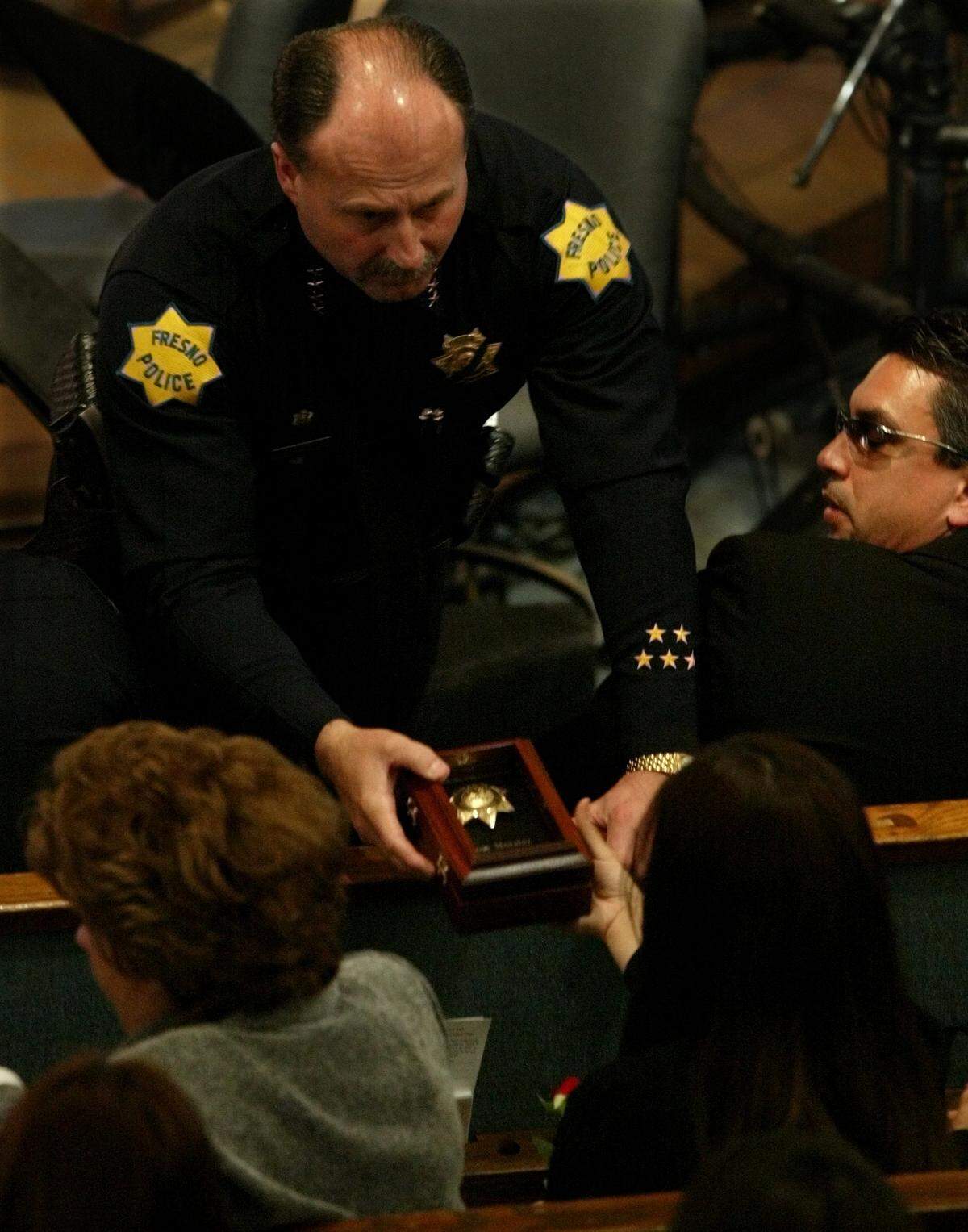
Moralez’s widow, Yolanda, has nothing good to say about Dyer.
She maintains her belief that her late husband was the “sacrificial lamb” of the Fresno Police Department amid lurking extramarital affairs scandals. And she believes Dyer played a role in her husband’s death.
“I can accept the fact that my husband (died by) suicide,” she said in an interview with The Bee. “But the evidence does not point to suicide.”
Looking back on his 18-year career as police chief, Dyer said the death of his friend and the public blame that followed from the Moralez family was his most difficult hardship as chief. Speculation about Moralez’s death still circulates online today.
“I know the truth, and I know my love and friendship for Jose,” Dyer said. “And there’s not much I can do or say that’s going to bring him back or change the minds of those people who believe that his death was caused by anything other than himself. And so I have to learn to accept that and live with it.”
And then there’s Keith Foster.
The former deputy chief is serving a federal prison sentence in Aurora, Colo., for conspiring to traffic heroin and marijuana. The Bee wrote to him seeking comment for this story, but he did not respond.
Foster’s arrest, trial and conviction was another dark but “glaring” time during Dyer’s career, Dyer said.
“I have spent a lot of time going back and looking and thinking about, was there a sign? Was there anything? And honest to God, I never saw anything that would cause me to believe that he was involved in criminal behavior,” Dyer said.
Despite details in Foster’s divorce papers, Dyer said his No. 2 didn’t live a lavish lifestyle. He drove a nice, but older car, and wore nice, but older suits. And even though Dyer and Foster were close, Dyer had never been to Foster’s house, he said.
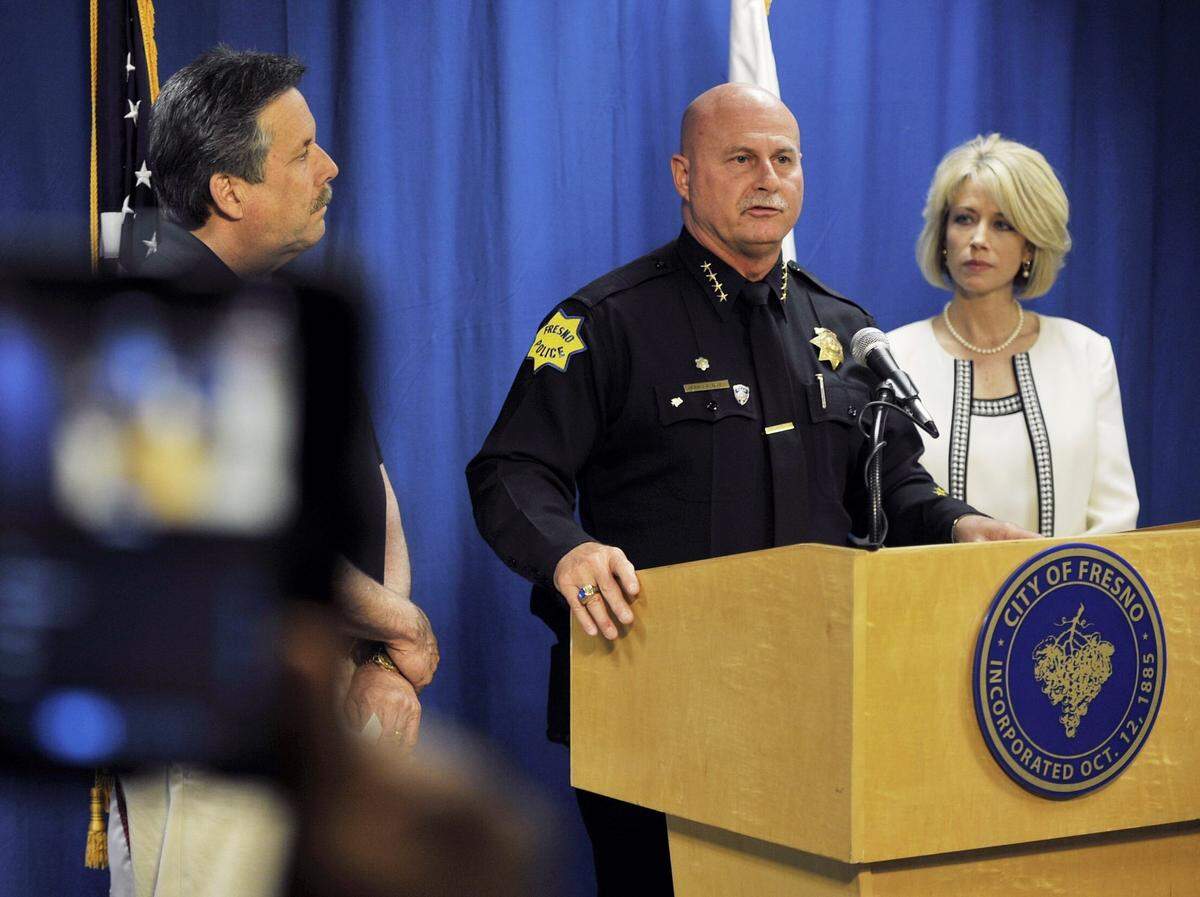
Lawsuits
A few years before Foster’s stunning arrest in 2015, Dyer faced another controversy involving two deputy chiefs. In 2011, Deputy Chiefs Robert Nevarez and Sharon Shaffer sued Dyer, alleging he created a hostile work environment by making demeaning remarks about blacks, Asians and women.
By the next year, the city settled the lawsuit with Nevarez and Shaffer before it went to trial. Shaffer retired a few years later, and Nevarez eventually moved on to become Delano’s police chief. The Bee made multiple attempts to contact each of them for comment for this story, but they did not respond.
Dyer said he thinks the lawsuit resulted from a breakdown in communication and could have been avoided before attorneys got involved.
Nevarez and Shaffer weren’t the first or the last to sue Dyer or the Fresno Police Department.
Dyer himself faced multiple lawsuits and formal complaints claiming discrimination, retaliation or favoritism.
In 2010, the EEOC recommended Dyer and his top staff take sensitivity training after former police Capt. Al Maroney filed a complaint alleging Dyer discriminated against him. During that incident, a black and white photo from the 1980s of Dyer holding a noose surfaced. Fresno’s city attorney at that time explained the noose in the photo “wasn’t a racial reference” but was taken when Dyer was a sergeant in the Internal Affairs unit and had a reputation for having “strong disciplinary recommendations.”
Maroney sued the city for discrimination in 2013, but the case was dismissed.
Dyer successfully defeated similar discrimination lawsuits filed by black officers, including from retired Sgt. James Lewis, officers Ron Manning and former police cadet Jonathan Pierro.
The department has faced other legal battles and allegations of violating rights, wrongful death and withholding public information.
The American Civil Liberties Union has taken Fresno Police Department to task a number of times, for instance. The ACLU, with others, filed a class-action suit against the police department and city on behalf of Fresno’s homeless, alleging the city illegally destroyed personal property in clearing homeless encampments.
The ACLU also has taken the department to court in seeking records.
And the group published a report in 2017 curating department data that showed Fresno police officers fired their guns at black and Latino people most often, and officer-involved shootings often involved cops who fired their weapons before.
Dyer dismissed the report, saying the ACLU has an “anti-police” agenda and is filing reports on Fresno from San Francisco. (The ACLU opened an office in Fresno in 2011.)
In recent years, the department also has faced heightened criticism and legal fights over deadly police shootings and use of force.
Last year, a federal jury awarded $4.75 million to the family of Casimero “Shane” Casillas, who was fatally shot by a Fresno officer in 2015. The city of Fresno settled a lawsuit in 2018 for $2.8 million with the family of Dylan Noble, another man fatally shot by Fresno police.
Mark Scott, who was Fresno’s city manager from about 2010-2013, said when it came to police shootings, the cases underwent intense evaluation. Through his experience working for other California cities, he said the Fresno Police Department did a good job at intervention.
“What people don’t see is that there’s so much effort, day in and day out, trying to keep people from ever getting into those circumstances in the first place – keeping young people out of gangs, getting them jobs or into drug treatment, giving them a purpose in life,” he said. “It’s dealing with the root causes that ultimately lead to these incidents where we end up with a person in jail or dead.
“There’s a whole lot more to looking at those cases than what ends up in lawsuits,” Scott said.
Fighting crime
How do you measure success when fighting crime?
It’s not necessarily about crime rates, Dyer said.
“I measure success by the word progress. And I also measure success by feedback that I received from people in the community. Do they feel safer? Do they feel that we’re making progress? People know that we can’t control every shooting or every violent crime, but what they want to know is that we’re in charge. We’re in control of violence in our community, and that we’re addressing it immediately. And that we’re making progress.”
During Dyer’s 18 years as police chief, violent crime in Fresno remained higher than national and state averages but followed trends of spikes and dips, data show.
Nearly 100 percent of the murder cases the Fresno Police Department submitted to the Fresno County District Attorney’s Office resulted in convictions, a rate both Dyer and District Attorney Lisa Smittcamp said is rare to achieve.
The biggest challenge, and one Dyer said he thinks the department under his leadership managed to overcome, has been gang suppression. Dyer tackled the problem through targeted, rapid responses to crime spikes and long-term suppression.
Over his 18 years as police chief, Dyer kept a careful tally of crime statistics. He held monthly news conferences with local media to discuss crime stats, which he called Crime View.
He established Fresno PD’s privately funded Real Time Crime Center, a network of cameras and sensors throughout the city that field 911 calls and gives officers access to any city camera, including police body and dash cams and traffic cameras. It operates 24/7.
The cases that weigh heavily on Dyer are the cases in which children are hurt – or worse: Janessa Ramirez, the 9-year-old girl killed by a stray bullet in a gang shooting. Andrew Mitchell, who was shot and paralyzed in a gang drive-by shooting when he was 6 years old. “Baby Rashad” Halford Jr., the 20-month-old who died in front of his parents after being shot by a gang member whose target was Baby Rashad’s father.
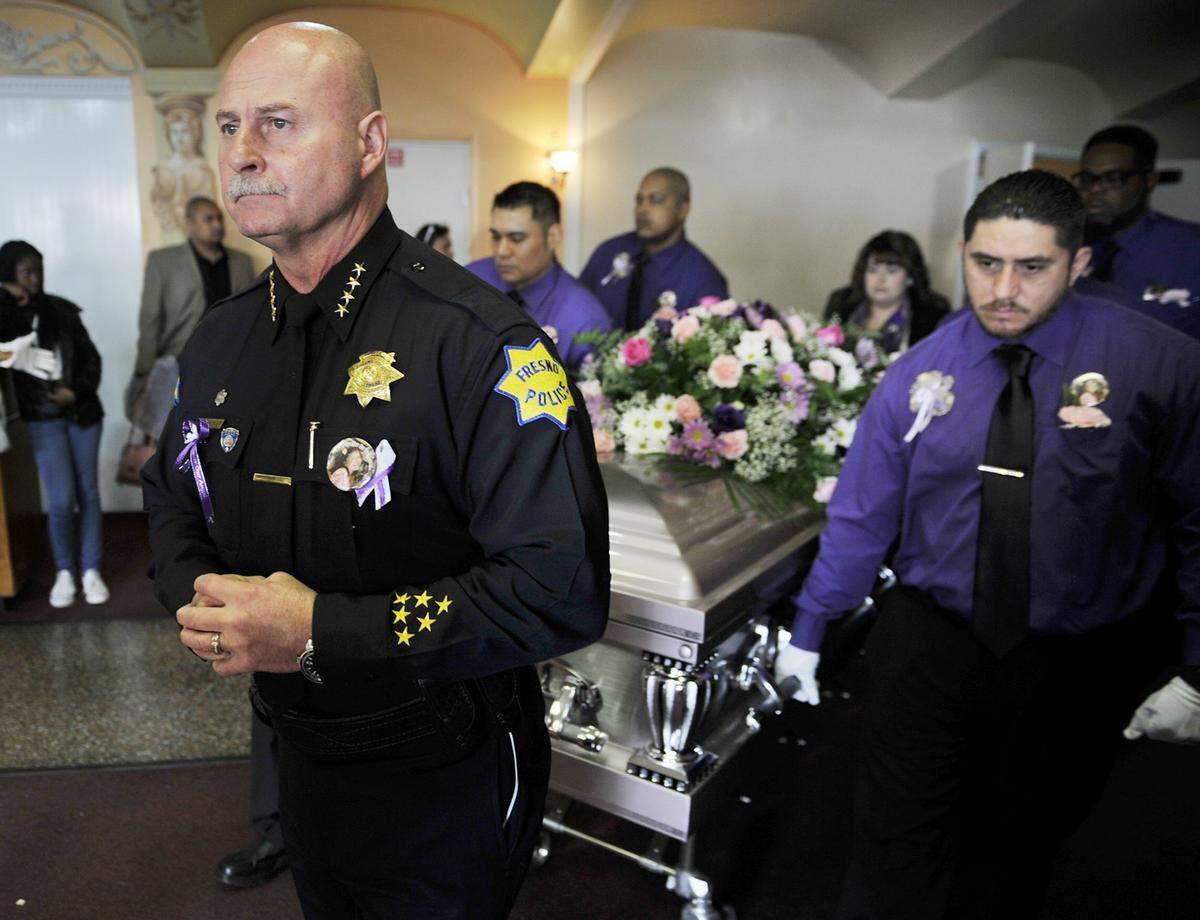
Before his retirement, Dyer pulled out from his top desk drawer a bulletin from Janessa’s funeral. He said it was an honor to close the casket at her funeral.
“I will always remember Janessa lying in that casket,” he said, his voice trembling with emotion.
Personal calling
Dyer has seen up close how a career in law enforcement can destroy one’s health, family and marriage.
“It can destroy your soul if you let it, and I thank God I have a relationship with Christ that really has kept me grounded and has been the glue with my marriage,” he said.
The entire city has seen evidence of that faith in photos and news coverage of Dyer praying with families of victims and attending various religious ceremonies.
His wife, Diane, has been his “rock,” he said.
“It’s no secret that in the early part of my career, I did some things I regret and was unfaithful to her,” he said. “But she forgave me, thank God.”
Dyer could’ve let his long tenure as chief be his crowning achievement. Instead, he chose to run for mayor. He said the decision was a calling from God.
“I love Fresno with all my heart. And I’m doing this for the right reason. I’m not doing it to occupy a seat of authority. I’ve had that for 18 years. … I’m doing this for the right reason because I care about Fresno and I want to make Fresno better.”
BEHIND THE STORY
MOREThe reporter began work in late 2019 on stories profiling leading Fresno mayoral candidates Jerry Dyer and Andrew Janz after they announced their candidacies.
The reporter researched about a dozen stories in The Bee’s archives as background for these stories. A second reporter compiled violent crime data for nearly two decades to create a data visual for one story. Two photographers compiled the videos.
The reporter conducted in-depth, in-person interviews with each candidate.
For Dyer, that interview covered his career as Fresno’s police chief. Dyer was interviewed several times afterward for other stories related to his candidacy. Content from his interview with The Bee’s editorial board also was included in this story.
For Janz, the interview covered his childhood and professional career. Janz did several follow-up interviews over the phone. Content from his interview with The Bee’s editorial board also was included in this story.
Several people either declined to be interviewed or could not be reached for comment. They include: former Fresno City Manager Bruce Rudd; former Fresno Police Deputy Chiefs Roger Enmark, Keith Foster, Sharon Shaffer and Robert Nevarez, who is now the Delano police chief; Fresno County Supervisor Buddy Mendes; Fresno County District Attorney Lisa Smittcamp and Fresno Superior Court Judge Timothy Kams. The Bee also reached out multiple times to the woman, now age 50, believed to be the person with whom Dyer had a relationship when the girl was 16. She declined to speak to a reporter.
This story was originally published February 13, 2020 at 7:42 AM.