
More than schoolwork: Why distance learning is so challenging for Fresno County students
Audrey Pacheco has been joining her fifth-grade class virtually since August. Since then, she said, her wrist has started to hurt.
“Reading and working on the computer is hard sometimes,” the 11-year-old Thomas Elementary student said. “I would rather read in a book than read on the computer. I’m getting a little more used to it.”
Audrey’s mom, Gabriela Pacheco, helps both her elementary school children every day while they are distance learning. She said her daughter has had computer malfunctions that stopped her from turning in her work.
“We’ve stayed up until 1 a.m. doing homework,” she said. “It was so stressful. I want to cry right now.”
The Fresno Bee’s Education Lab interviewed nearly two dozen students, parents, and teachers about their struggles and challenges navigating school during the coronavirus pandemic.
Some students said they’ve been getting better grades since distance learning but technology and broadband issues have interfered with learning for others. During an Ed Lab listening session, Joe Barron, a Fresno Unified high school teacher, said technology issues “occasionally” interfere with learning, especially when older siblings have to leave their virtual classroom to help their younger siblings with technology issues.
Audrey’s cousin, 14-year-old Lizette Pacheco, said adults don’t realize how stressful distance learning can be. In the last few months, she said, she’s taken up knitting as a hobby to destress. She also talks to friends or her mom when she’s feeling overwhelmed.
“We need time to work on our mental health,” the ninth-grader at Duncan Polytechnical High School said. “We’re stuck in the house all the time.”
Tabitha Peters, a 13-year-old seventh-grader at Baird Middle School, said she’s often bored during class and doesn’t feel challenged.
“All my teachers are running through their lessons,” Peters said. “It’s not in-depth. I’m like half asleep in most of my classes. I know teachers are trying their best and can only do so much. We need to go back. I haven’t seen my best friend since March. It’s been awful.”
However, every student and parent said they have been struggling with social, emotional, or mental health.
“They (adults) don’t understand how difficult it actually is,” Peters said. “I have so many assignments and so many classes. I just do schoolwork all the time.”
It’s up to local school districts to make decisions with guidance and approval from health officials on when to reopen for in-person instruction.
Some students in Fresno County have been able to return to in-person part time classes even though the county has been under a lockdown because of surging cases and the lack of ICU beds. Sanger Unified School District and Clovis Unified School District elementary students have returned to part-time in-person classes since last month.
Other students in the county won’t be able to return until positive coronavirus cases start to significantly decline.
Fresno County’s largest school district, The Fresno Unified School District, won’t reopen for in-person classes until the county reaches the orange Tier 3 in the state’s color-coded “Blueprint for a Safer Economy” of coronavirus safety measures and restrictions. The orange tier represents “moderate” risk levels for spreading COVID-19. To get to the orange tier, positive coronavirus cases would need to dip between 1 and 3.9 daily cases per 100,000.
Central Unified schools in Fresno changed plans this week, citing surging coronavirus cases locally. Central’s students won’t return to classrooms until Fresno reaches California’s less-restrictive red tier. School officials on Tuesday acknowledged that could keep students off campuses until at least March or April and possibly longer.
Student learning loss not as bad as feared, but is data reliable?
Since the beginning of the coronavirus pandemic educators and researchers across the country have been projecting how much students will regress in reading, writing, and math. A report that came out recently shows students are behind, but not nearly as much as what was projected.
Compared to the fall of 2019, students in grades 3-8, on average, has similar test score percentiles in reading this year, according to a study done by The Collaborative for Student Growth at NWEA. Researchers examined data from nearly 4.4 million students in grades 3-8.
Percentile scores for math were lower, the research found. Students are, on average, between five to 10 percentile points lower from last fall.
“I feel so behind in my math class I don’t have the same understanding as I would in (in-person) school,” Peters said.
Fresno Unified did an assessment on academic progress in October which showed more students were on grade level this school year compared to last school year. According to i-Ready data collected from the district after the first quarter, 9% more students were on grade level in reading this school year than the previous.
There were 8% more students performing at grade level this school year in math than last year, the data found. Although this school year 23% of students in grades 3-8 have “F’s,” a significant jump from the last school year which was at 12%. Overall, fewer students are receiving “A,” “B,” and “C” grades compared to the previous school year, the data shows.
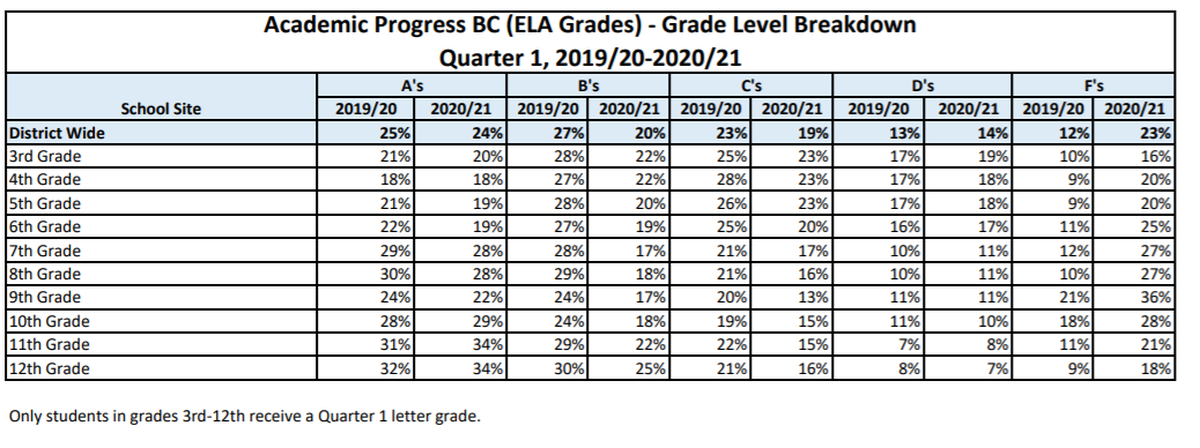
Fresno Unified will have more data analyzed in January after grades are finalized this school year, officials told The Bee.
However, data doesn’t take into account the number of students who haven’t been able to login to their classes.
Students the Ed Lab spoke with said distance learning has made school easier in some ways. Some of Lizette Pacheco’s virtual lessons get recorded, she said, and it makes it easier to do her homework because she can re-watch the class if she doesn’t understand something.
Sally Peters, Tabitha Peters 17-year-old sister, said she’s been getting better grades during distance learning, in part, because the assignments are easier and teachers are more flexible about turning in work.
Dominic Marsella, a sophomore at Edison High School, said distance learning takes a lot of self-motivation because he works independently for the most part.
“I’ve developed strategies to help, like a calendar and to-do lists and things of that nature,” he said. “It’s still challenging overall. It might work for some people but doesn’t necessarily work for everyone.”
Clovis Unified School District students have been struggling academically this year, according to school district officials. In particular, students who are in transition grades, like going from middle to high school, and haven’t had the opportunity to personally connect with their new learning environments.
“As a result, teachers are creating individual intervention plans to engage students struggling to connect with online learning and those who are failing to complete schoolwork,” an emailed statement from Clovis Unified said.
Learning loss is also another reason some parents and students want to return to in-person instruction.
“She has no motivation to participate in school,” Jason Peters said of his daughter, Tabitha. “Not being in-person changes the whole academic perspective. It puts a lot of stress on the family unit.”
Students face mental health challenges due to COVID-19 isolation
Dominic’s mom Janene Lamanuzzi Marsella, who is also a teacher, said some students are really falling behind academically, but are losing so much more.
“When I think about how much we have lost, I think about the safe environment, the classroom we give children and support of social and emotional health that can not be disregarded,” she said. “I can’t reiterate that enough.”
Sally Peters, who is a junior at Bullard High School, said she doesn’t have anything to look forward to and it’s been tough not going back to school. Her sister, Tabitha Peters, said she missed so many sixth-grade field trips last school year and feels like she can never get those experiences back.
Amber Jennings, an adult school teacher at Fresno Unified, said she’s mostly worried about the children who can’t go back to school and don’t have support systems at home. Her two children, who are in the Kingsburg Unified School District, have been going to school in-person part-time and she said she already and noticed the difference in their moods.
“They’re much happier and so excited,” Jennings said. “I just think we don’t’ need isolation we need education. More education as far as how things get spread, you could be just as exposed going to Walmart if you’re not wearing a mask and washing your hands as you could at a school. the school is going to take those precautions.”
The Education Lab is a local journalism initiative that highlights education issues critical to the advancement of the San Joaquin Valley. It is funded by donors. Read more from The Bee’s Education Lab on our website.
This story was originally published December 17, 2020 at 5:00 AM.