Fresno received millions for past planning sins. So, why does it keep repeating them?
Students at Orange Center Elementary School are “strongly discouraged” from walking or biking to school.
The person doing the discouraging? Terry Hirschfield, principal and superintendent of the one-school district located inside the so-called “industrial triangle” between Highways 41 and 99 where Fresno’s southern border blends into Fresno County.
“We don’t have any kids that walk or ride their bikes. It’s just not safe,” Hirschfield said. “They either get bused or their parents drop them off.”
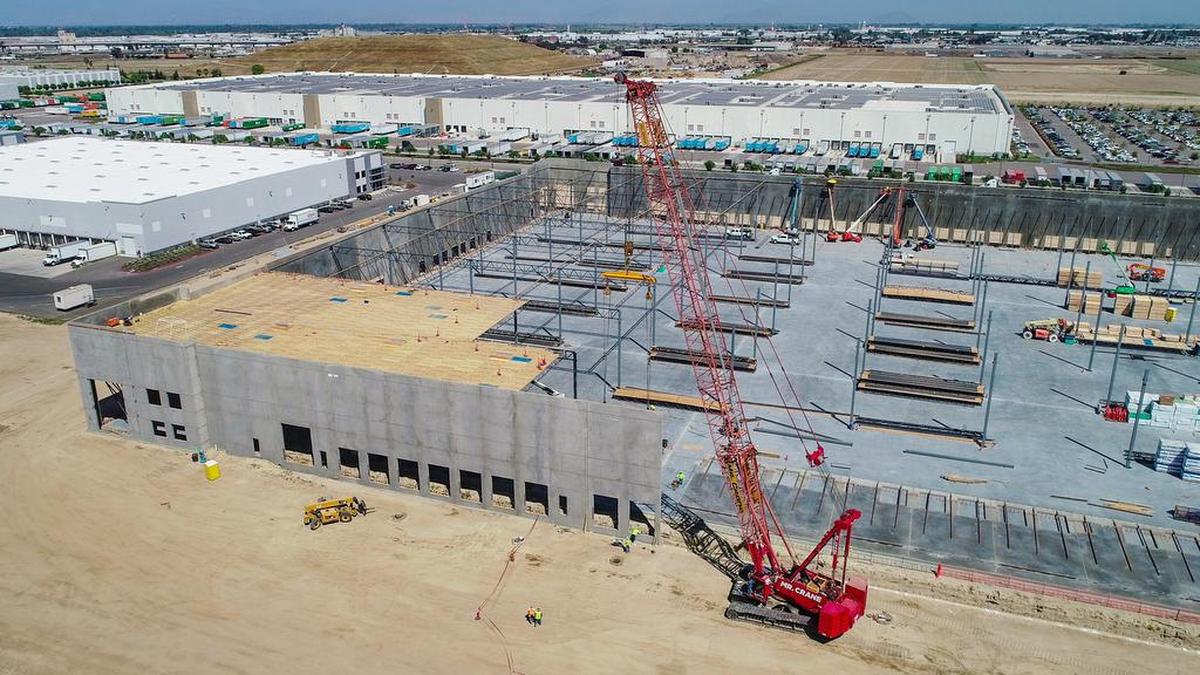
Pay a visit to the Orange Center campus and you’ll immediately see why. While Cherry Avenue itself maintains a rural feel, at least for now, neighboring streets have been transformed into Fresno’s hub for large warehouses and distribution centers with the requisite stream of semi-trucks.
For the school’s 311 students (as well as their families), there is literally no escape from the truck traffic, noise and air pollution. Even when they go out to play at recess. Loading docks belonging to the 38-acre Ulta facility at Central and East avenues sit just beyond the playground and are plainly visible.
Hirschfield became Orange Center’s principal and superintendent in 2016, the year before Fresno city officials made the deal with Ulta and two before it opened. Not once during that time, she says, did anyone from the city meet with her to discuss the impacts or offer any kind of mitigation.
“The city does whatever it wants, and the people out here don’t matter,” Hirschfield said. “They don’t care at all about our quality of life. It’s like we don’t exist.”
Even though Orange Center technically lies within Fresno County — the city limits are a stone’s throw or two away and the school district’s boundaries overlap county and city — city planners still include that segment of Cherry Avenue in the South Central Specific Plan.
On proposed land use maps, Orange Center appears as a blue square in a sea of light purple, indicating parcels zoned for a business park. Meaning if city officials get their way, the school would be surrounded on all sides by industrial warehouses and distribution centers without having to undergo any public process.
A Fresno poverty cycle that pays off
Now’s the time to ask yourself a few questions. Starting with this: Would Fresno planners surround a school on the north side of town with warehouses and distribution centers? Of course not.
So why is it OK in south Fresno? But even larger than that, why do city officials continue playing this paradox? On one hand, they gladly accept millions in state and federal dollars for development sins of the past. On the other, they perpetuate the problems those sins created by making the same types of policy decisions.
Helping continue a poverty cycle of a different sort. One that pays off.
A prime example is the $66.5 million given to Fresno by the Strategic Growth Council through the Transformative Climate Communities initiative. The city received that state aid, which is helping fund 24 projects ranging from the Fresno City College West Campus to community gardens and orchards, because southwest Fresno and Chinatown have some of California’s poorest census tracts combined with its highest pollution levels.
Some might call that cashing in on decades of neglect.
Roughly half of Fresno’s brownfield toxic land sites are located in southwest Fresno, and over the last decade the city has received roughly $2 million in federal grants from the Environmental Protection Agency to address the problem. Has it been? By all indications, no.
And then there’s the Southwest Specific Plan, a planning document hailed as “historic” when it passed in 2017 following a two-year process involving hundreds of community members. The city paid $789,000 in consulting fees, most of which came from Community Development Block Grants awarded by the Department of Housing and Urban Development.
Now, with the ink on the Southwest Specific Plan barely dry, officials want to begin chipping away at core provisions by reversing the elimination of new industrial zoning along 92 acres of Elm Avenue. And they want to do it with nowhere near the same level of public engagement.
It’s the same pattern over and over.
State: rezone “would undermine” air pollution goal
Louise Bedsworth, former executive director of the Strategic Growth Council, the state agency that awarded Fresno the $66.5 million in cap-and-trade funds, took note of that in an April letter she wrote to city planner Rob Holt in opposition to the Elm Avenue rezone.
Bedworth noted that the proposed rezone enables higher polluting industries to remain in areas right next to several TCC-funded bike paths and pedestrian improvements, as well as a planned affordable housing complex serving seniors.
“We believe this action would deter from critical investments made thus far and would undermine the shared goal to reduce air pollution sources in close proximity to one of the most disadvantaged communities in Fresno,” Bedworth wrote.
What did Fresno do with the letter? (The city received a similar missive from the California Air Resources Board.) Probably stuck it in a file, never to be seen again.
I get that many of these development decisions are made with the greater economy in mind. More $15 per hour warehouse jobs are generally a good thing, even though studies show wages have dropped since Amazon and Ulta opened.
But why must the same people, whether they live in southwest Fresno or county residents whose kids attend Orange Center Elementary, get saddled with all the downsides?
Unless, of course, inequitable planning that pays off decades later in the form of state and federal grants has been the plan all along.