Giant sequoias are burning up in Sierra wildfires. Here’s how to save the rest
When I wish to absorb the presence of a giant sequoia, I don’t go to Giant Forest, Grant Grove or any of the heavily visited areas of Sequoia and Kings Canyon National Parks.
The Muir Grove is located just far enough off the Generals Highway to keep the crowds away. In a section of the park that stands directly in the path of the KNP Complex Fire.
Giant sequoias and fire have a complex relationship. The magnificent, captivating trees need low-intensity burns for their cones to pop open and sprouts to release. But the hotter, high-intensity wildfires that have become a California staple every August and September — caused by a myriad of factors, not the least of which is climate change — have caused devastation. Between 10% and 14% of “all large sequoias in the natural sequoia groves of the Sierra Nevada” died in the 2020 Castle Fire alone, according to scientific estimates.
Officials at Sequoia and Kings Canyon have employed prescribed fire, piling forest debris and setting intentional blazes, as a tool to preserve and protect giant sequoia groves since the late 1960s. However, those efforts have focused on Giant Forest and Grant Grove that are both accessible and contain the largest and most historically significant specimens.
Leaving giant sequoias in Muir Grove and others that require a hike and don’t boast the biggest of the big vulnerable to the advancing flames.
In his Thursday update, KNP Complex Fire Operations Chief Jon Wallace indicated air tankers would begin dropping flame retardant and gel into the tree canopies of giant sequoias in Muir Grove (as well as Lost Grove) if weather conditions permit.
“To try to reduce the impacts on giant sequoias when the fire moves into that area, eventually,” Wallace said.
Which doesn’t sound too promising for my favorite sequoia grove.
How effective is prescribed fire in forests that contain giant sequoias? Some of the best evidence can be seen along the North Grove Trail, a 2-mile walk not far from Grant Grove and the mighty General Grant Tree.
On the loop’s eastern side, which had been thinned and treated with fire, only 1% of the giant sequoias perished in the 2015 Rough Fire. On the western side, which was left untreated, 25% died, including a few as wide as compact cars. Those figures are from Nate Stephenson, a U.S. Geological Survey forest ecologist.
“You can look at fire maps and there is a good correlation between areas that have received prescribed fire and where the fire stopped burning,” added Stephenson, co-author of the Castle Fire giant sequoia mortality report. “It’s pretty remarkable.”
Prescribed fire goal in Sequoia & Kings Canyon a fraction of need
This is the point where I’d typically express anger and frustration with park officials and forest managers for neglecting their responsibility. If controlled fire around giant sequoias is the best remedy for the out-of-control kind, why haven’t more areas and acreage been burned?
Christy Brigham, the chief of natural resources and science at Sequoia and Kings Canyon National Parks, is sympathetic to that question.
“I understand people being frustrated and upset that we’re not doing more,” Brigham said. “We’re frustrated and upset right along with them. Once you’ve lost a 2,000-year old tree, it’s basically irreplaceable.”
Sequoia and Kings Canyon’s annual goal, according to Brigham, is to mechanically treat and burn 1,000 acres with prescribed fire, including areas such as Cedar Grove that don’t contain giant sequoias. (A fire atlas published on the park’s website indicates that in some years managers exceed that total and some years fall short.)
How does the 1,000-acre goal compare to the actual need?
“We need to be burning 30,000 (acres),” Brigham said. “That’s 30 times the current level of effort.”
The chasm between what park managers like Brigham are currently doing and what they know in their hearts they should be comes down to more than just funding and manpower. Though she could certainly use more of both.
Park takes rare step of summer burn around Sherman Tree
Prescribed fire on public land is difficult to pull off. In addition to planning and site preparation, there are a series of bureaucratic hoops to jump through. National Environmental Protection Act regulations must be satisfied. So too must the Endangered Species Act (many giant sequoia groves are in Pacific fisher habitat) and National Historic Preservation Act.
Getting from the proposal stage to approved and ready to go takes between two and four years, Brigham said.
Even after all that, prescribed fires can only be set at certain times of the year and when air quality conditions allow. And due to climate change, those windows keep getting narrower.
“In the spring it isn’t wet enough,” Brigham said, “and in the fall half the state is burning.”
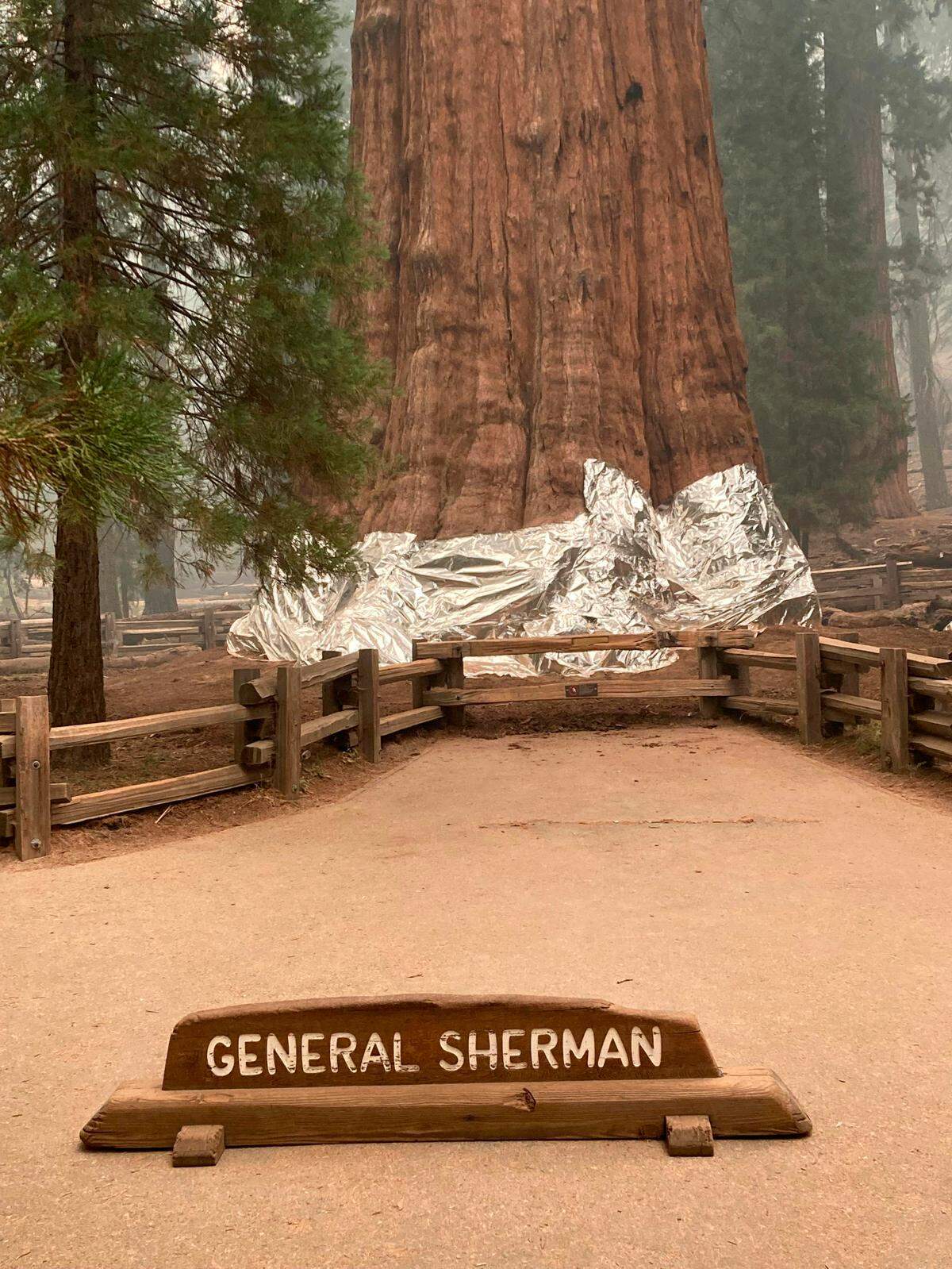
In July 2019, following three or four reschedules, park officials took the unusual step of conducting a 489-acre burn in the Giant Forest near the General Sherman Tree during peak visitor season. Some complained about the smoke, but they also got a first-hand education about fire’s positive impacts.
That inconvenient burn may well be the reason why the world’s largest tree, which scientists believe has withstood more than 100 fires during its 2,200-year lifespan, has remained unscathed by the KNP Complex Fire. At least so far.
Not as fortunate are four smaller, lesser known giant sequoia groves (including Suwanee, Oriole Lake and Atwood) located in areas where the fire has already burned through — as well as those further south being impacted by the Windy Fire in the Giant Sequoia National Monument.
Sierra wildfires are fast, and government moves slow
Following last year’s devastation, Brigham said she and the park’s fuels specialist formulated a new strategic plan detailing how to best protect giant sequoia groves that haven’t seen fire, natural or prescribed, in decades.
The Oriole Lake and Suwanee Groves were both on the high priority list. Too late.
“Government is slow, and wildfire is fast,” Brigham said. “And we need a way to speed up government if we want to protect these trees we love so much.”
The 2020 Castle Fire killed between 7,500 and 10,500 large giant sequoias across Sequoia National Park, Giant Sequoia National Monument, Mountain Home State Forest and private lands. In response, these agencies and other land owners and stewards formed the Giant Sequoia Lands Coalition with the goal of better protecting these heritage trees across jurisdictional boundaries.
What can giant sequoia lovers do? They can start by calling and emailing their elected representatives in Washington, D.C. and demanding our national parks and forests get allocated more resources to deal with this giant problem. We must employ prescribed fire with the same focus and dedication that we fight wildfires.
Meanwhile, send your thoughts and prayers (the sincere kind) to the Muir Grove.