They wanted to turn this Fresno golf course into estates. State said not so fast
For decades, the state of California seemed to pay little attention to public property rights along the San Joaquin River in Fresno.
Which, at least to some extent, helps explain why there’s so little public access.
There’s good news on that front. State officials are no longer ignoring the course of California’s second-longest river through its fifth-largest city — as a local developer planning to turn a former riverside golf course into low-density housing recently found out.
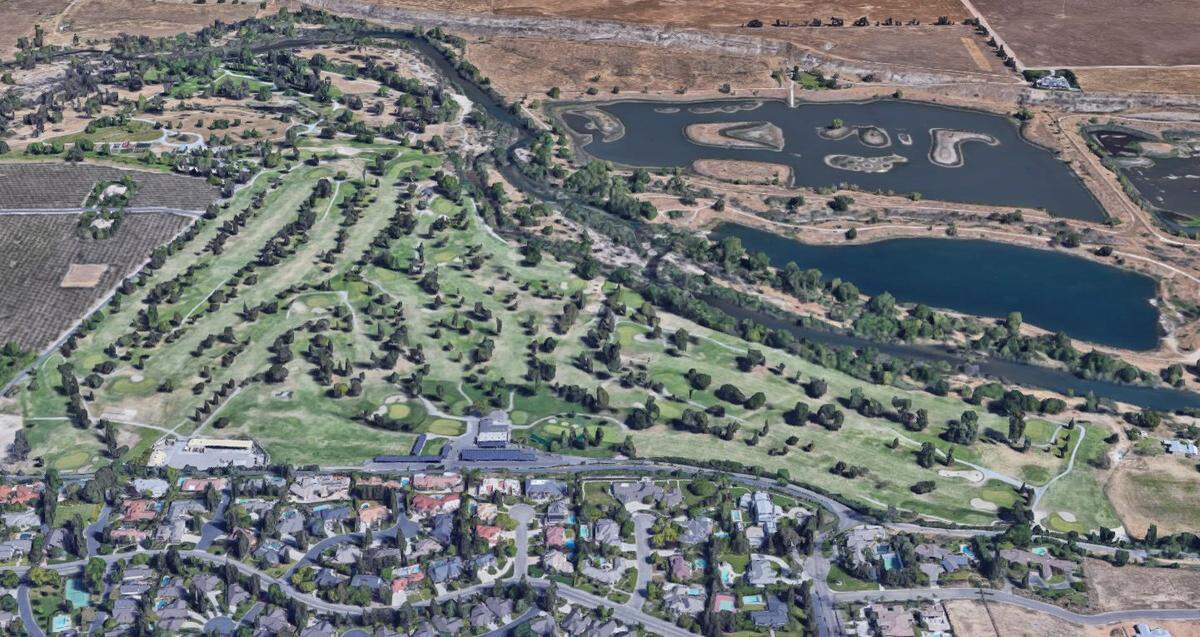
Last May, the Fresno County Department of Public Works and Planning processed a general plan amendment application to rezone the 140.1-acre Fig Garden Golf Club into seven 20-acre home estates. In doing so, it requested comments from various state and local stakeholders.
The one that came back from the State Lands Commission, the state agency with jurisdiction over California’s rivers and other navigable waters, halted the application for at least a year.
How? By pointing out to county bureaucrats (and, in turn, the developer) that the state has jurisdiction over parts of the 140-acre property that lie within the river’s ordinary high-water mark. In addition, any use of that land must be lease authorized and consistent with the Public Trust Doctrine, a legal definition that guarantees the public’s right to utilize California waterways for boating, fishing, swimming and natural habitat protection.
The rezone application submitted to Fresno County made no mention of any state property or public access to the river. As a result, everything is on hold until the developer and State Lands Commission can work out a boundary agreement that assures the public won’t get shut out of its rightful public property.
What does that mean in a practical sense? Any development on the former golf course must include some form of public access to or along the river, which will help fill in a key piece of the San Joaquin River Parkway puzzle.
But more than that, it’s an indication that Sacramento bureaucrats are at long last looking out for our interests.
“Between quite a few state agencies, they’re aware of the San Joaquin River now and the parkway effort,” said John Shelton, executive director of the state agency responsible for assembling the 22-mile river recreation greenbelt between Friant Dam and Highway 99.
“And they will be paying attention to it.”
That’s good to hear. Because if the State Lands Commission gets involved with other boundary disputes along the river, the San Joaquin River Parkway will have an easier path toward completion.
Golf club sells for $4 million
In 2018, Fig Garden Golf Course closed after more than 60 years, citing declining interest in golf as well as tumbling profits. The semi-private course was then sold to Larry Freels, a nut farmer with extensive land holdings in both Fresno and Madera counties.
The purchase price was $4 million, according to local developer and water attorney Ben Ewell. Ewell said he is “overseeing” the project on behalf of Fig Garden Investments LLC, the investment group Freels formed before he died unexpectedly earlier this year.
Fig Garden Investments considered several options for the 140 acres, including planting pistachio trees, a boutique hotel and restaurant and a 50-55 home development before deciding to carve the acreage into seven 20-acre estates, Ewell said.
“The idea is to maintain the open-space look with very few homes,” he added.
Ewell, who developed Brighton Crest and Millerton New Town, said the investment group was unaware of the state’s land jurisdiction when it bought the golf club from David Knott, son of founder Gordon Knott.
Administrative satellite maps of the San Joaquin River, based on California Lands Commission surveys, are published on the California Natural Resources Agency website. Those for the Fig Garden Golf Course show a small sliver within the river’s low water level, which is considered state property.
However, a much larger portion stretching from what used to be the 12th and 16th fairways across the northernmost section of the course is shown to be within the river’s high water level. Land that, again, must adhere to the Public Trust Doctrine.
Future San Joaquin River Parkway
The State Lands Commission (along with its sibling, the California Coastal Commission) has a lengthy history of legal successes in this area. They’ve tangled in court with Silicon Valley billionaire venture capitalists and exclusive Santa Barbara enclaves over public access to beaches and usually come out on top.
Rather than fight, Ewell said Fig Garden Investments will work with the state to find a solution that’s amenable to both parties.
“We’re not going to do anything that’s contrary to what the State Lands Commission wants — even if we wanted to try to make that claim,” Ewell said. “The Knotts paid taxes on that land for 50 years, but that doesn’t make a difference.”
Ewell said he is open to the idea of having a bike path run along or near the edge of the river. Such a path could someday connect by bridge to state-owned Sycamore Island Park on the Madera County side and head downstream toward Scout Island.
Piece by piece. This is how the San Joaquin River Parkway, with the Lewis S. Eaton Trail as its asphalt backbone, slowly comes together.
“I’m a big advocate for the Parkway,” Ewell said. “The (operations and maintenance) side of things is the issue.”
No question about that. But with new funding sources opening up including (potentially) Measure P and the State Lands Commission throwing its weight around on the public’s behalf, there’s reason for optimism.
This story was originally published December 23, 2020 at 5:00 AM.