
The science of catching up: How Fresno schools are helping students make up lost time
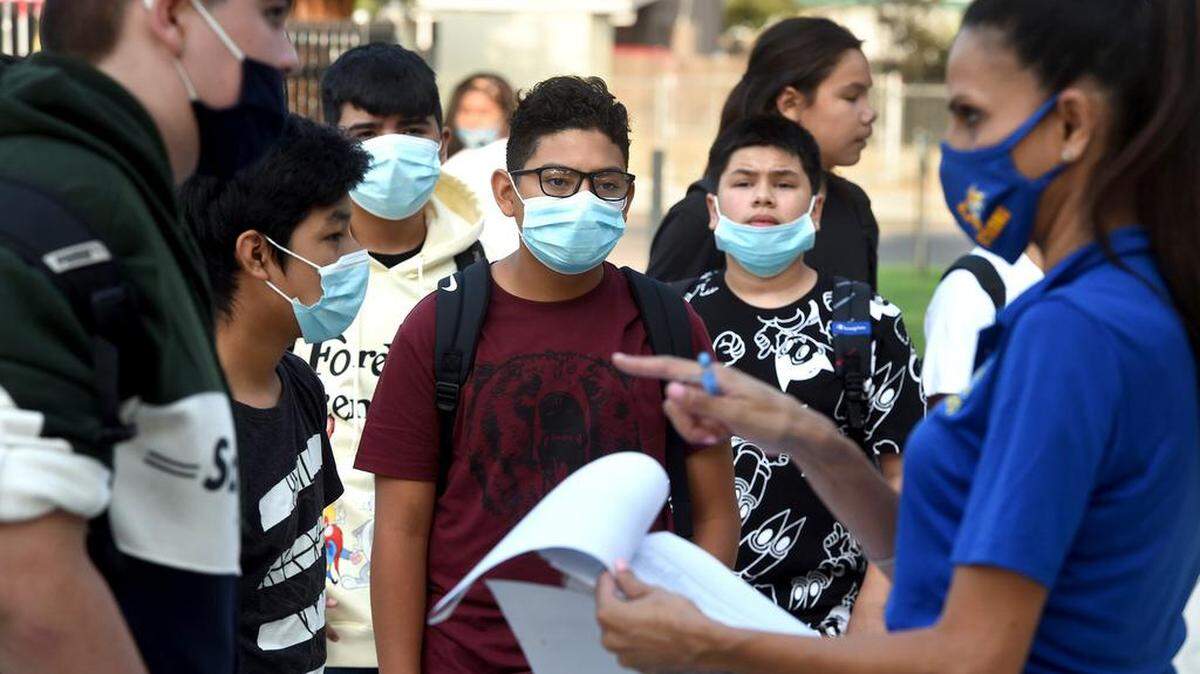
Tens of millions of students — including thousands in Fresno County — may now be months or, in some cases, even a full year behind because they couldn’t attend school in person during the pandemic.
Now, as campuses have reopened to students five days a week, students in the Fresno Unified School District, the third-largest district in California, must try and make up for any learning loss.
Significant setbacks are especially likely for the most vulnerable students — kids with disabilities and those living in poverty, who didn’t have a computer, a reliable internet connection or a workspace to learn at home. Educators will have to do something different for the 2021-22 school year to make up for those losses.
Schools are already spending big chunks of their approximately $190 billion in pandemic relief money on a range of strategies from after-school programs to cutting class size.
Fresno Unified is getting over $700 million in COVID-relief funding, which will be used to help hire support staff and strengthen its afterschool program, among other endeavors.
Fresno Unified Instructional Superintendent Ed Gomes said the district is looking into many ways to help kids with what he calls “unfinished learning.”
But research shows that many of these ideas have had a spotty track record in the past and that schools will have to pay close attention to what’s worked—and what hasn’t—to maximize their odds for success with just about any strategy. There’s no silver bullet. And the pandemic’s fits and starts in instruction are unprecedented in the history of American public education and have affected students unevenly.
From extra class time to social-emotional support, Gomes believes quality time with teachers will best help students assimilate back into the classroom and learn.
No catch-up strategy can possibly benefit all students. But studies do point toward which strategies are most effective, how they can best be implemented—and what approaches might be a waste of time and money. Here’s a rundown of the most relevant research.
TUTORING
Research points to intensive daily tutoring as one of the most effective ways to help academically struggling children catch up. A seminal 2016 study sorted through almost 200 well-designed experiments on improving education, from expanding preschool to reducing class size, and found that frequent one-to-one tutoring was especially effective in increasing learning rates for low-performing students.
Education researchers have a particular kind of tutoring in mind, what they call “high-dosage” tutoring. Studies show it has produced big achievement gains for students when the tutoring occurs every day or almost every day. Less frequent tutoring, by contrast, was not as helpful as many other types of educational interventions. In the research literature, the tutors are specially trained and coached and adhere to a detailed curriculum with clear steps on how to work with one or two students at a time. The best results occur when tutoring takes place at school during the regular day.
“It’s not once-a-week homework help,” said Jonathan Guryan, an economist at Northwestern University who has evaluated school tutoring programs.
A 2020 review of 100 tutoring programs found that intensive tutoring is particularly helpful at improving students’ reading skills during the early elementary years, and most effective in math for slightly older children. One 2021 study found tutoring led to strong math gains for even high school students, enabling those who started two years behind grade level to catch up.
With technological advancements, tutoring now comes in many forms and can be tailored to a child’s needs, Gomes said.
Although he doesn’t believe traditional tutoring is the best tool in the arsenal for unfinished learning, Gomes listed as helpful afterschool tutoring and online tutoring, where a student meets with a person on camera. There are even tutoring services where teachers can monitor a student’s progress.
“Back when I was at school, it was more of, I have a person that sits in a room and when the after school bell rings, my parents have me go sit in that room to learn from a tutor,” he said. “And we have that still, but now I think we’re in the place where we could be a lot more technology-based and provide, I think, even more accurate supports that are adaptive.”
Gomes said the real help would come in the form of face-to-face teaching and class time.
“I don’t think it’s the overall change-maker,” Gomes said about tutoring. “I think good, quality time with their quality teacher has been shown in research that it’s above and beyond the most critical part of how a child learns.”
Not all tutoring has been successful. When the No Child Left Behind law was first passed in 2001, schools got extra money to tutor students who were behind. But there were many reports of tutoring fraud and fiascos. Sometimes tutors weren’t properly trained and there wasn’t a clear curriculum. Often when tutoring was scheduled after school, many students didn’t show up.
In effective math programs tutors don’t simply reteach the previous year’s lessons. Instead, tutors know what is being taught in the students’ regular classes that week and give their students extra practice on those topics or review prerequisite concepts.
To accomplish this, the tutors themselves don’t need to be highly trained educators, but they do need training, coaching and monitoring. The late Robert Slavin, a researcher at Johns Hopkins University, calculated that college-educated teaching assistants produced learning gains that were at least as high as those produced by certified teachers and sometimes larger. Even paid volunteers, such as AmeriCorps members working as tutors, were able to produce strong results, Slavin found.
The question, of course, is whether we can recruit and train enough tutors to meet the need right now. That’s ambitious but at least there’s evidence for this approach.
AFTERSCHOOL
After-school programs might seem like a good idea because they give teachers extra time to cover material that students missed last year. But getting students to attend faithfully is a chronic problem. For students who attend regularly, high quality after-school programs sometimes produce reading or math gains, but many programs operate with poorly trained teachers and lessons that are disconnected from what students are learning in class. When researchers look across studies, they usually don’t see meaningful gains in reading or math achievement.
Summer school programs don’t fare well in evaluations either. Kids don’t want to miss out on outdoor fun with their friends and often don’t show up.
After-school programs appear to be better at improving students’ social wellbeing. A meta-analysis of 68 studies of after-school programs by the Collaborative for Academic, Social and Emotional Learning found that students participating in an after-school program improved their school-day attendance and were less likely to engage in drug use or problem behavior.
A typical after-school program at Fresno Unified will give 30 to 45 minutes of teaching or homework time, according to Gomes, and then follow with extracurricular activities and socializing time.
The district has put almost $7 million into expanding after school programs, ensuring that eventually, any student in transitional kindergarten through sixth grade will be able to stay after school. According to Deputy Superintendent Misty Her, building after school programs will be a phased-in approach. The district has done some hiring over the summer, and they may be able to hire about 88 employees.
Another option is to make after-school hours mandatory by extending the school day for everyone. That has worked well when the extra time is used for tutoring. But research evaluations have also shown longer school days can be an academic bust. Schools don’t always use the extra time effectively with well-designed classes targeted at students’ specific academic gaps. And learning is taxing; students’ brains might need a break after almost seven hours of classes.
Adding to the end of the day is exactly what Fresno Unified is doing. In that half an hour extra of instruction time, teachers will focus on math and literacy, which will eventually add up to days of instruction time, Gomes said.
RETENTION
Repeating a grade, what educators call retention, might make intuitive sense, especially for students who missed most of the past year at school and weren’t able to engage with online instruction. Before the pandemic, research outcomes for retention were generally miserable. Having students do the same thing twice didn’t help. A successful exception was shown in a study of a Florida program in which the most commonly repeated year, third grade, was accompanied by tutoring and extra support. It’s possible that these students would have fared just as well, or better, if they had received tutoring and proceeded to fourth grade. We don’t have a study to test that.
It’s not clear if the retention research is a good guide right now. We don’t really know how students will fare if they repeat a year in-person that they effectively missed because they were learning remotely. However, educators point out that being held back is demoralizing and many students lose their enthusiasm for school. Even if students are told that it’s not their fault that they are repeating, they may be discouraged to see classmates move on while they are being left behind. And a discouraged child isn’t going to be open to learning.
Gomes agreed that retention isn’t the best way to help students. Although it is used in some instances at Fresno Unified, it’s not a widespread measure.
“It’s very traumatic to the students, and the research shows, usually the child that has retained continues a downward spiral until you really pinpoint areas of need and provide that service during the school,” he said.
Fresno County’s largest school districts agreed in the spring they were not considering retention to help with learning loss during the pandemic.
“Research shows that retention is not positively correlated with increasing student achievement,” Clovis Unified School District spokesperson Kelly Avants said. “So we need to take a look at the whole child when making a determination about whether or not retention is appropriate.”
REMEDIAL CLASSES
Historically, remedial classes have been a bust. The argument for them is that teachers can give lower-achieving students the correct level of instruction so that the students aren’t overwhelmed in classes that are too challenging for them. But in practice, students often don’t progress in remedial classes. Instead, they get stuck at the bottom, learning less each year and falling further and further behind the rest of their classmates.
Online credit recovery classes, which allow students to retake classes that they have failed, have been popular with high school administrators in recent years. Studies show that students are more likely to pass a course when they can click their way through it, and such classes are helping more students graduate from high school, but students do not seem to improve their academic skills as much as they would in face-to-face classes.
Remedial courses are typically only used in middle and high schools at Fresno Unified, Gomes said. He described credit recovery courses in high school as remedial but said he didn’t think the district was offering much more than previous years in remedial work.
“You’ve got to be careful saying I’m going to create remedial (courses) when we’re also adding other areas that can actually support students.”
One promising approach is to assign students who are far behind to both a remedial class and a grade-level class simultaneously. This double-dosing strategy has spread rapidly at community colleges but hasn’t been studied as much in elementary, middle or high schools. One evaluation of double-dosing in algebra found that it worked in Chicago high schools but not in middle school math in Miami. Refinement and further study are warranted.
ACCELERATION
Teachers know that students in remedial classes get discouraged and lose their motivation to learn. This year, an anti-remediation sentiment has spread quickly among educators, who’ve adopted a mantra: “Accelerate, don’t remediate.” What they mean by acceleration is fuzzy. Teachers at one elementary school in Washington state described it as promoting kids to grade-level material with extra support, such as a preprinted multiplication table to help them follow along in class, while also asking teachers to somehow find time to do catch-up review when breaking the class into small groups.
Gomes described acceleration as a better way of “looking at how to treat a year of pandemic.”
With technology, students can access resources to learn, then take a post-test that is sent to the teacher, who can then “maneuver the instruction next day,” based on what kids have proven they know or don’t know.
He said instead of giving students a packet of homework to complete, a teacher could assign a quick online assessment to see where students are struggling, then be able to provide feedback.
A charter school network recently described acceleration as interweaving review material with grade-level content. A May 2021 report by a nonprofit online math provider, Zearn, found that students learned more math during the 2020-21 school year when truncated review material was woven into grade-level lessons than when they were retaught many of the previous year’s lessons.
LOOKING AHEAD
Gomes said the outlook for students is not all negative. With the increase in access to technology in the last year, some students are on target. And there has been a huge uptick in teacher training.
“Teachers better understand the use of their old technology, understand how to accelerate students through these learning areas and unfinished learning, and we’re in a different place because of it,” he said.
Still, educators have a lot of work ahead of them.
Students will need to be frequently assessed to figure out their individual gaps. Teachers are going to need a lot more planning time for lesson plans. And schools also need strategies to help students move past the trauma of the past two years, including more counselors, because students cannot learn well when they are coping with Covid-19 deaths in the family and struggling with problems at home.
Social-emotional learning is something Fresno Unified is highly focused on this year, officials said. The first two days of instruction were half days and focused on relationship building and understanding the school structure again. The district has hired an extra 25 full-time employees to help with health, social, emotional, and mental support.
The influx of pandemic money is enticing school systems to spend it on things that they wanted to do long before the pandemic and call it a pandemic response.
If schools embrace the research — adding tutoring for the students who are most behind and testing promising ideas for others — adversity and crisis could lead to lasting, progressive change.
This story about catching up was produced by The Hechinger Report, a nonprofit, independent news organization focused on inequality and innovation in education, with support from the Education Writers Association Reporting Fellowship program. Sign up for the Hechinger newsletter.
This story was originally published August 26, 2021 at 5:00 AM.