‘Time to act.’ What’s rising from the ashes of major giant sequoia wildfires in California
The passing of two winters in one burnt Southern Sierra giant sequoia grove has done little to change that blackened forest.
“I’ve shed my share of tears over this,” Jim Kral said as he walked beneath dead giant sequoias last month at Mountain Home Demonstration State Forest, where he works as the forest’s manager.
Like the ancient forest’s better-known neighbors – national parks, monuments and forests – Mountain Home was hit hard by California’s increasingly destructive wildfires.
“I’ve been managing this piece of ground for almost 14 years now and it’s somewhat akin to losing a child, it really is,” Kral said. “I’ve loved it and nurtured it, the same way we all do with our kids. Then in the course of one hot windy day in September in 2020, everything changed.”
That was the lightning-sparked SQF Complex, a merging of the Castle Fire and smaller Shotgun Fire.
Kral said approximately 1,600 of Mountain Home’s nearly 5,000 acres, about 32%, burned intensely in that blaze, killing most trees – what he calls stand replacing fire.
Of around 5,000 old-growth giant sequoias there, the Cal Fire forester expects a final mortality estimate underway to show the loss of about 4%, a couple hundred of those large trees.
That would be a small fraction of thousands of mature giant sequoias estimated killed by fire in 2020 and 2021 across the Sierra Nevada, including from the KNP Complex and Windy Fire. Scientists think the losses from those years comprised as much as 19% of the world’s population of giant sequoias.
Facing such immense loss, Kral and other land managers are now turning to tree planting projects as one remedy. A planting that began the last week of April is wrapping up Tuesday across more than 500 acres at Mountain Home that added 212,000 conifer seedlings, including more than 29,000 giant sequoias.
The strongest sequoia seedlings could have a chance at living for the next 3,000-plus years and helping propagate an imperiled tree species that only naturally grows in about 75 groves from the Southern Sierra to around Lake Tahoe, along the western slope of the mountain range.
“It’s gonna help stabilize the soil,” Kral said of the plantings, “and if we foresters don’t come in and plant these burn scars early, then literally, we’re going to have to let Mother Nature in succession run its course. ... When you’ve got these landscapes where it’s a mile from the closest seed tree, you could be looking at 1,500 years, 2,000 years, before you have trees.”
Unique Cal Fire grove surrounded by other agencies
The SQF Complex burned vast hillsides of Mountain Home Demonstration State Forest, but much also remains unscathed.
The hidden gem east of Porterville reached via narrow, winding country roads is still closed for the season. Kral plans to open its locked gates to the public on May 20.
“It’s never going to be the forest they grew accustomed to, but it’s still a forest,” Kral said. “Most of what the public sees doesn’t look drastically different.”
Of what’s different, the monarch Bonsai Tree was killed, and there are changes to the Genesis Tree and Hob Goblin.
Mountain Home provides a unique vantage point for looking at the effects of recent wildfires. For one thing, it’s the only giant sequoia grove – and the only forest in the Southern Sierra – managed by Cal Fire, the state agency primarily responsible for fighting fires.
Conservationist John Muir once called giant sequoias in the Mountain Home area “the finest in the Sierra.” The state of California purchased the Mountain Home tract from a logging company in 1946 to help protect more than 5,000 old-growth sequoias there. Logging still continues, but in a different capacity.
Cal Fire, as its steward today, aims to “balance forest growth with harvest” and sustain its population of old-growth sequoias. The agency runs eight other demonstration forests in California, described as living laboratories “for how to care for California’s timberlands for multiple benefits – wood products and timber production, recreation, watershed protection and habitat restoration.”
Mountain Home has welcomed academics researching a variety of topics, things like assisted species migration and laser imaging to create inventories of trees. Many studies were damaged by the Castle Fire, Kral said. Still, some forestry research continues there as Kral’s focus is centered on post-fire recovery.
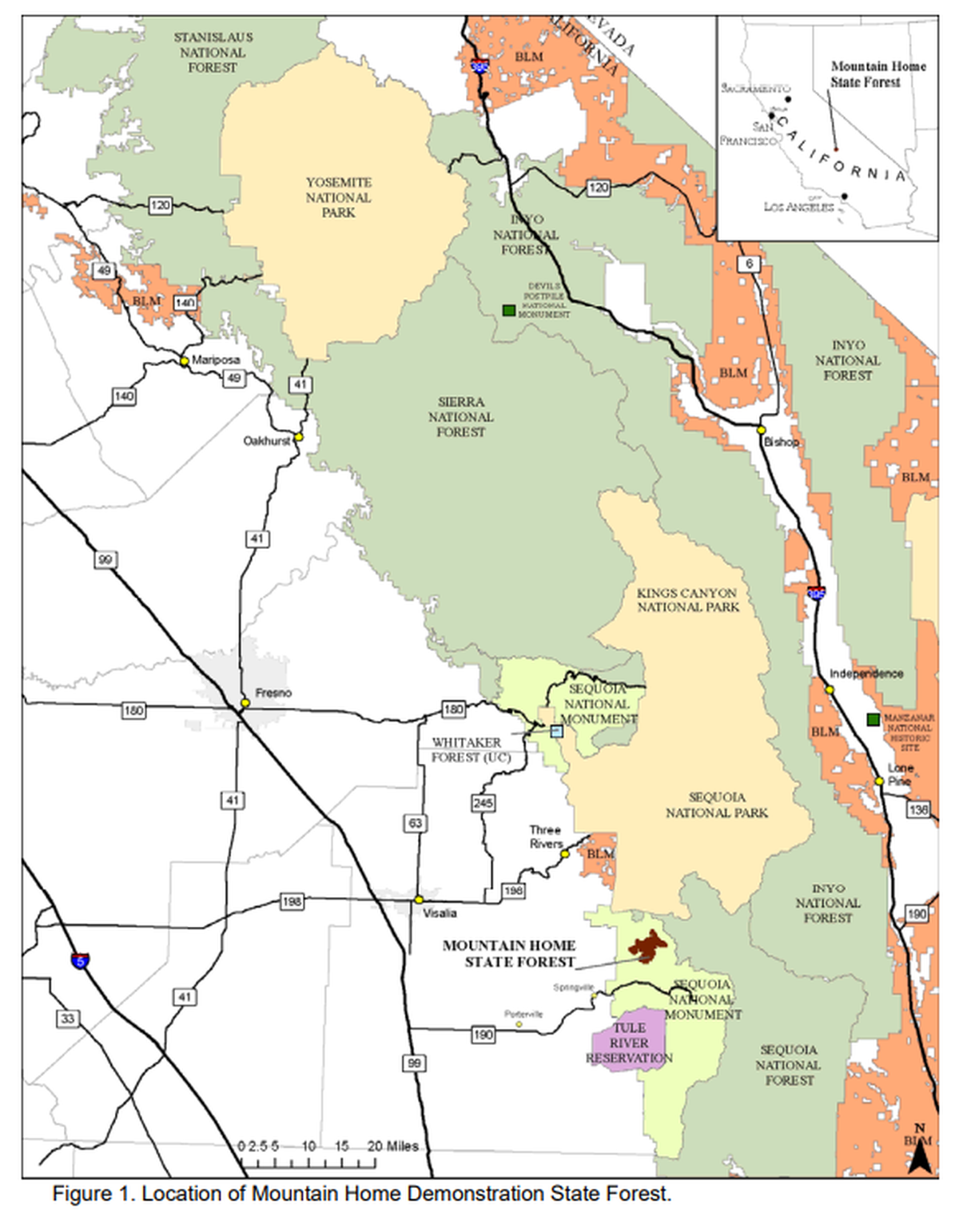
Mountain Home makes up a small piece of a large network of public lands in the Sierra Nevada. It’s mostly surrounded by Giant Sequoia National Monument and the Golden Trout Wilderness, both managed by the U.S. Forest Service. Other nearby forests include Sequoia & Kings Canyon National Parks and the Tule River Reservation. In addition to some private lands, smaller management areas in the neighborhood include Bureau of Land Management lands, 160-acre Red Hill grove and 530-acre Alder Creek grove, both recently purchased by Save the Redwoods League, and 160-acre Balch Park, owned by Tulare County, that sits almost entirely within Mountain Home.
This convergence of federal, state and local interests is becoming a growing partnership in the wake of destructive wildfires.
Sierra tree plantings, high demand for seedlings in burn scars
An array of Sierra stakeholders will be watching Mountain Home’s newly planted sequoias with great interest. The seedlings sent to Mountain Home was the largest single order that California’s Cal Fire nursery has done, 86,400 seedlings. The others came from private Cal Forest Nurseries in Northern California.
Nonprofit American Forests provided much of the funding for the recent planting at Mountain Home.
Kral said the 212,000 conifer seedlings planted are 14% giant sequoia, 64% ponderosa pine, 6% sugar pine, 4% blister rust resistant sugar pine, and 12% Douglas fir.
The seeds used to grow the planted sequoias were collected from Mountain Home in 1994, said Jessica Huang, seed bank manager for the Cal Fire nursery.
The seedlings were kept in a freezer in recent months to mimic typical winter conditions. A traveling planting crew, supervised by South Fork Forest Solutions based out of North Fork, was contracted to do the hard work of planting the seedlings across hundreds of acres at Mountain Home. The planters raced across steep mountainsides, plunking seedlings into holes quickly carved by the metal ends of planting hoes thrust into ash-covered soil, newly dominated by charcoal and resilient swarms of tiny biting insects.
Kral said a previous planting at Mountain Home about a decade ago had a very high survival rate, of those that didn’t burn in the Castle Fire. Kral is planning to plant around 200,000 more seedlings at Mountain Home next year.
Cal Fire managers at the Lewis A. Moran Reforestation Center in Davis said they don’t have much information about how well planted seedlings do in the wild.
“Our program needs that data. We want to be able to feed back into that model, whether or not those projections were accurate, and the only way that’s going to happen is by testing out those trials in the field,” said Jimi Scheid, program manager of Cal Fire’s reforestation services.
Cal Fire is seeking more funding to increase staffing for that and other work. The center in Davis has half a dozen staff members between its nursery and seed bank.
Since the closed Cal Fire nursery reopened in 2017, the demand for seedlings across California has outweighed what the nursery has been able to grow, said Kuldeep Singh, its horticulturist and nursery manager. Unlike a few other large nurseries in the state, one run by the Forest Service and a couple others by commercial logging companies, Singh said the Davis nursery primarily serves individuals.
It prioritizes seedling requests for post-fire recovery in burn scars and currently grows about 200,000 seedlings a year. Cal Fire shipped about half of its seedlings this growing season to locations across the Southern Sierra’s western side, between the San Joaquin and Tule rivers. The seedlings were a mix of giant sequoia and ponderosa, Jeffrey and sugar pines.
Behind Mountain Home, the nursery’s next-largest delivery in the Southern Sierra this year was nearly 8,900 seedlings to Kirby Molen, who works as a forester with Sierra Forest Products in Terra Bella, the only major sawmill still operating in the region. Molen said the seedlings he received were for a private landowner in eastern Fresno County who had their land destroyed by the Creek Fire. He said 54,000 seedlings in all from various nurseries have been planted there over the last two years.
“The seedlings from the Cal Fire nursery are excellent,” Molen said. “The trees we are planting now won’t be harvested for 40-plus years but they are going to spend those 40-plus years scrubbing greenhouse gases and sequestering carbon from the air.”
At least another 2,100 seedlings delivered to two other individuals this year were marked for Creek Fire recovery by Cal Fire.
Further south, in more giant sequoia territory, several other groups have done tree plantings or are planning some.
On the weekend of April 30-May 1, with support and seedlings from Cal Fire and the Forest Service, 150 volunteers with Rotary District 5230 and the Fire Complex community replanting project put another 6,000 seedlings in the ground – including giant sequoias – in the communities of Sequoia Crest, Alpine Village, Cedar Slope and adjacent Forest Service lands.
Two of its organizers, Bob Yeager and Uta Kögelsberger of the Fire Complex project, lost their Sequoia Crest home of 23 years in the SQF Complex. They also led a smaller planting of 150 young giant sequoias there last year. Kögelsberger initiated the plantings in her work as a Newcastle University professor.
Gretchen Fitzgerald, an ecosystem staff officer with Sequoia National Forest, called the plantings a great success. She said there will be another opportunity for volunteer plantings next year. The Forest Service is planning to plant seedlings across about 1,000 acres next spring – 700 acres in the Castle Fire burn scar, and 350 acres in the Windy Fire burn scar, Fitzgerald said.
At the nearby Alder Creek grove, Save the Redwoods League wants to plant 53,000 seedlings – 30,000 of them giant sequoias – across 275 acres next March. Fifty giant sequoia seedlings were planted there last year.
The Tule River Tribe planted about 200,000 seedlings over the past four years, since the arson-caused Pier Fire of 2017, said Charles Lwenya, the tribe’s director of natural resources. About 32,000 were planted this year, between January and February. In the tribe’s annual plantings, between 300 and 1,000 of the conifers are giant sequoias, Lwenya said.
About 50%-60% of the planted seedlings on the reservation survive on average, but last year the success rate dropped to about 30%-40% survival, due to the worsening drought, Lwenya said. He expects a similar number from this year’s planting.
In Sequoia & Kings Canyon National Parks, there’s a proposal to potentially plant 12,000 sequoia seedlings in Board Camp Grove this fall, which has faced some opposition.
Christy Brigham, the parks’ chief of resources management and science, said staff is in the “consideration, planning, and compliance phase” following the public comment period recently closing.
Natural regeneration and concerns about planting trees
Some of the concerns about plantings is that it can harm natural regeneration, and claims that planted seedlings don’t survive nearly as well as their tougher counterparts that rise from the ash on their own.
Abundant natural giant sequoia regeneration in a large, severe burn scar within Nelder Grove, charred in the 2017 Railroad Fire, is one success story for nature’s ability to heal itself, although there are worries the vulnerable young trees could perish in a future fire.
Some fire is known to be beneficial for giant sequoias. The huge trees can survive even after fire kills 90% to 95% of their foliage, and flames are needed to open sequoia cones to disperse the seeds within – thin flecks that resemble oats.
Research has shown sequoias can experience significant reproduction after moderate and high-intensity fire, but in the past, this was predominantly seen in small canopy gaps. An overall low-intensity fire, that could have some pockets of hotter flames, is what’s generally viewed as most beneficial for giant sequoias.
Plentiful sequoia regeneration in large, severe burn scars is a new phenomenon as those scars are becoming a concerning new normal for California. It’s unclear what percentage of large, severe fires have experienced bountiful sequoia regeneration.
“This is another emerging phenomenon and one that we do not understand well,” Brigham said about that during a news conference last year. “There are definitely high-severity areas in those previous fires – Rough, Pier, Railroad – that have come back quite well, where the canopy trees were damaged or killed, and there was seed left on the ground and the seed survived, and you get beautiful, dense thickets. Now, they’re not monarchs, and they won’t be for quite some time, but they are sequoia trees, and they are lovely to see.”
Kral hoped Mountain Home would have a similar success story this spring. He said there were tons of sequoia seeds across the forest after the Castle Fire. He suspects many were eaten by animals and the rest weren’t able to germinate due to drought conditions.
Ecologist Chad Hanson, co-founder and director of the John Muir Project, said the disruption post-fire logging and brush removal caused at Mountain Home could have prevented some from taking hold.
At Nelder Grove, thousands of young sequoias are growing within thickets of ceanothus bushes that aren’t hindering growth, but rather providing some protection, Hanson said.
In a number of other groves, brush has been cleared with the thought that shrubs will compete with tree seedlings rather than help them.
More time also needs to pass to reap the full benefits of natural regeneration, Hanson said. Sequoias can continue to sprout on their own each spring for many years after a fire.
“In many cases, you don’t see much at all in the first year post-fire,” Hanson said. “At some places, you don’t see much at all for three years post-fire and then see tons at year four post-fire. I saw that in the Rim Fire, for example.”
Kral said the natural regeneration he’s seen at Mountain Home is in areas where it isn’t needed – beneath mature living monarchs, where fire burned at low or moderate intensity.
Brigham said she also hasn’t seen much natural sequoia regeneration at Sequoia & Kings Canyon National Parks after the recent fires. She said field surveys are underway to update initial 2020 and 2021 sequoia mortality estimates. New data analysis isn’t expected until next year.
Another concern with plantings: The introduction of non-native species.
Kral said the 25,440 Douglas fir seedlings planted at Mountain Home this spring are not native to that grove.
“The method to my madness to the Doug fir is that it tolerates shade similar to sugar pine,” Kral said, “and this part of California has been hard hit by white pine blister rust and the (bark) beetle, too. All the five needle pines are affected by the white pine blister rust.”
Hanson thinks that was a bad idea.
“People shouldn’t be planting trees at all after fires, especially this soon after fires, because we know that most of the regeneration comes in a few years later, but they certainly should not be planting non-native species. That’s a terrible idea, a terrible precedent,” Hanson said, adding that most planted seedlings also die. “It’s a matter of ecological integrity, maintaining the native species in a given area, and not, basically, countermanding millions of years of evolution by putting something there that actually didn’t evolve there.”
Forest management views in the era of mega fires
Facing an evolving duel of forest and wildfire science, for Kral what it comes down to is “doing something.”
Looking at dead giant sequoias at Mountain Home, he said, “If this doesn’t draw attention to some of the crises that we face with the management of our public lands, I don’t know what it’s going to take,” adding that now is the “time to act.”
All the work he’d like to do at Mountain Home can be tough to complete with his peak staffing of around a handful of people, “if I’m lucky.”
“When we started taking a more hands-off approach on a lot of our public land, we all predicted this was going to happen,” Kral said, referring to recent destructive fires. “We were hoping we were going to be wrong, but it’s all coming to fruition now.”
The wildfires also followed decades of human interventions – aggressive commercial logging, near-constant wildfire suppression, and human-driven climate change.
There’s a growing hope land managers will be able to strike the right balance to create healthier and safer forests with a new influx of state, federal and private dollars for forest management, including for lighting low-intensity fires to clear forest floors.
More funding could be coming soon. Several members of Congress toured Sequoia National Forest on May 5. Representatives from the central San Joaquin Valley included House Minority Leader Kevin McCarthy, Rep. Jim Costa, and Rep. David Valadao.
Kral points to sections of Mountain Home that were treated before the Castle Fire – by thinning, logging and prescribed fire – as an example of what worked and saved countless other giant sequoias from fatally torching.
One such fire break that Kral showed The Bee on April 26 was at the top of a ridge. Fire raced up the mountain below it, severely burning the forest in its path before largely stopping at an area previously treated at the top. Flames were racing through the crowns of trees up the canyon and then dropped to the ground, morphing into smaller spot fires. Kral acknowledged that topography likely played a role – fires tend to burn more quickly uphill – but he feels confident that forest management on the ridge ultimately kept flames from progressing further.
On the other side of the argument is a feeling that land managers cherry pick some treated locations as success stories while ignoring research showing some of the most destructive wildfires have been in areas that were previously logged.
Logging is a preferred forest management practice for Kral. He said he would have done more post-fire logging at Mountain Home if the Terra Bella sawmill had more capacity.
“I think it’s the first treatment that makes the most amount of sense,” Kral said. “You got to start somewhere and you may as well try to generate some revenue in the process, so not everything’s coming out of pocket.”
The Terra Bella sawmill usually gets about 5%-10% of its logs from Mountain Home. That increased to about 17% last year of 6,000 log truck loads (about 35 million board feet of wood) typically taken by the sawmill each year from forests across the region, said Darren Mahr, timber manager of Sierra Forest Products and chair of the Southern San Joaquin chapter of the Society of American Foresters.
It’s a small percentage compared to the past. Dozens of California sawmills closed in recent history following more environmental protections. Mahr is a proponent of sustainable logging to help prevent destructive wildfires.
“Do we sit outside of nature, and nature takes care of itself, or are we actually in the circle, where we’re part of it?” Mahr said. “I think we’re part of it. And so we’re taking care of it, like someone tends a garden.”
Those working in the Sierra talk about wanting to do something good for future generations.
Mahr called Mountain Home a treasure, adding, “You’ve got to be very thoughtful about what you do here.”
This story was originally published May 9, 2022 at 5:00 AM.