Old Fresno County sawmill making a comeback due to Creek Fire, but challenges abound
Sawmill equipment strewn across acres of an eastern Fresno County property is “well worn” and “discombobulated,” Kirk Ringgold says on a recent spring day, but the scarred and rusted machinery has “good steel bones.”
He’s hitched his livelihood to this steel that’s sitting in a kind of boneyard: The site of the Auberry sawmill that closed in 1994. Ringgold wants to bring it back to life.
He started buying surplus sawmill equipment this year with that goal in mind. The pieces are comparable in age to what might still be sitting at the site today if equipment there wasn’t scrapped when the mill closed 27 years ago.
Ringgold bought the property 13 years later with the thought of someday converting it into a mini storage facility. The 2020 Creek Fire changed that plan.
He sees thousands of charred trees above his Auberry home that need to be logged after the single-largest wildfire in California’s history burned through nearly 380,000 acres of Sierra National Forest and destroyed hundreds of mountain homes, including one belonging to his wife’s uncle.
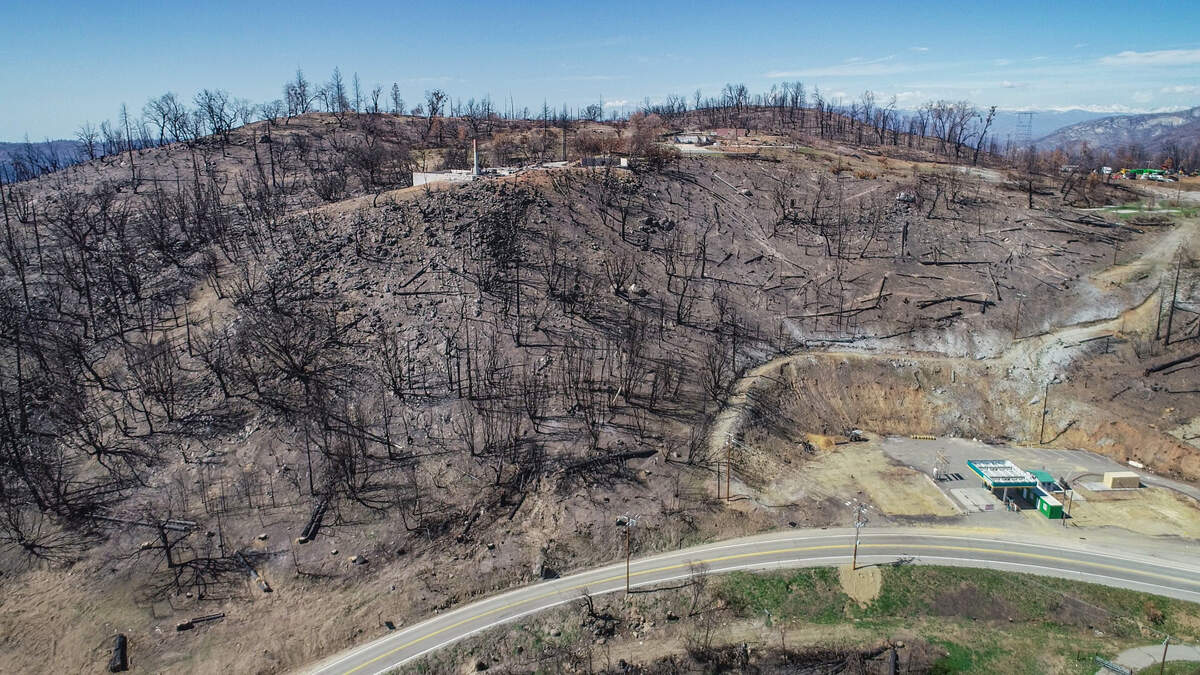
People in his small town started talking more about the old days when Auberry was a sawmill town, and forest management meant logging. One narrative dominated a lot of conversations: If there were fewer trees in the Sierra Nevada, then recent wildfires wouldn’t be so historically large, severe and destructive.
People in the town started looking at the shuttered sawmill and Ringgold for answers. So Ringgold, at age 63, started thinking about trying his hand at a new career – sawmill owner. He decided there was an opportunity to do something good and hopefully make a profit.
“Someone needed to do it,” Ringgold said of working to reopen the mill, “and I was in the wrong place in the wrong time.”
The soon-to-be retired plumber at Fresno Unified School District is now using his remaining vacation time to put everything he’s got into reviving the mill. He figures he’s got about two years to “make hay while the sun is shining” – that is, log and mill thousands of burned trees in Sierra National Forest before dead wood starts to rot.
It’s one of the most ambitious and challenging projects in decades in California’s logging industry. The newcomer is relying on his welding skills and the knowledge of some older veteran loggers to help him make it possible.
“I’m just overwhelmed right now,” Ringgold said. “It’s like being dropped off in the Pacific Ocean, learning to swim, and now you have to go somewhere.”
What he’s been able to learn in a short period of time was enough to earn him a recent boost from the federal government. The U.S. Forest Service announced this month that Ringgold received a $250,000 grant. The grant notes the money will go to train employees and complete installation and commissioning of a “small industrial sawmill” in Auberry.
It comes at a precarious time for Ringgold, who stands to take a hard hit if a new lawsuit against the Forest Service is successful.
Several conservation groups sued the Forest Service and U.S. Fish and Wildlife Service in March, alleging that the Pacific fisher, a tree-dwelling mammal in the weasel family, hasn’t been adequately studied and protected. The Southern Sierra Nevada population of Pacific fisher was listed as a federally endangered species last year, shortly before the Creek Fire ignited and burned more of its dwindling habitat.

A federal judge in Fresno on Tuesday said he would try to issue a decision within a couple weeks about whether to grant a preliminary injunction that could halt dozens of logging projects across Sierra, Sequoia and Stanislaus national forests while the case is being decided.
Ringgold is rushing to get his sawmill open and “strike when it’s hot.” He’s already amassed hundreds of charred logs from the Creek Fire burn scar that are now waiting to be milled.
“It is crazy,” Ringgold said of his new endeavor, “and that’s where I’m at.”
History of sawmills closing in Fresno, Madera, Tulare counties
For many, the fisher lawsuit is reminiscent of a 1991 federal court ruling that temporarily halted logging in millions of acres of spotted owl habitat further north under federal jurisdiction. The owl was considered threatened then, which is less protection than the federally endangered Southern Sierra Nevada population of Pacific fisher now has under the Endangered Species Act.
The following year, in Sierra National Forest, a Forest Service plan was put forward to reduce logging, recounted in a 1992 Fresno Bee story titled “endangered occupation,” referring to the logging industry.
“I’ve got no beef about the owl, but to me it was used as a surrogate to stop management of the forests,” said Kirby Molen, a forester at the Sierra Forest Products sawmill in Terra Bella, “and in 1994 there was three sawmills – big ones – that went out of business.”
Those three were in Auberry, and Madera and North Fork in Madera County. He was a manager at the North Fork mill then.
“February 23, 1994, that was a tough day for me,” Molen said. “When you close down a sawmill, it’s not just steel and whatever. It’s families.”

Not long after, he also had to oversee the demolition of the North Fork and Auberry mills. Molen, who lives in Tollhouse, couldn’t bring himself to go to his office at the Auberry mill for a couple days while a demolition company tore out steel.
The only major sawmills in the region still operating today are over 100 miles away – in Terra Bella south of Porterville, and Sonora in Tuolumne County to the north.
Madera County Supervisor Tom Wheeler, who previously worked as a logger in North Fork, said over 100 sawmills in California shut down because of protections for the spotted owl, and that there’s only around 20 mills still operating in the state today.
Ringgold already has an operational portable saw on his Auberry property that he’s used to mill a small amount of wood. Molen said there’s a handful of operators in the area who use portable saws like it, but Ringgold’s vision is much bigger.
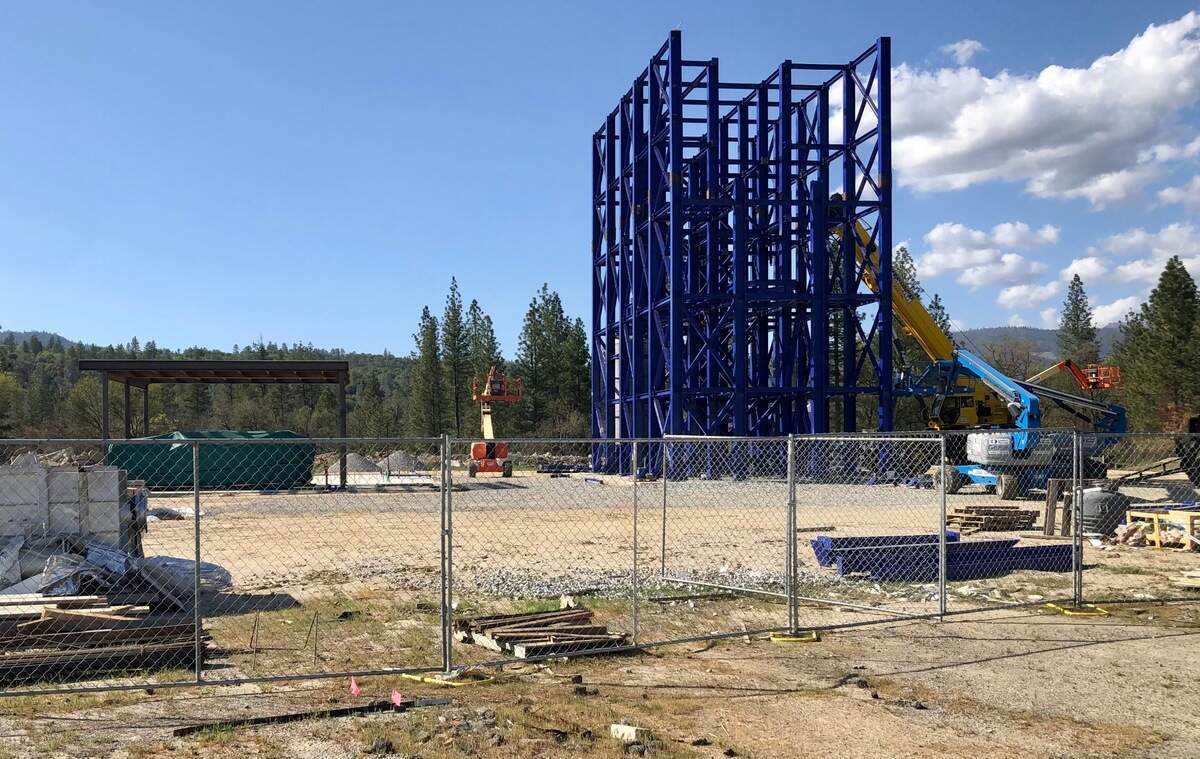
Ringgold is working to set up multiple, more-permanent manufacturing lines. Dozens of large pieces of recently-purchased logging equipment on his property indicate he’s serious about that goal. Many came from a sawmill in Arizona that is upgrading its equipment.
Ringgold’s 70 acres are also uniquely positioned for his endeavor. His Auberry property still retains its old Fresno County zoning for an industrial sawmill.
The Auberry sawmill was built in the 1950s and owned by several different companies over the years. Molen wrote about it and other sawmills in a book published in 2001, “In Search of the Last Sugar Pine,” that recounts sawmill history in the Southern Sierra from the 1930s onward.
Molen said the Auberry mill’s list of owners includes Mathews Lumber Company, Kings River Pine Industries, Sequoia Forest Industries (under two different owners), and Wickes Forest Industries. Its last owner was Sequoia Forest Industries under Ron Yanke, who ran it for around 10 years until 1994. Ringgold bought the property without logging saws in 2007.
Molen said the Auberry mill was among 10 sawmills south of Yosemite National Park in 1975 – the early days of his logging career. Now the Terra Bella mill Molen works at in Tulare County is the only one still standing in that range. The last to close was the Dinuba sawmill in 2000, after nearby Giant Sequoia National Monument was created by President Bill Clinton.
A forest plan revision in the early 2000s shifted the Forest Service’s focus further “from timber industry support to a more holistic ecosystem restoration and maintenance objective.”
Molen said he loves the logging business but probably wouldn’t go into it today. He wishes Ringgold luck.
“Kirk is a hard worker,” Molen said. “I’m not sure there’s too many guys who work as hard as he does.”
New Auberry mill owner working to overcome obstacles
Ringgold isn’t intimidated by the task before him of fitting pieces of equipment together and making the sawmill operational. He’s been doing industrial work since he was 18 years old, what started in Bakersfield oil fields and then the dairy industry. He’s done a lot of welding, fabricating and installing machinery, including over the past 23 years as a plumber for Fresno Unified, one of the largest school districts in California.
He said he’s more worried about the business side of things, and whether he’ll be able to log enough trees in Sierra National Forest to keep his operation profitable.
Ringgold will probably need at least four to five truckloads of logs a day, maybe even 10, to make a good profit, although starting with one or two truckloads a day would still be “fairly significant,” said Walt Schrader, who has worked in the logging and sawmill industry for most of his life. He’s been helping Ringgold buy sawmill equipment and set things up.
Molen said Sierra Forest Products in Terra Bella normally hauls 40 to 50 loads of logs a day out of the Sierra while operating about half of the year. He said that’s usually 3,000 to 4,000 truckloads of logs annually, most of it from Fresno and Madera counties in Sierra National Forest. Molen said those logs range in size from six inches in diameter to four feet across.
Schrader said some of the largest sawmills in the United States go through 200 loads of logs a day.
Ringgold is grateful for the Forest Service grant to help him get started.
“You feel like you’re the lone ranger,” Ringgold said, “and then all of a sudden some guys like the Forest Service come up beside you.”
Ringgold was the only individual named in a list of 44 recipients this year for the Wood Innovations Grants Program, which supports the timber industry, energy production from burning wood, and companies pioneering forest management technologies. Tears filled his eyes while talking about seeing “Kirk M. Ringgold” in the list of corporations, agencies, associations, research centers and universities.
“I think that’s when it really hit me, what I’m trying to do here, was when I got that government money. I’ve been vetted, they think I can do this, somebody has faith in me, and so I’m going forward with it. It’s just overwhelming you know, but I’m going to do it. I mean, I’m going to try.”
Talking about it can be frustrating. He doesn’t want to let anyone down. He just wants to do the work to make it happen. At the same time, he recognizes how sharing his plans can get him more allies. Several groups reached out to him with offers to help after the Forest Service announced he was a grant recipient.
“Talk is nothing, nothing happened here, I talked to you guys,” Ringgold said during an interview for this story. “When it makes a difference is when I get over on that piece of metal and start grinding on it and start putting it together. That’s when it means something.”
He stopped using the already-operational portable sawmill on his property so he could retrofit it with metal siding to keep sawdust from piling up on one side, what he sees as a fire risk. He said too many sawmills have burned down because of “lazy housekeeping” and “I will not have that.”
The portable saw is currently powered by diesel. He plans to power the sawmill mostly hydraulically with electric motors.
He said he needs three-phase power, which generates more electricity than one-phase, to run his equipment at a reasonable cost. He’s planning to submit a proposal to Pacific Gas and Electric Company for three-phase power within the month.
Ringgold heard it can take a year and a half to get power like that in place if approved. He hopes PG&E will make it happen faster. In the meantime, he said he may have to use more costly diesel generators.
There’s an old building on the property that was used as a cogeneration plant that burned wood byproducts to power the mill, but it’s no longer operational and Ringgold said it’s too expensive to run. He’s planning to take a lot of his wood waste to Rio Bravo Fresno, a biomass plant in southeast Fresno.
Ringgold sees his future sawmill as “not too big and not too small.” He hopes to sell milled wood in various markets, ranging from plywood to wood trim and siding on the high end. He’s also getting a pole peeler to make telephone poles.
He said his equipment is adjustable and can process small to large logs. There are hundreds, mostly pine and cedar, stacked on his property awaiting their fate.
Ringgold paid for the sawmill equipment with savings and rent money received from various agencies now using his property as headquarters for Creek Fire cleanup and recovery efforts. He lives at the property in a modest mobile home with his wife. He said if he could do it again, he wouldn’t have bought the property 17 years ago, but we’re “still standing.”
“We’ve had some pretty hard hits on our journey ... My wife is a saint. We lived in a tin garage for a year with no insulation. It was hard, really hard, on us.”
He’s eager to make it up to her. The cost of lumber is high right now, which gives him more optimism for making a good profit.
He also wants to challenge himself with a new adventure. Ringgold said he’s worked “for the man” his whole life and “now it’s the time to spend” to make and run something his way.
Bringing logging jobs back to the Auberry community he loves is a big part of his motivation.
“When I first came up here, it was all associated around this mill. If you didn’t work for the mill, you were associated directly with the mill. ... I’m not saying it’s going to be like that, but I’d like to start somewhere, and I’m going to – I’m going to try. ... I’d like to see that back again.”
Schrader thinks he’s going to do “just fine.”
“He’s got tremendous work ethic and he learns fast,” Schrader said, “and I suspect that if anyone would be successful, it would be him.”
Political support for Sierra Nevada logging
Sierra National Forest Supervisor Dean Gould wrote a recommendation letter that helped Ringgold get his Forest Service grant.
Gould said the sawmill would be a “really good complement to what’s in place” and cut down trucking costs. He said it’s expected to be a “smaller capacity mill, six to eight million board feet a year.”
“That’s a really helpful number for us,” Gould said, “and the fact that it’s so close.”
Gould estimates there’s at least 300 million board feet of dead wood available from the Creek Fire burn scar, but added his agency is still going through processes laid out by the National Environmental Policy Act to determine how much should be logged.
Logging has increased substantially in the forest in recent years to remove trees killed by wildfires, beetle infestations, drought and climate change. Still, a sawmill reopening in Auberry doesn’t mean logging in the area will be going back to the way things were before, Gould added.
“In the case of the Ringgolds, there’s clearly an opportunity for a mill of that size to play a key role to help us restore the forest.”
Gould hopes to have a new forest management plan for Sierra National Forest in place by spring 2022. He said the “objection phase” hasn’t yet started, what begins after a final draft of that plan is released, expected this year.
The Forest Service has also been under pressure to release information about the investigation into the cause of the Creek Fire that ignited nine months ago.
“These investigations can take 10 to 11 months,” Gould said last week. “I know folks are anxious, and no more so than I, but there’s some things that we have control over time-wise and some things we don’t. It’s still very much an active investigation and we’re trying to close it as quickly as we can.”
Fresno County Supervisor Nathan Magsig, whose district includes many communities hardest hit by the Creek Fire, is among those supporting Ringgold in his work to reopen the mill.
“It generated hundreds of jobs and was an economic engine of Prather and Tollhouse, too,” Magsig said of the old Auberry sawmill. “So reviving the timber industry I believe is absolutely necessary to get back to appropriate forest management and forest health.”
Madera County Supervisor Wheeler, whose district includes mountain communities north of Auberry, is another vocal proponent for logging in the region.
“Our forest is the most renewable resource that we have, and now it’s all burning up,” Wheeler said.
Additionally, the cost of building materials for houses has gone up 35% and California needs 3 million more homes, he said.
Wheeler also has been working to bring wood industry jobs back to his communities. He said construction of a biomass plant is underway on the old North Fork sawmill site and could be operational this year. Biomass plants use wood waste products to create electricity.
In the wake of devastating 2020 wildfires, national forests in California are getting more attention now than they have for many years. Forest plans from federal and state officials are full of phrases like forest and vegetation management, thinning, and prescribed burning.
Gov. Gavin Newsom held a news conference last month near Shaver Lake that was hit by the Creek Fire to announce the state will provide half a billion dollars in aid to improve California’s response to wildfires – work that will include making buildings more fire resistant, creating buffer zones, prescribed burning and forest management.
Loggers’ views about the environment
Wheeler said when he worked as a logger in North Fork several decades ago, there was “always more growth than there was cutting” in Sierra National Forest.
He said local sawmills collectively averaged about 100 million board feet a year back then, while the forest grew 160 to 180 million board feet a year.
Wheeler said bark beetle infestations, which contributed to a severe tree mortality event several years ago, are not new to the Sierra. He remembers a similar infestation in 1977, but said loggers quickly identified and logged beetle-infested trees then before they turned brown.
“We beat the bugs then, we whooped them,” he said. “They could not keep producing.”
Of the beetle infestations, Wheeler said, “I think God made it so they can help control the forest when it gets overgrown.” Before loggers, he said Native Americans took care of the forest by cleaning it up and lighting low-intensity fires that helped on that front.
“We never ever had these devastating fires because the forest was being managed,” Wheeler said. “There’s so much fuel out there it’s unbelievable.”
By the 1990s, Sierra National Forest officials were leaning into more “selective harvesting” instead of clear-cutting and reforestation.
Schrader – who Ringgold describes as a logging “guru” helping him – said clear-cutting is bad in environments like California’s Sierra Nevada because trees don’t grow as quickly as in wetter environments further north. Some areas where this has happened are “still a desert” today.
“It’s not to say that logging companies haven’t really screwed up,” Schrader said of the past, “but the Forest Service isn’t doing us any favors, either, and it’s because they just can’t get past the courts,” referring to numerous lawsuits from environmental groups over the years.
The 70-year-old, whose middle name is Forrest, started doing logging work as a boy helping his father, and has been employed in all realms of the industry for around 45 years, including rebuilding sawmill machinery and training employees. He views trees ultimately as a crop, just like wheat or rice.
“I understand why people are emotional about trees. They’re pretty and all that stuff,” Schrader said, “but if you don’t manage them properly, you lose them, and you lose them all, you don’t just lose some of them. It’s kind of a sad commentary that you actually have to harvest trees to save them.”
In addition, he said a good-sized tree can drink 250 gallons of water a day. Researchers found that moisture in the leaves of trees and plants in many places around the state are at the driest levels ever. California is experiencing extreme drought conditions in many areas.
All these factors point people like Ringgold in the direction of wanting to increase logging.
Some retired loggers in their 80s have been wandering onto Ringgold’s property in recent months to reminisce about working at the old Auberry mill. Ringgold said some have tears in their eyes while talking about the old days. They tell him things like they never did clear-cutting.
“You’d think you’re talking to some hardcore environmentalist,” Ringgold said.
It makes sense to him, though. Loggers live in these forests and hunt and fish in them, he said. They don’t want to see them destroyed.
Ringgold loves to recreate in the forest, too, but takes a different view about its creatures than environmentalists.
“Let’s face it, we’re humans. We’re here. This place is for us,” he said. “This place isn’t for that squirrel or that tree. This place is for us” but “let’s manage it, let’s keep it for them and everything like that.”
Ringgold gets excited when he looks out the windows of his house and thinks about how his piles of logs will become an “asset to society.”
There’s still a lot of obstacles ahead, but Ringgold is committed for the long haul.
“I’m going to give it everything I’ve got. And really, I’ve burned the ships in the harbor. I have no backup plan. There’s nothing but straight ahead hard, and that’s all that I have.”
This story was originally published May 23, 2021 at 5:00 AM.