Thousands of giant sequoias ravaged in recent Southern Sierra wildfires, study says
Thousands of large giant sequoias were ravaged by lightning-sparked wildfires this year across the Southern Sierra Nevada, land managers said Friday in announcing the results of a mortality report for the KNP Complex and Windy Fire.
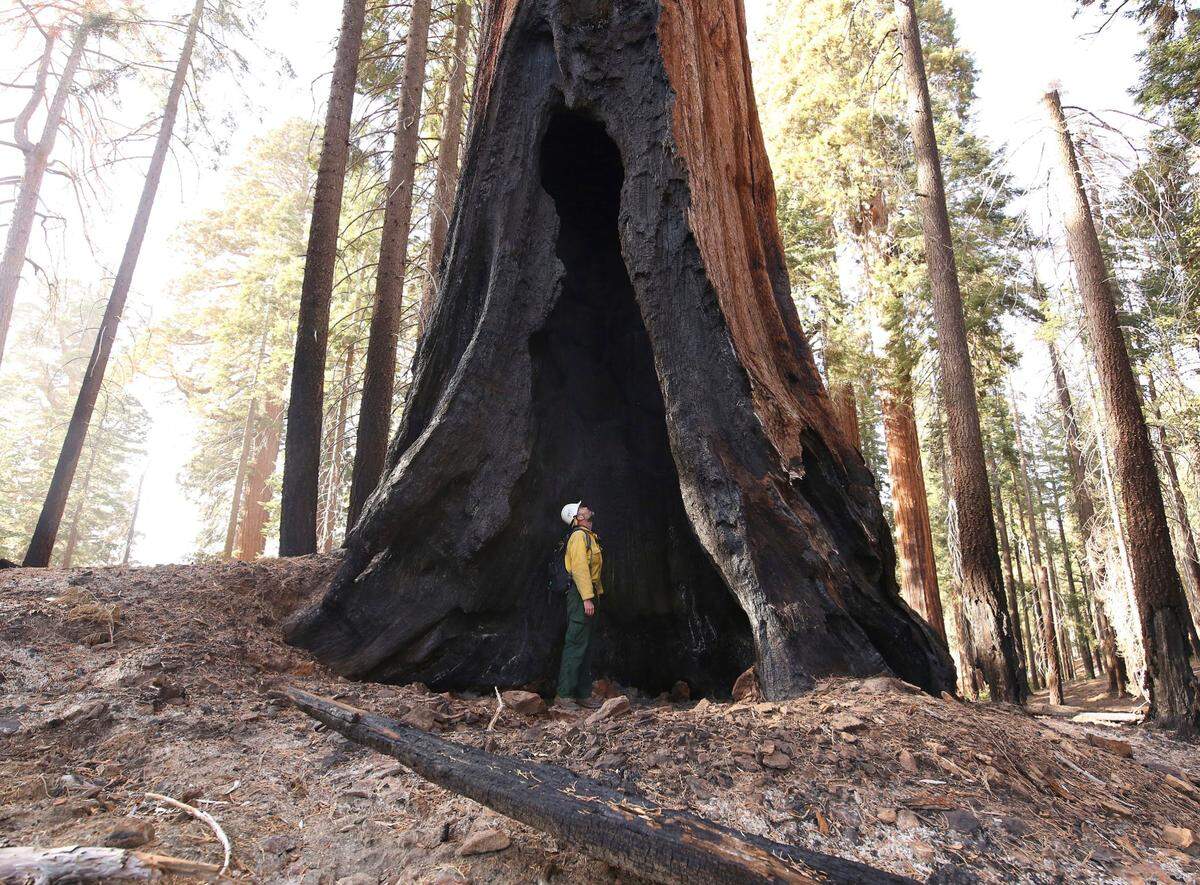
Between 2,261 and 3,637 large giant sequoias, 4 feet or more in diameter, have either been killed or so severely burned by those fires that they are expected to die within the next three to five years, according to estimates released by the Burned Area Emergency Response team that pulled data from agencies including the National Park Service and Nature Conservancy.
Christy Brigham, Sequoia and Kings Canyon National Parks’ chief of resources management and science, started to cry as she shared the numbers during a news conference at Grant Grove in Kings Canyon National Park near Redwood Mountain Grove, one of 27 groves that experienced some fire.
The losses make up approximately 3% to 5% of the world’s population of large giant sequoias. The KNP Complex burned mostly within Sequoia and Kings Canyon National Parks, and the Windy Fire primarily burned in Giant Sequoia National Monument and Sequoia National Forest, which manages the monument.
That’s on top of an earlier estimate that last year’s Castle Fire, which burned in the same region, killed 10% to 14% of the world’s giant sequoias.
Brigham said while the KNP and Windy fire losses aren’t as large, “they are still significant, unsustainable, and outside the range of historic fire effects on large sequoias and are not what we are trying to achieve as we manage these magnificent forests for fire and climate change resilience.”
“Why were these trees killed?” Brigham continued. “A combination of fire exclusion in many areas for over a century, combined with climate-change-driven hotter droughts, have increased fuel loads and changed fire behavior beyond what these incredibly fire-adapted trees can tolerate.”
.JPG "GiantSequoiasKilled (1).JPG")
According to the study, an estimated 1,330 to 2,380 mature giant sequoias died or will die across 16 groves in the KNP Complex. For the Windy Fire, those numbers are 931 and 1,257 giant sequoias across 11 groves.
The fires burned at a range of fire intensities, with a lot of the fire expected to have positive effects for giant sequoias, which need fire to reproduce. The trees can live to be over 3,000 years old, but can grow to maturity much faster, within 150 years. Giant sequoias only live in approximately 70 groves along the western slope of the Sierra Nevada in California.
The KNP Complex and Windy Fire mortality estimates were determined using a combination of satellite imagery that were then cross-referenced with field data sets from three previous fires, Brigham said. Castle Fire preliminary mortality estimates were based largely on satellite images. There is no timeline for the final estimates, which Brigham said will include more field surveys.
Ecologist Chad Hanson, co-founder of the John Muir Project, thinks giant sequoia mortality estimates for fires over the past couple years have been overblown, and even more so for the KNP Complex and Windy Fire, because those numbers also include trees “that are expected to die” – what he sees as meaning they still have some green foliage.
“Sequoias are remarkably resilient to fire ... they can survive even after fire kills 90% to 95% of their foliage,” Nate Stephenson, a forest ecologist and scientist emeritus with the U.S. Geological Survey, said earlier this fall, also noting how new buds can emerge along the trunks of sequoias where fire killed foliage.
What’s next? More prescribed fire could be coming
“The giant sequoia trees have stood for thousands of years,” Sequoia National Forest Supervisor Teresa Benson said, “and they are adapted to withstand frequent and low mixed-severity fires, but nothing compared to the intensity experienced in recent wildfires. Until about five years ago, sequoia mortality from fire and other stresses, such as insect attack, was statistically rare.
“So what is needed to protect giant sequoias? Fuels reduction work. That is one of the primary things that we need to be able to do more of.”
Benson said that includes a variety of practices, including “piling and burning,” prescribed fire, “and in some cases, going in and doing some thinning of the trees that are in the groves that will help those groves withstand the next large fire that comes there.”
Joanna Nelson, director of science and conservation planning for Save the Redwoods League, whose 160-acre property in the Red Hill Grove was hit by the Windy Fire, said “the practice of prescribed burning is unequivocally supported by both current Western science and the traditional, cultural knowledge and science of indigenous peoples.”
The lightning-sparked Windy Fire ignited on the Tule River Reservation, with about 20% of that wildfire burning on the tribe’s lands.
The giant sequoias have been there “for thousands of years, and also our people have been there for thousands of years,” said Loren Mcdarment, cultural specialist for the Chumash Fire Department and a member of the Tule River tribe. “There’s a lot of connection between us and the redwoods and the land that surrounds it.”
Detailed mortality estimates weren’t available for what was lost on the reservation, but a forester for the tribe said it was safe to say more than 20 large sequoias died from fire there.
Gretchen Fitzgerald, an ecosystem staff officer for Sequoia National Forest, said earlier this month that the Forest Service would like to do repeated burning in giant sequoia groves every 10 to 15 years.
Hanson said giant sequoias historically only experienced a good-sized fire, on average, every 30 years, and to burn in a grove too soon means killing seedlings and saplings. He’s not aware of any protocols in place to prevent the killing of sequoia seedlings and saplings during prescribed fire. Hanson said the imperiled species’ greatest threat over the last century has been a lack of lasting reproduction.
Brigham said prescribed fire does kill some young giant sequoias, but that sequoias evolved with frequent fire, and thinning some out allows the remaining ones to grow with less competition, and helps prevent dense fuels and severe fire later on.
Hanson has been studying extraordinary giant sequoia reproduction within a large, high-severity burn scar in Nelder Grove from the 2017 Railroad Fire. He’s using what he’s learning there to advocate for more severe fire for giant sequoia reproduction.
“This is another emerging phenomenon and one that we do not understand well,” Brigham said about sequoia reproduction after high-intensity fire. “There are definitely high-severity areas in those previous fires – Rough, Pier, Railroad – that have come back quite well, where the canopy trees were damaged or killed, and there was seed left on the ground and the seed survived, and you get beautiful, dense thickets. Now, they’re not monarchs, and they won’t be for quite some time, but they are sequoia trees, and they are lovely to see.”
However, Brigham said few sequoia seedlings were seen recently in a 40-acre high-severity burn scar in Board Camp Grove that burned in the Castle Fire. Brigham agreed with Hanson that high-intensity fire can be beneficial for giant sequoia reproduction, but said in the past it has been in small pockets, not large ones, within mixed-intensity fire.
Sequoia and Kings Canyon National Parks reported that 4,610 acres of their 10,000 acres of giant sequoia groves have received one or more prescribed or managed wildfire within the last 20 years, mostly in Giant Forest, home to the General Sherman Tree, the world’s largest, which was not harmed by the KNP Complex. Speakers during Friday’s event also talked about how past forest treatments and firefighting efforts helped save many monarchs.
Brigham said she and others will continue to do what they can to help giant sequoias, acting “in the face of uncertainty to create a future that we’re happy about.”
.JPG "GiantSequoiasKilled (2).JPG")
This story was originally published November 19, 2021 at 12:06 PM.