American Indians calling for Squaw Valley renaming want Fresno County leaders’ interest
There’s deep “intergenerational trauma” associated with the word “squaw” for Native Americans, but local elected officials haven’t shown interest in learning about that, said speakers during a recent meeting about a campaign started last year to rename the town of Squaw Valley in Fresno County.
The organizer of that campaign, Roman Rain Tree, a member of American Indian tribes in the Squaw Valley area, has been unsuccessful in trying to get a renaming proposal on the agenda of a Fresno County Board of Supervisors’ meeting, including after asking supervisors directly during a public comment period this year.
Rain Tree has focused on Supervisor Nathan Magsig, who represents unincorporated Squaw Valley and other rural communities in eastern Fresno County.
“What I kind of expected from Supervisor Magsig,” Rain Tree said, “was something along the lines of you saying, ‘Hey, I don’t promise you that I’m going to support it. I don’t promise you that I’m not going to support it. What I do promise you is that as my constituent, and as your elected official, that I will sit down and listen to you. That I will give you my undivided attention and hear you out.’ But right now, we feel like we’re continuously being ignored, and that’s why we had to take this forum to kind of get our word out.”
That forum, held Wednesday evening, was described as a virtual town hall in a news release by the American Civil Liberties Union of Northern California, which helped promote and organize the event.
Rain Tree said the experience of feeling ignored is how many Native American women have felt for generations when they share their concerns about the word “squaw.” It’s now widely considered a slur. Many who consider it racially derogatory say it has roots in a word that describes an indigenous woman’s genitalia, and is also offensive because it was used in a disparaging way by colonizers.
“Many of the females in our community feel ignored, feel disrespected,” Rain Tree continued, “and it’s kind of the same situation in which the Board of Supervisors has made us feel – just told us to go away, seem to have made up their mind already, and really doesn’t want to say anything.”
Fresno County Supervisor Nathan Magsig responds
Magsig didn’t attend the virtual town hall, but said one of his staff members tuned in. Magsig said he learned of the meeting Wednesday morning when The Bee contacted him for comments about it.
He said he’s since heard from Squaw Valley residents who are upset they also didn’t know about the meeting earlier. Rain Tree said information about the meeting was shared previously, including in local Facebook groups and more broadly by the ACLU.
The ACLU said over 80 people attended. Attendees were able to submit questions and comments in a chat section that were only visible to panelists. Many were read aloud, but Magsig said that’s not the same as having an in-person meeting.
Magsig said when his office first spoke with Rain Tree last year, staffers said the “first step” would be to hold a widely-announced public meeting in Squaw Valley. Magsig doesn’t consider Wednesday’s virtual forum to be the same thing. Rain Tree said that meeting was held via Zoom online because of COVID-19 concerns.
The small unincorporated town of Squaw Valley has an activity center connected to its Bear Mountain Library.
Magsig said his office has been in communication with Rain Tree, but he hasn’t been directly asked to have a meeting with him. Rain Tree said otherwise: “It was my first question in July of 2020 when I began reaching out to his office.”
Magsig said his own research hasn’t led him to believe there’s strong support from within Squaw Valley for a change.
“When it comes to Squaw Valley and its name,” Magsig said, “any change needs to be driven by its residents. ... I’ve found a lot of Native Americans from the local area are divided on this issue.”
Leader of campaign to rename town is member of area tribes
Rain Tree is a lifelong resident of Fresno and member of the Dunlap Band of Mono Indians and Choinumni tribes. He spent summers at his grandparents’ home and tribes’ ancestral homeland in Squaw Valley, where he still has family.
He said he was able to reach out to area tribes because he knows them intimately. His uncle is the chairperson of the Dunlap Band, and his great-aunt is Choinumni’s tribal chairperson, Rain Tree said.
Rain Tree takes offense that his campaign is being painted by Magsig and others as being driven by outsiders.
In describing his connection to the place, Rain Tree fondly recalled stories of growing up there, including picking and eating berries in Squaw Valley, and what his late mother used to tell him as they enjoyed the fruit together: You’re not just of the land, “that land is in you.” It speaks to the epistemology of Native Americans, he said, that “the land we’re born into is the center of our universe.”
He said many local Native Americans have expressed personal support for a change. That includes a couple members of the Dunlap Band’s tribal council, including its vice chairperson. Darlene Franco started the town hall meeting about the renaming campaign with a prayer. She’s the chairperson of the Wukchumni tribe, Rain Tree said.
Tribes closest to Squaw Valley historically include the Choinumni, Wukchumni, Wuksachi, and Dunlap Band of Mono Indians, Rain Tree said. None are federally recognized. Some have had applications pending before the government for decades. That’s made some hesitant to speak on behalf of their tribe as a whole, Rain Tree said, because “lots of the folks are really superstitious about rocking the boat for federal acknowledgment.”
“It causes tunnel vision for some of the leaders,” he added.
Rain Tree said another reason is because some tribes closest to Squaw Valley don’t formally meet as frequently as others in the central San Joaquin Valley.
Working to protect his daughter and other indigenous women
Rain Tree was inspired to start his campaign after Squaw Valley Ski Resort near Lake Tahoe announced last year that it would change its name, followed by its public service district.
Rain Tree said the word “squaw” is very different from the stereotype of the “Indian princess,” often portrayed as a person of “virtue and purity and one of wholeness.”
“Then the antithesis of that: The word squaw is of low self-worth, one of being abused and open to sexual gratification ... and when you start to regard people like that, that’s when the rapes started to happen early on with colonizers,” Rain Tree said. “Now it’s so out of control that one in three indigenous women will experience sexual assault in their lifetime.”
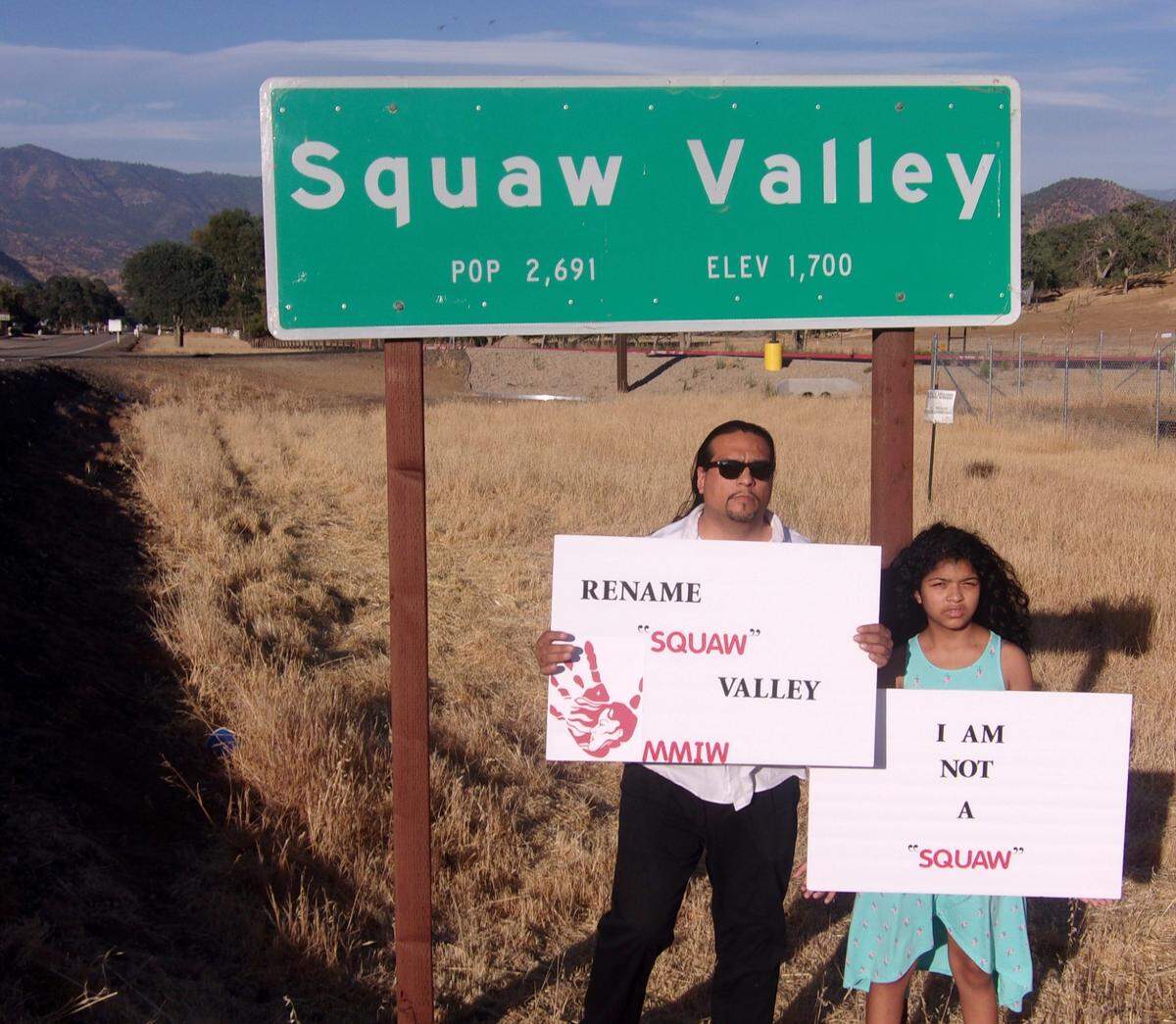
He’s looking at this crisis from the eyes of a father with a 10-year-old daughter. He wants to do everything he can to keep her and other Native American women safe. He sees his campaign as closely connected to the Murdered and Missing Indigenous Women movement, which aims to help Native American women and stop violence against them.
Rain Tree said Magsig not wanting to change the name runs contrary to how he describes himself as a “defender of public safety.” He also criticized Fresno County supervisors for not living up to the board’s official guiding principles, which includes, “Respecting and embracing ethnic and cultural diversity.”
Speakers at the town hall meeting encouraged participants to call and email supervisors with their support for a name change.
Rain Tree made a petition to change the name via change.org that’s received more than 14,200 signatures. He said Magsig has written it off as mostly signatures from out of the area, even though his office advised him to make it when he first inquired about the process needed to be considered for a change.
Rain Tree doesn’t think the issue should be limited to input from Squaw Valley residents, but said he’s been doing local outreach and research, too. He said he’s found that Bear Mountain Valley – similar to the name of Squaw Valley’s post office – has been the most popular alternative name among local residents.
Rain Tree initially proposed the town be renamed Nïm Valley, and then Nuum Valley (a more phonetic spelling of Nïm, which means “the people” in the Mono language) but is open to others.
He conducted an anonymous survey during the town hall, asking for input. The ACLU said over 90% of more than 80 participants who attended the town hall voiced support for renaming the town.
The ACLU followed Rain Tree’s petition by making a petition of its own that’s received more than 4,100 signatures. The organization promoted it in a full-page advertisement in The Bee on June 20 that read: “What if I told you there is one common word people use to demean and objectify Native American women? An entire community is named after this word. That word is squaw. The community is Squaw Valley. The word epitomizes the racism, sexism, and dehumanization Native American women face.”
Leece Lee-Oliver – director of Fresno State’s American Indian Studies program, and assistant professor of American Indian Studies and Women’s, Gender and Sexuality Studies – was among the town hall speakers to talk about that. Other speakers included Morning Star Gali, project director for Restoring Justice for Indigenous Peoples, whose aunt is the Dunlap Band’s vice chairperson; James Martin of Valley Natives for Change, who helped recently lead the call to change Fresno High School’s mascot, what used to be an American Indian warrior caricature; and Malachi Suarez, a fifth-grader leading a campaign to rename Central Unified School District’s Polk Elementary School in Fresno.
Many other place names with “squaw” in them around the country have been changed by the U.S. Board on Geographic Names, which has the authority to rename unincorporated places. Rain Tree is now focused on strengthening an application to submit to that federal board. He expects to send one by the end of the summer.
Rain Tree also plans to raise money with the ACLU to help local merchants change business names with Squaw Valley in them.
“We are there at the library with you, we’re there at the post office, checking our mail, with you,” Rain Tree said. “Getting the gas with you, shopping at the Dollar General with you now. We are members of your community and we’re not trying to impose our will on you. We’re trying to educate you and illuminate the crisis that is going on in our respective community.”