
‘Reverence and dread’: Lessons learned climbing Elephant Walk at Tollhouse Rock | Opinion
I live about ten minutes up the road from Tollhouse Rock, a locally famous hunk of granite in the western Sierra Nevada foothills, in a small mountain town near Shaver Lake. Here, the air smells like pine sap and old campfires, and the trails are more familiar than the roads. Shaver Lake is often referred to as the “backside” of Yosemite — a quieter, less-traveled gateway to granite domes, alpine lakes and classic California climbing.
It’s where the crowds thin, the air sharpens and the stone still holds stories. Tollhouse Rock has long been a staple for central California climbers — a practice ground for footwork, friction and humility.
And slab. Lots of it.
My best friend and climbing partner, Peter, and I had our sights set on Elephant Walk, a classic Tollhouse multi-pitch that winds its way up the sweeping granite apron in a graceful, technical dance of footwork and friction. It’s a rite of passage for local climbers: three pitches of slabby, delicate climbing with the occasional crack, flake and mental crux. The name comes from the giant, weathered streaks on the rock face that resemble the folds of an elephant’s skin, giving the route a sense of quiet grandeur from below.
Elephant Walk is all about subtlety. It demands trust — in your gear, your partner, your feet — and rewards precision over power. A single misstep can mean a long, skin-sanding slide.
For years, I had heard locals talk about Elephant Walk with equal parts reverence and dread. It was the kind of climb that didn’t just test your technique, it exposed it. The granite here doesn’t give much. There are no jugs to grab, no obvious sequences. Just a faint shimmer of quartz and the knowledge that every move matters. And now, standing at the base of it with my mis-matched-shoe-wearing partner and a backpack full of granola bars and regret, I was finally here.
This was my second-ever crack climb, and my first real introduction to slab. Peter had accidentally packed two different climbing shoes — one trad, one edging — which felt like a grim omen, but he floated up the first pitch with ease.
Slab, I was learning, is less about climbing up something and more about staying on it. Unlike overhanging routes that reward raw strength, slab requires subtlety. You don’t grip your way up; you whisper. You smear your shoes against glassy stone, balance your weight like a nervous deer and commit to steps that feel physically impossible until you’ve already made them.
It’s a game of trust — primarily in your shoes, your body and your brain’s ability to override fear. There are no jugs. Just friction, hope, calves on fire and the risk of being cheese grated by Mother Earth.
“You got me?” I called up.
“Marissa, it’s just like top rope in the gym. I won’t let you fall. I got you,” Peter replied with just enough patience to let me know he meant it. I felt like a turtle rather than a mountain goat (have you ever seen a turtle climb a granite face?)
Just as I started to settle into the rhythm of the climb — balancing on thin granite features, heartbeat finally syncing with the silence of the slab — a strange vibration cut through the air. It wasn’t the wind or the wings of birds, it was something else entirely.
That’s when they arrived.
A low-flying, tightly clustered swarm of wasps buzzed behind me like a warning shot. The hum was sharp, metallic — too synchronized to be accidental, too close to ignore. Peter stiffened above me.
“What the hell…” he muttered, eyes following their path like we’d just been marked.
I stayed completely still, suspended between movement and panic, already drafting the headline in my head: Stung and done: Local climbers survive slick slab only to be ambushed by airborne assassins. A real hive-risk maneuver.
Not quite the heroic epic I’d envisioned, but fortunately they passed and I could breathe again.
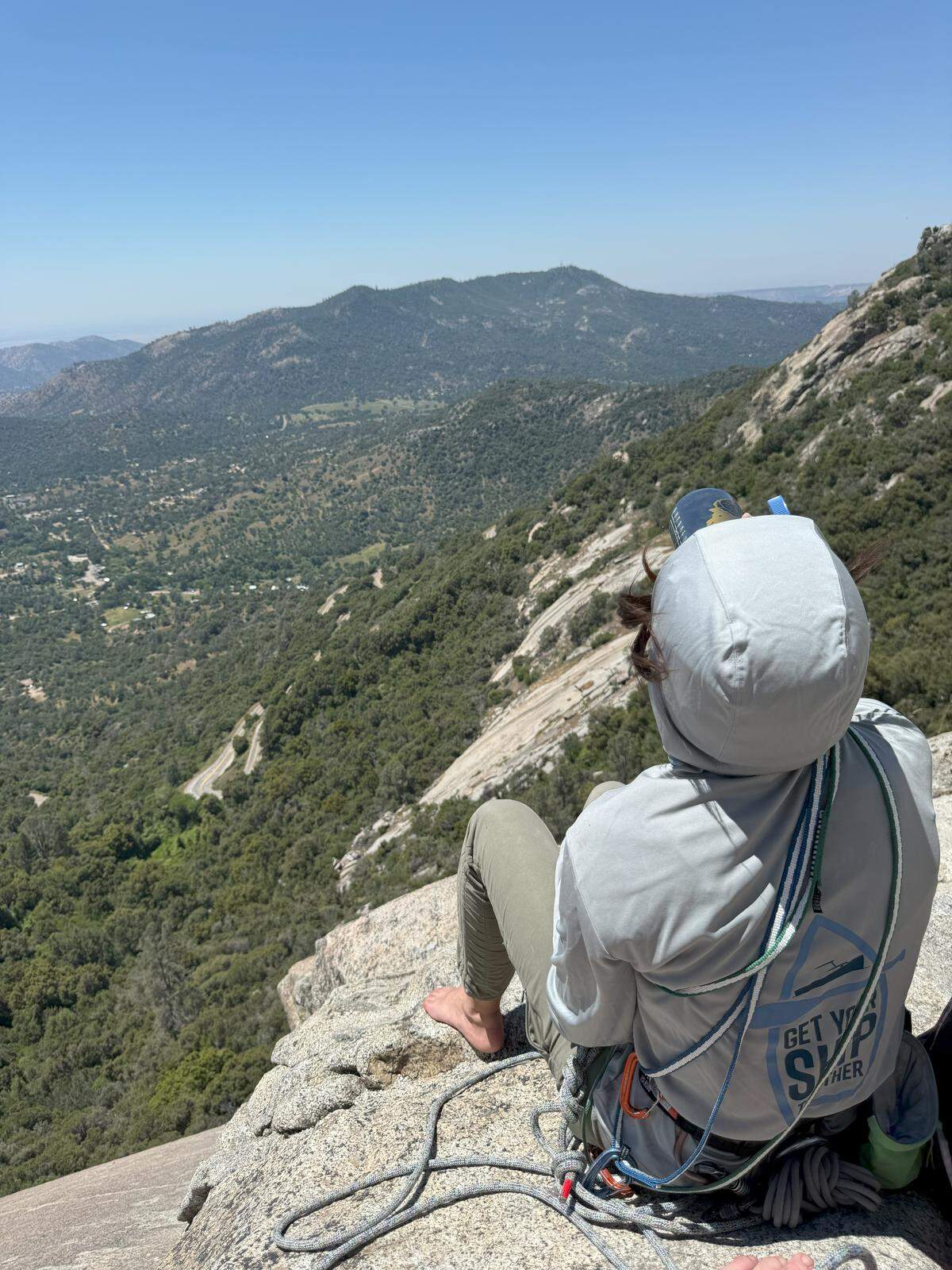
We paused to hydrate at the next anchor, catching our breath and quietly assessing the climb so far. Definitely a bit sandbagged. (But, to be fair, we weren’t exactly operating at peak performance: Mismatched shoes, a couple weeks out of practice and the sun creeping higher weren’t doing us any favors).
As I started to move, something shifted. I climbed with unexpected clarity, cleaning gear with focus and flow. Somewhere in the middle of all that granite, I stopped second-guessing myself. Peter’s voice echoed in my head: Nothing feels safe. Trust your feet.
At the next anchor, he was lounging in the sun like he’d just finished a half-day at the spa. He was proud, I was proud and we were both ready to get the hell off that rock.
The final pitch was cruel — brutal heat, sharp pain in every step and the kind of silence that builds when both partners are suffering. I tried to stay quiet about my feet until Peter broke first, whining theatrically as he climbed the final section. I couldn’t see him, but I could definitely hear him.
There was a bouldering problem near the top — awkward, exposed and not at all what I wanted to face after three pitches. Peter wrestled it with a mix of grace and exasperation, calling “Off belay!” from above. I took a breath and started climbing.
It was, unexpectedly, my favorite pitch. Trust-your-toes slab with the occasional crimp or flake — a rhythm I could fall into. At the final move, I had to abandon Peter’s beta (some contortionist heel hook that looked like a one-way ticket to knee surgery) and find my own way. I flung my leg wide, pulled into the move, and let out a power scream as I flopped belly-down onto the summit. I lay there, chest heaving, thanking my body.
“So… what’d you think?” he asked.
In the moment? It was infuriating. But now? Kind of fun. Maybe. The jury’s still out. I guess I’ll have to do it again. And again. Just to be sure.
Marissa Neely splits her year between sea and summit — sailing aboard her 1979 Cheoy Lee 41’ Avocet in Mexico and retreating to her mountain home near Shaver Lake. She shares stories of adventure, grit, and self-discovery through her blog svavocet.com and YouTube channel Sailing Avocet.