
Let us now reckon with Fresno Unified’s exclusion of Armenians
We are about to select a name for the newest school in Fresno Unified, the 111th campus, if my count is correct.
I say “we” because the naming of a school, at its purest expression, is a community’s choice. The usual school board politics need not rear its head. After all, the person so honored is often dead. He or she seeks no recognition. He or she pulls no strings. The selection of a name, if done in accordance with the people’s will, might even say something charitable about our city.
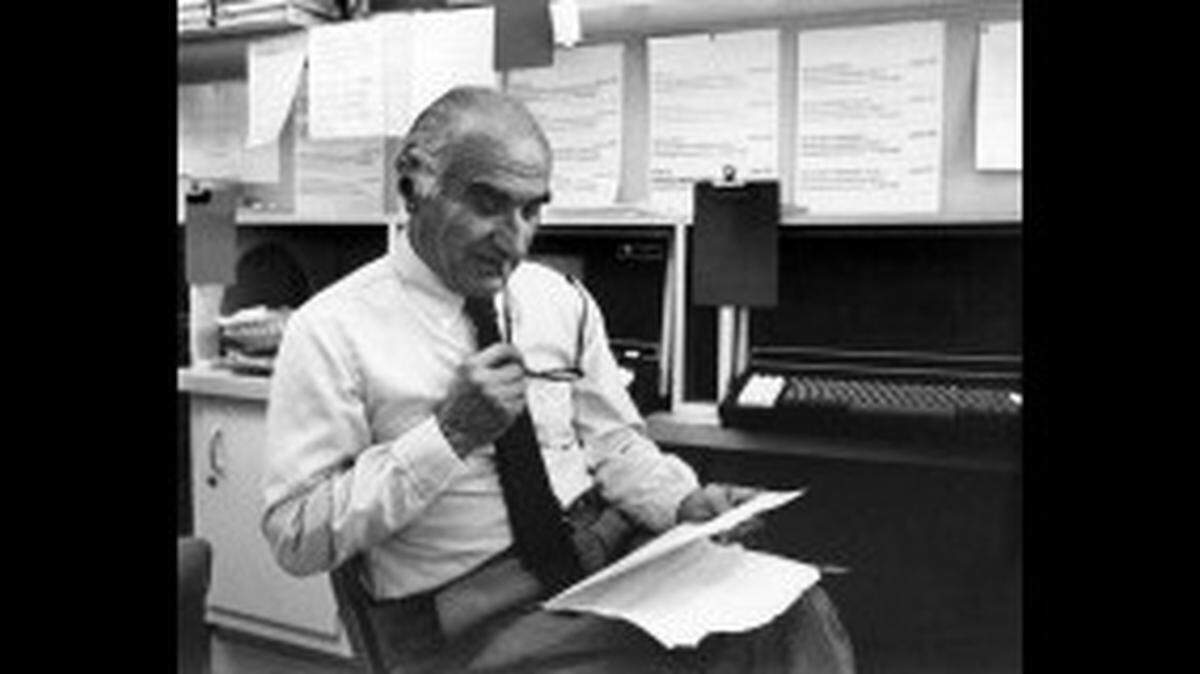
But the Fresno Unified School Board, on the eve of its Wednesday vote, appears ready to ignore the people’s choice to name the new campus, on Ventura Avenue and 10th Street, after Roger Tatarian, a native son of Fresno’s Armenian community who grew up in that very neighborhood and went on to become a legendary journalist and brilliant teacher at Fresno State.
Instead, the board majority is poised to name the school after Francine and Murray Farber, an East Coast couple who moved to Fresno in their retirement years and have generously guided hundreds of thousands of dollars from their deceased son’s estate to student scholarships.
Never mind that selecting the Farbers would completely disregard the results of the school district’s own survey of the community. That survey generated an outpouring of support for Tatarian, who died in 1995 at the age of 78. Nearly a thousand people voted for the new school to be named after him. This far exceeds the 100-plus votes for the late Dolphas Trotter, a Fresno Unified administrator, and the fewer than 100 votes for the Farbers.
The choice of the Farbers, it should be noted, has been the plan all along for several of the trustees, who have treated the honor as if it were a piece of political patronage that is theirs to dole out. In fact, they had wanted to name the previous new school after the couple but were lobbied at the last hour by the Latino community to name it for poet Juan Felipe Herrera.
This time, as the game is played, it’s the Farbers’ turn. The board discussion on Wednesday night, to be followed by a vote, is likely nothing more than veneer for a fait accompli — a term that was a favorite of Professor Tatarian, who was my teacher and had a keen smell for a charade.
Even as the school district kicked off the community vote last month, trustee Elizabeth Jonasson Rosas took the unusual step of making her choice publicly known. The Farbers, she said, are “absolutely humble and wonderful human beings who care about Fresno and about our future and have dedicated a lot of time to making Fresno better.” As if this endorsement wasn’t enough, her husband, Luis Chavez, a member of the Fresno City Council, a body that has no business in school matters, engineered a vote of his colleagues to also stamp the Farber name.
What seems almost forgotten by our local pols is the raw moment of recompense we find ourselves in. The naming of schools and other public institutions is a cause of deep divide in our nation — decisions freighted by a past of racism, inequality and exclusion. Such a moment demands that we in Fresno look back at our own untidy past, to the mixed record of our school boards over the past 130 years, when the first names we adopted for our campuses were Lincoln, Jefferson and Jackson.
Unexplainable omission
My own educational stops in Fresno Unified — first at Ewing Elementary on Olive near Chestnut, then at Malloch in the New Fig Garden and then onto Tenaya Junior High and Bullard High — are a case in point. Three of those four schools were named after white men. Ewing was our county’s first treasurer who had lost his right arm in a railroad accident. Malloch was the first dean of St. James Episcopal Cathedral downtown. (So much for the separation of church and state.) Bullard was a first, too, in the realm of turning hardpan into houses.
What is striking all these years later is the naming of a junior high in the northwest part of town after Tenaya. How to explain this selection if not a surprising choice, an inspired choice, a choice of penance, by our school board?
Tenaya was the last chief of the Ahwahnechee tribe that had been driven out of its ancient Yosemite homeland in the early 1850s and herded onto a rancheria on the hot Valley plain to live out its last days. The chief, a man of immense presence, did not go quietly, uttering a curse against the white man that, read 170 years later, brings tears to the eye. Somehow, I and my fellow Braves, who had each built a replica of a California mission in the fourth grade, finished three years of learning at Tenaya without ever being taught who Chief Tenaya was or how his people were erased in what was surely a California Genocide.
And so I now count 110 schools — schools bearing the names of a New England poet, a Midwestern essayist, an intrepid war correspondent, a Civil Rights giant, a labor union icon, a tireless local librarian and a wily Hmong general whose naming occurred after scores of Hmong, survivors of a journey that took them from 18th Century Laos to 20th Century America in a single plane flight, resolved to make their voices heard.
I count schools named after the children of Dust Bowl white migrants and Mexican migrants and black migrants who fled the racism of the South only to find in our Valley a prettied-up version of old Jim Crow. I count schools named after Danes and Germans, Japanese and Jews, Irish and Scottish Americans.
What I cannot count is a single campus in Fresno Unified named after an Armenian, a people whose deep imprint on this Valley, from literature to agriculture, put Fresno on the map.
How to explain such an omission? Should we set it down as an oversight, a snub, a vestige of the prejudice that as late as the 1960s barred Armenians from living in the north end of town, blackballed them from service clubs and country clubs, kept them out of the ranks of teachers in Fresno Unified and journalists at The Fresno Bee, held their numbers to “manageable” levels inside City Hall and the police and fire departments?
Such was the durability of this discrimination that eighty years after the first Armenians had landed in Fresno, an Armenian kid growing up in the suburbs found himself confronted by a Slavic classmate who called him a “Fresno Indian” and broke into a war dance. The “woo, woo, woo, woo,” out of his mouth sure sounded like a slur. He should have seen my roundhouse coming. We were survivors of genocide, exiles clawing for rebirth in a valley where the old peasants needed new peasants to measure and lock in their climb. We were the Hmong three generations before the Hmong ever arrived.
‘Name it Tatarian’
You can imagine my swell of ethnic pride when in the fall of 1976 I walked up the stairs of the journalism department at Fresno State and entered the classroom of Roger Tatarian. The legendary newsman, who had been the editor in chief of United Press International before a heart attack brought him back to Fresno, looked every bit a member of my tribe. His unruly eyebrows, his black eyes, his long nose that angled over the page of the story I had just turned in — he was my people.
If I thought our shared blood (wasn’t every Armenian a cousin of every other?) would give me a leg up, I was sorely mistaken. I have never had a public ass-chewing like the one he gave me that first semester when I showed up late to his class two times in the same week. “You just missed the breaking news,” he said with a hoarse growl.
He was a stickler for facts and fairness. Many of us — Latino, Black, Asian, Arab, Jew, Armenian — were the first in our families to graduate from college. Though we carried injustices in our tribal narratives, these injustices, he admonished, were only there to inform us as human beings, not to wear as badges as we went about our task to inform the public. Our personal opinions were largely irrelevant.
Nothing replaced the hard-earned details that came with painstaking reporting, he preached. A story lived or died by the craft of its lede — the opening paragraphs. “Grab the reader the very first sentence and don’t let go,” he said. “The only way to judge your paragraphs, whether they’re music or noise, is to read them out loud. Your silent eyes can fool you. Your voice won’t.”
He became more than a mentor to us. To those like me whose fathers had died young, he became a father figure. Mr. T, we called him. He was the wisest and most principled man we would ever know, and the classiest. By my junior year, I had willed my way deeper into his life, and he graciously took me in. He and his wife, Eunice, lived in a tucked-away house on Christmas Tree Lane. She was a formidable woman, as worldly as he was, a Fresno girl who fell for him during their years at Fresno State. It did not go unnoticed that she wasn’t Armenian. They had made a grand life of it in London and Rome, where he served as bureau chief for UPI, and then in Washington, D.C., and New York, where he became editor in chief.
He did not enjoy talking about himself, but I kept boring in. He had schooled me well. At the dinner table or seated in his study or in his wood shop out back, he began to confide some of the more painful details of his early years.
He was born Hrach Roger Tatarian on Christmas Day 1916. His father was a shoemaker and his mother a homemaker, and both of them, he said, could have done anything with their lives had their lives took place in another time. They had fled Turkey before the Armenian Genocide and in the 1920s lived across the street from the bellowing Saroyans in old Armenian town.
It was a ghetto filled with survivors whose madness was on full display. Fresno made sure the Armenians knew their place. That they were despised by so much of the citizenry was made plain in restrictive real estate codes that read: “No Negro, Mexican, Chinese, Japanese, Armenian or any descendant of the Turkic empire.” Our exclusion, in case we failed to see the first reference, was made plain twice.
“No one of Armenian parentage who grew up in those days in the Central Valley can ever forget the humiliation that was so regularly heaped upon people who names ended with i-a-n,” Mr. T wrote in 1991 in one of his Bee columns.
He felt the sting of prejudice from Longfellow Junior High all the way through Fresno State. Though he had graduated at the top of his class, he was told not to bother to apply for a position at The Bee. Like so many Fresno Armenians who had studied to be teachers, he, too, had to leave town to get a job. He hightailed it in the late 1930s to the Phoenix bureau of UPI. As the teletype machine triumphantly spat out his first story, his editor on the East Coast was on the phone. “What the hell is Hrach?” he demanded. The editor thought his first name was a typo.
For the rest of his life, he became simply Roger Tatarian in all matters except for the beautifully grained wood clocks and keepsake boxes he built in his shop. On the underside of each one, he etched: “H.R. Tatarian.”
Given the love we had for him, it surprised me not in the least when scores of his former students, responding to a social media post last month, filled out the Fresno Unified survey. “Name it Tatarian.”
What extra case has to now be made that a school in a neighborhood where Armenians huddled against the forces of discrimination — forces applied by the school district and other public institutions — should bear the name of a great Fresno Armenian? Is the absence of an “i-a-n” on the 110 existing schools not evidence enough to redress a century’s wrong?
This is not to say that the Farbers do not deserve their own honor at Tehipite Middle School, the campus where they have put so much of their time and money. Rightfully, it should be renamed the Farber-Tehipite Academy.
Might the couple, touched by the recent example of Joe Biden, the first U.S. president in a century to publicly recognize the Armenian Genocide, agree that recognizing the educational contributions of Fresno Armenians — survivors of that genocide — is long past due, as well?
This story was originally published May 17, 2021 at 11:41 AM.