
A Fresno council member wants all buses to be free to ride. But can the city afford that?
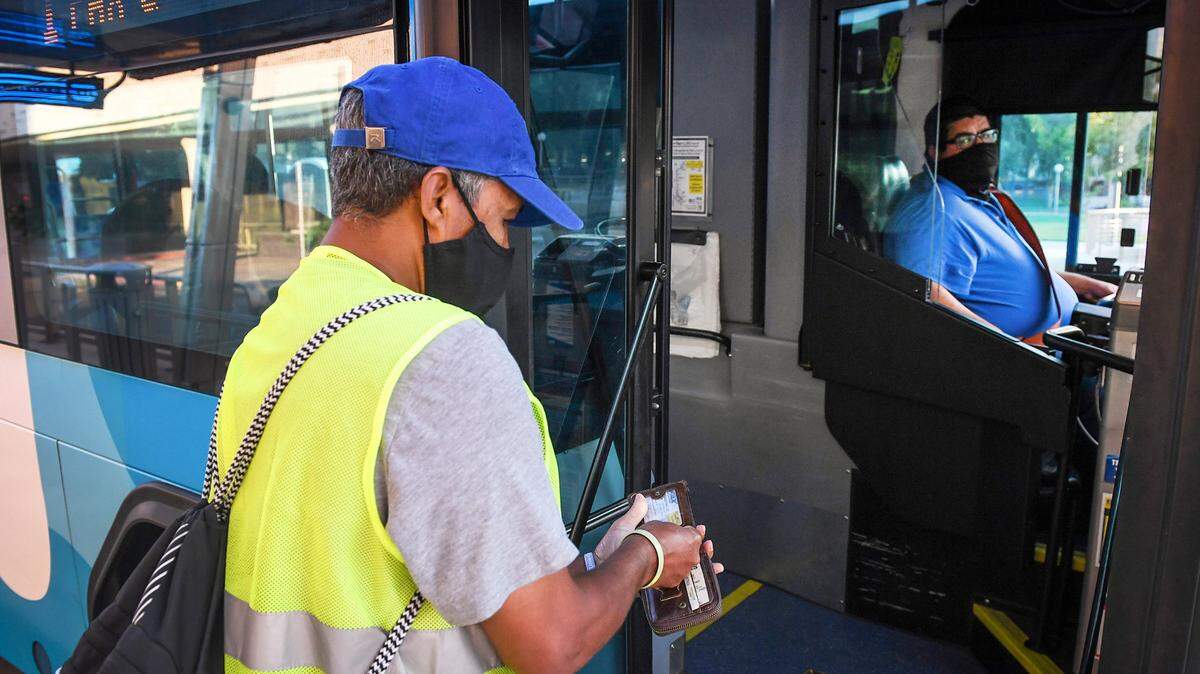
Should Fresno residents be able to ride city buses for free?
That is the issue coming to the City Council next week, when District 4 Council member Tyler Maxwell proposes that the city’s transit system become zero fare.
The proposal is being co-sponsored by Councilmembers Esmeralda Soria and Nelson Esparza. In Soria’s view, the zero-fare issue will reveal the priorities and values that the seven council members hold dear. For Esparza, zero fare is part of a larger picture of just how the Fresno of tomorrow will develop.
In the Fresno of today, Maxwell sees lots of reasons to scrap fares and let riders board for free.
For starters, the typical passenger of a Fresno Area Express (FAX) bus is a single mother of young children who needs a way to get to school or work.
FAX statistics show that 76% of passengers earn $20,000 or less a year; 77% of riders don’t have a vehicle or access to one. Most of the riders come from the city’s lower-income neighborhoods in the central and southern parts of Fresno.
By making buses free to ride, there won’t be any more fare disputes, which means less need for a police force dedicated to FAX, Maxwell says.
Air quality will benefit when more people ride buses rather than drive in private vehicles. He proposes his “Zero Fare Clean Air Act” on that expectation.
With free service, Maxwell envisions residents being able to get jobs they might not otherwise have taken, or ride to Fresno City College and Fresno State for higher education. Immediately, he sees riders taking the bus to COVID testing sites or vaccination clinics.
In summary, he sees a rising tide of opportunity for Fresnans wanting to improve their lives, powered through a bus service that can get them where they need to go.
But there’s a catch.
Fare revenue
FAX earns around $5.5 million a year from fares paid by passengers. Then there are state and federal grants that also provide key support. State grants require matching funds. If FAX did not have that funding and those grants had to be dropped, the total loss to the city could actually be over $30 million annually, FAX officials say.
Maxwell is undaunted.
In other cities in the nation that are considering zero fare, like Kansas City, major health-care companies are being considered to subsidize some of the cost. That might work here, too. Firms like Kaiser Permanente could be approached.
He also points to federal funds that are available, like pandemic relief monies.
Maxwell sees potential support from large employers whose workers take the bus. And State Center Community College District, Fresno State and Fresno County are already top users who pay into FAX and will likely remain users.
Fresno’s public transit is popular, Maxwell notes: From 2017 to 2019 the city’s ridership grew by 1 million passengers. It dropped over the past year because of the coronavirus pandemic.
Is free affordable?
It is easy to imagine that free bus service would raise the quality of life for lower-income residents and most likely improve the city’s economy. So the idea has merit.
However, Fresno is not a wealthy town, and cannot easily add services without considering its budget.
For example, Fresno currently cannot pay for its parks system. Maintenance is way behind and few new parks can be built, despite the fact Fresno is one of the worst cities in the nation for quantity and quality of its parks.
That was the point of Measure P in 2018 — to develop a new funding source via higher sales taxes that could be devoted to the underfunded parks program.
Some city departments, such as police and fire, struggle with staffing shortfalls that are rooted in the 2008 recession.
Then there are concerns that making bus service zero fare might logically create a jump in ridership. Without fare revenue, how will the city be able to add buses that might be needed for all the new passengers?
These concerns are not meant to discourage a good idea. Soria is right; if this is a priority of the council majority, they may be able to find cuts elsewhere in the budget and redirect monies to transit.
But the funding questions must be addressed before the city can convert to a zero-fare system. It would be a shame to start the program, only to have to pull back in a year or two because it proves unaffordable.