
Anyone will be allowed to run for sheriff in California — if the state drops eligibility rules
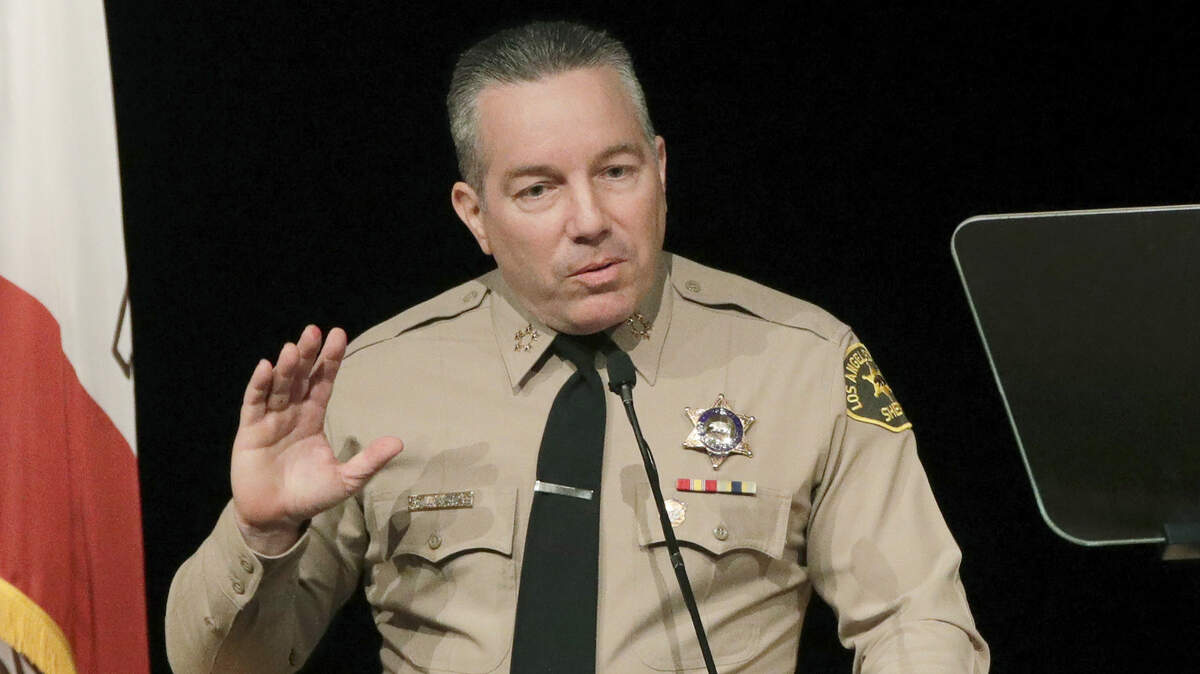
Dozens of county sheriffs in California are up for reelection in 2022 — including controversial, high-profile sheriffs in Los Angeles, Sacramento and Fresno counties.
Yet there’s no guarantee that voters in any particular county will have a choice of candidates in 2022.
Even in some of the worst-run sheriff’s departments in the state, incumbents often sail unopposed through one election cycle after another.
One possible reason: Only candidates with law enforcement certification and/or experience are eligible to run for sheriff in California. Along with the power of the incumbency, that limits the pool of potential candidates.
That’s an issue especially in smaller counties; Sonoma County, for example, once went 25 years without a contested election.
That could change; last week, Sen. Scott Wiener of San Francisco introduced a bill, SB-271, that would allow any registered voter to run for sheriff.
Wiener says it would “prioritize democracy and diversity” in a state where 49 of the 58 sheriffs are white men.
While it may sound preposterous to allow just anybody to run for county sheriff, take a look at the qualifications to run for president of the United States. No special experience or training required.
Who can run for sheriff
Civilians were eligible to run for sheriff up until 1989, when a law took effect requiring candidates to have certification from the Commission on Peace Officers Standards and Training or recent paid experience in law enforcement.
That bill was passed under “intense pressure” from the Sheriffs Association, according to Wiener.
On its face, the requirement makes perfect sense.
A 2019 court of appeal ruling that upheld the law sums it up well: “To get a ‘feel’ for law enforcement, i.e., coming to a true understanding of it, you must learn about it in the field by doing it.”
Yet the job of sheriff has evolved far beyond the enforcement of laws. Sheriffs deal with mental health, addiction, homelessness, child welfare and — as we’ve seen during the pandemic — public health.
They are in charge of incarceration and rehabilitation, and on top of that, they have administrative duties such as budgeting and personnel management.
Given all that, a case could be made for electing a sheriff with a strong background in social services, public administration or public health.
Plus, an outsider might be in a better position to press for reforms.
It’s true that many voters would be highly reluctant to support someone who’s never served as a peace officer.
But shouldn’t voters at least have the opportunity to decide for themselves?
And honestly, it’s hard to imagine that a well-qualified civilian could do any worse than some of the sheriffs currently in office.
Among the worst of the worst:
- The Los Angeles County Sheriff’s Department is under investigation for alleged civil rights violations, including false arrests, discrimination and excessive force. An oversight panel has demanded L.A. Sheriff Alex Villanueva’s resignation. He’s refused.
- Sacramento County Sheriff Scott Jones has been held responsible for a litany of abuses, including inhumane conditions at county jails that resulted in a $100 million lawsuit settlement.
- Fresno County Sheriff Margaret Mims oversees a jail with one of the highest inmate death rates in the state. On top of that, the New York Times data tracker shows Fresno County jail has had more COVID-19 infections — nearly 4,000 — than any correctional facility in the nation, though Fresno County sheriff’s officials dispute that.
Holding sheriffs accountable
Little can be done to rein in even the most out-of-control sheriffs, though there has been a recent push for reform.
State legislation passed last year allows counties to set up oversight boards that investigate allegations against sheriff’s departments and issue subpoenas.
Allowing civilians to run for office could help as well. At the very least, robust election campaigns would open the door to discussion of the incumbents’ records and force them to address calls for reform.
But these are half measures.
If California truly wants to transform sheriff’s departments, it’s time to consider a more fundamental change.
One idea: Make the office of sheriff an appointed, rather than an elected, position.
That would allow the county administration to appoint the sheriff, just as in cities police chiefs are appointed by the mayor or city manager, often with approval or input from the city council or a citizens commission.
That would immediately open up the field of candidates in a dramatic way, because we would no longer limited to individuals living in our home county who are willing to run for office.
Plus, sheriffs would no longer be allowed to run their own little fiefdoms — they would be accountable to the Board of Supervisors who, in turn, are accountable to the voters.
It’s a logical system that works for cities, but it would be a tough sell, since it would require amending the California Constitution.
While the idea is gaining traction among some criminal justice reform advocates, we’re a long way from giving up our elected sheriffs.
But maybe it’s time to start discussing it more seriously.
We’ve seen too many examples of abuse of power, resistance to meaningful reform and outright corruption.
If that keeps up, in a generation or two, Californians may be willing to take drastic action — and sheriffs will have only themselves to blame.
This editorial has been updated to clarify how police chiefs are appointed in California cities.
This story was originally published February 5, 2021 at 8:44 AM.