Will Valley cities agree to share local taxes with High-Speed Rail? Fresno ‘not willing’
AI-generated summary reviewed by our newsroom.
- Fresno Mayor Jerry Dyer says he is “not willing” to share local tax dollars with HSR.
- The High-Speed Rail Authority proposes “mutually agreed-upon” tax revenue sharing.
- Other Central Valley mayors say an agreement is possible, but they still opposed the idea.
Fresno Mayor Jerry Dyer says the city cannot afford to share any local sales and property tax dollars with California’s High-Speed Rail Authority, which has floated the idea as a way to help pay for the train system and infrastructure around its future stations.
The agency has begun talking about the idea with some local governments in Central Valley areas slated for a high-speed rail station. Some cities remain skeptical, and others appear open to hearing what the rail authority has to say.
But Dyer, who has spoken against the idea since February, has remained strongly opposed to it. He said the rail authority has not contacted him to discuss sharing tax dollars, but added that he does not see it as a fiscally responsible idea for Fresno.
“I’m not in a position to compromise,” Dyer told The Fresno Bee on Wednesday. “I am not willing to.”
Local governments use their portions of sales and property tax revenues to pay for various essential public services, including police, fire and local transportation.
But the rail authority says it wants a portion of the rise in those tax revenues — known as tax increments — created by high-speed rail within a half-mile of its stations. The funding model, known as tax-increment financing, is based on the idea that property values and sales tax revenues increase with the arrival of the new high-speed rail and stations, so some of the extra money should help pay for the project.
In the Central Valley, stations are planned for downtown Fresno, an area adjacent to the City of Hanford, an area not yet finalized in Merced, and downtown Bakersfield — though the agency has also proposed first building a temporary Bakersfield station to the north of downtown.
The project’s current focus is completing a 171-mile Merced-to-Bakersfield segment that the rail authority says it can do for $34.76 billion. But the agency will need at least $126 billion to finish the originally envisioned Los Angeles-to-San Francisco system.
Though Dyer has supported high-speed rail and sees the project as an economic necessity for Fresno, he said the rail authority is not entitled to local tax dollars to build the system.
“I cannot afford to lose any tax dollars in the City of Fresno, especially when I just got through balancing a budget where we were $34.5 million in the red,” he said.
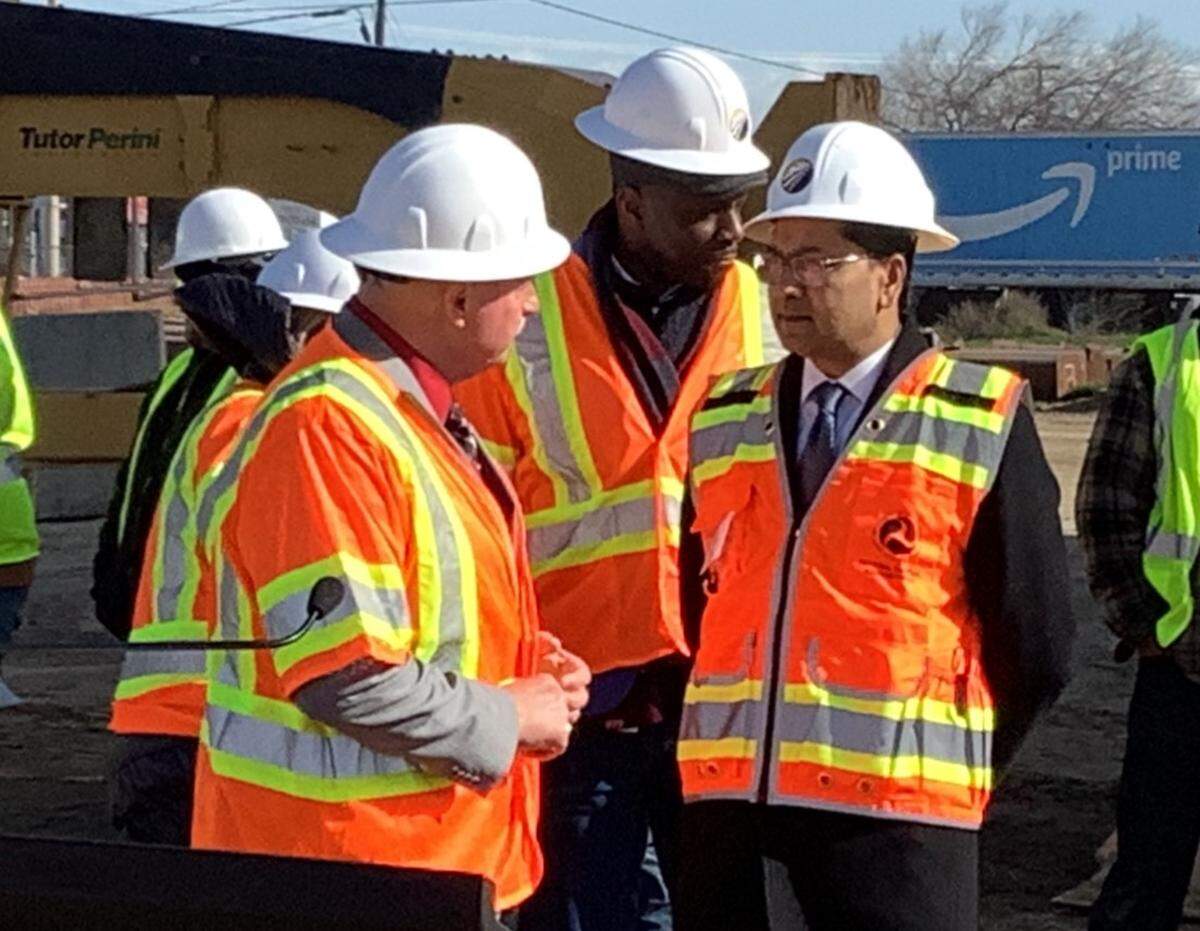
CA High-Speed Rail says it wants ‘mutually agreed-upon’ local tax share
The tax increment financing idea is one of several the rail authority is pursuing to advance money for a train it says has never been fully funded. The idea led 10 California mayors to send rail authority CEO Ian Choudri a letter in late April that said capturing local sales and property tax revenues would be unconstitutional.
Dyer signed the letter, as did Merced Mayor Matthew Serrato, Hanford Mayor Mark Kairis and Bakersfield Mayor Karen Goh.
In a Friday statement to The Bee, the rail authority said its current discussions with local governments are focused on whether a “mutually agreed-upon” portion of local tax revenue increases could be reinvested into high-speed rail infrastructure in the future.
The agreements would work similarly to infrastructure financing districts that local governments have established with regional transit agencies elsewhere in the state, the rail authority said.
“Value capture is only one of many concepts being discussed, and the Authority is not proposing any policy — particularly not one that would override local land-use or tax authority,” the agency’s statement said.
Will other Central Valley cities share taxes with High-Speed Rail?
Serratto, the Merced mayor, said Merced officials have spoken to the rail authority about its tax increment financing idea. To him, and most leaders of cities, it’s a “non-starter.”
But he said there could be a scenario where he’d support sharing some tax revenue with the rail authority.
“It would have to be part of some significant job-generating business park or something like that,” said Serratto, who has also been an overall supporter of high-speed rail.
In a statement to The Bee, the City of Bakersfield said it has met with the rail authority in recent months. The city said it is “still opposed” to the tax increment financing idea, but added that it hasn’t seen “a real proposal” from the rail authority.
“However, we are open to exploring the idea if it will result in a good project for downtown Bakersfield,” the city’s statement said.
Kairis, the Hanford mayor, said in an emailed statement that the rail authority has not contacted Hanford City Councilmembers or staff to discuss tax increment financing.
“However, we look forward to those conversations so we can learn more and collaborate with the Authority on the topic,” Kairis said. “While I stand by the joint letter recently sent to the Authority’s CEO, I am encouraged by recent reporting indicating the Authority does not intend to infringe on local land-use or tax authority.”
This story was originally published April 26, 2026 at 5:11 AM.