What will Valley high-speed rail stations look like? Designer gets $35M to figure it out
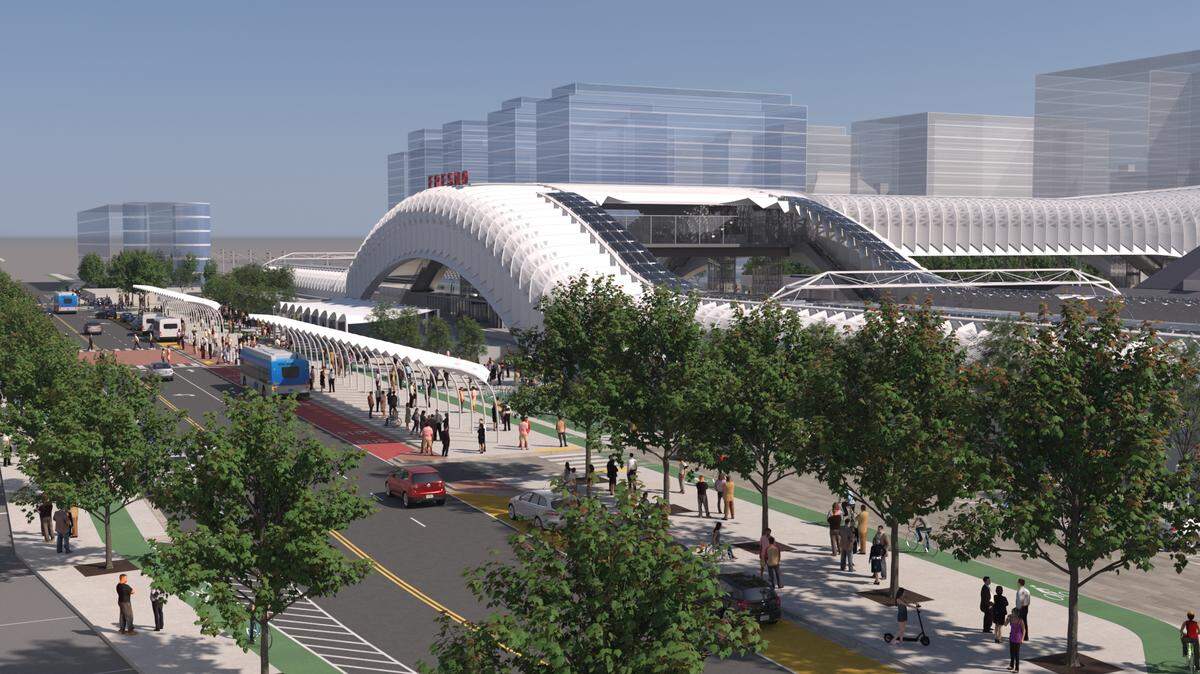
Future riders of California’s planned high-speed rail system won’t be boarding the trains until the end of this decade. But planning is already underway for the first passenger stations for the initial operating route through the San Joaquin Valley.
The California High-Speed Rail Authority’s board unanimously awarded a $35.3 million, 30-month contract for preliminary site planning and design for stations in Fresno, Merced, Hanford and Bakersfield.
The contract, awarded Thursday at the board’s meeting in Sacramento went to a joint venture comprised of two London-based multinational companies: Foster + Partners, an architectural firm, and engineering consulting firm Arup. It calls for the team to analyze the sites, acquire the needed property, and develop preliminary designs and configurations for the stations.
“The first four Central Valley high-speed rail stations are one step closer to reality,” said Tom Richards, a Fresno developer who is chairperson of the rail authority’s board. “High-speed rail stations will transform cities, spur economic development and create community hubs within the heart of our state.”
The station locations in the Valley are:
Fresno: Adjacent to the Union Pacific Railroad tracks on a site bounded by Fresno, Tulare, G and H streets in the downtown district.
Merced: Along the Union Pacific Railroad tracks, either between G Street and Martin Luther King Jr. Way or a few blocks to the northwest near R Street.
Bakersfield: North of downtown at a site bounded by Highway 204, the Union Pacific freight tracks, Chester Avenue and the Kern River.
Hanford: East of the city, north of Lacey Boulevard and Highway 198, east of Highway 43.
There is an option for the authority to have the same Foster/Arup team develop final construction-ready plans and support construction and commissioning of the stations for initial passenger operations. That second phase of design is estimated at about $36 million.
The combined price tag of about $71 million for both the preliminary and final designs does not include construction of the stations, which will be built in stages. The first stage of each site will be scaled to serve the initial operating segment between Bakersfield and Merced.
A second stage for the stations will be designed to handle operations for a built-out system that is ultimately planned to connect the Bay Area and the Los Angeles Basin with trains moving at up to 220 mph.
The 171-mile stretch between Bakersfield and Merced is planned to be the first operational segment for high-speed trains. The latest estimates of construction costs for the Valley route between Merced and Bakersfield range from $22.5 billion to $23.9 billion.
For a full San Francisco-Los Angeles/Anaheim system, the rail agency estimated earlier this year that the costs could range from a low of $72.3 billion to as much as $105.1 billion. Much of that wide variation stems from the uncertainty of how much it would cost to tunnel through mountain ranges, as well as the price of property that would be needed before construction could begin.
Role of stations
Margaret Cederoth, director of planning and sustainability for the rail agency, said engineers have already identified early design concepts for the stations. “This contract will take those concept designs and take them to a configured footprint,” Cederoth told the board. “Thirty months should get us through to configured footprints by 2025.”
A station in Madera is also under development under a separate process led by the San Joaquin Joint Powers Authority, the agency that oversees Amtrak operations in the San Joaquin Valley.
The selection of the Foster/Arup team and award of a contract is the culmination of a process that began earlier this year, when the California High-Speed Rail Authority solicited proposals from firms interested in competing for the design contract.
The Foster/Arup team was the highest-rated of two firms that responded to the solicitation.
“Stations are so important going forward for the economic development of the areas,” said Lynn Schenk, an authority board member from San Diego. Schenk said she hopes the board members will have a chance to see the designs as they are developed and perhaps offer their thoughts on how a station can fit into each of the communities.
Earlier this year, Cederoth acknowledged the importance of creating stations that serve as more than just a place where people can board or disembark from the bullet trains. While rail operations aren’t expected until the end of the decade, “other parts of the station complex could be built independently” and put to use, Cederoth said in April, when the agency began the process of seeking proposals from design firms.
At that time, Cederoth added that the public will be able to weigh in with what they would like to see in station complexes in each of the communities, both before and after rail operations begin.
“In Fresno we’ve started work on some things that we hope to have in place in 2025. We refer to it as ‘placemaking’ or ‘early site activation,’” she said. “We recognize how important it is for people to think about going to that spot. … There’s a portion of our station site that’s adjacent to the surrounding development that we can move into things with that, in advance of rail service.”
In Spain, for example, high-speed train stations in major cities such as Madrid and Barcelona are also hubs for retailers and restaurants amid the downtown areas where they are located.
The idea, Cederoth said, is to get people used to thinking that the train station site will “definitely be a place to go to even if you’re not taking the train.”
This story was originally published October 20, 2022 at 4:58 PM.