California bullet train planners take critical next step to plan Fresno, Valley stations
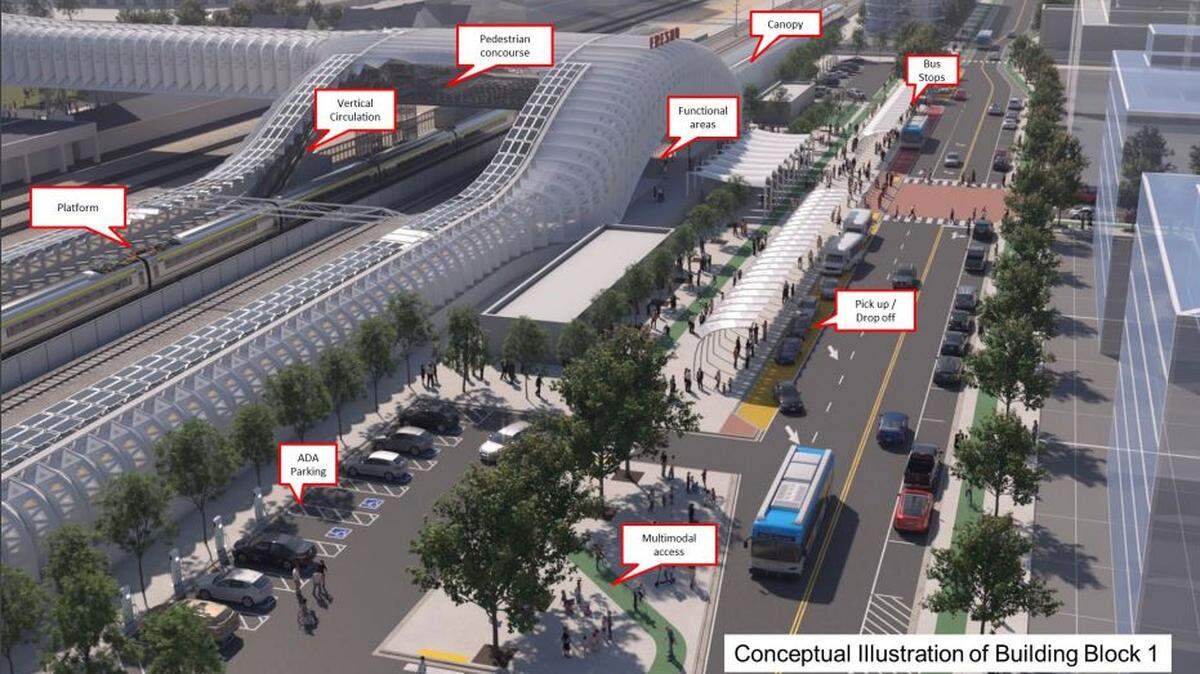
Preliminary planning and designs for four future high-speed train stations in Fresno and the San Joaquin Valley are expected to start later this year under a process approved Wednesday by the California High-Speed Rail Authority.
The agency’s board of directors, meeting in Sacramento, agreed to seek proposals from engineering firms to take on the first layers of work on stations in Merced, Fresno, Hanford and Bakersfield.
The first phase of work will include finalizing the “footprint” of station locations in each city, updating the estimated costs of development and construction, utility requirement and more. The initial cost ceiling on the work is expected to come in at or under $35.3 million.
“It ties into the fact that we are moving to having trains operational by the end of the decade, and to do that you have to have stations designed and ready to go,” said Henry R. Perea, a former member of the Fresno County Board of Supervisors who now serves on the rail authority’s board. “There’s a sense of urgency for our board members (that) we need to get these done sooner rather than later.”
Officials with the cities of Fresno, Merced and Bakersfield voiced support for moving ahead with the work.
John Ellis, government affairs manager for Fresno Mayor Jerry Dyer, told board members by phone Wednesday that the city supports the design work “necessary to build the nation’s first HSR station in the heart of downtown Fresno.”
“This will bring positive change to Fresno, likely on a scale not seen since the city was founded in 1872 by the Central Pacific Railroad Company,” Ellis said. “The resulting economic development for our community, and the state, mean the importance of properly funding and resourcing the design element is critical.”
Ellis also stressed the need for a station design to reflect the cities and incorporate the best design practices. “To state it very clearly, a vibrant station is a must,” he said. “The city of Fresno is not interested in having (just) a platform placed in the heart of a thriving downtown.”
In Fresno, where work on the high-speed rail line commenced in 2013, the proposed station location is adjacent to the Union Pacific Railroad tracks on a site bounded by Fresno, Tulare, G and H streets in the downtown district.
Merced has two downtown sites under consideration: one along the Union Pacific Railroad tracks between G Street and Martin Luther King Jr. Way that was included in previous environmental approvals for the Valley route, and other a few blocks to the northwest near R Street.
Merced’s deputy city manager, Frank Quintero, told The Fresno Bee before the meeting that city officials prefer the station location closer to R Street because it would be less disruptive and more in alignment with downtown revitalization plans.
“Highway 99 is elevated, so it acts as a barrier” between central and western Merced, Quintero said, “so we don’t want anything that increases that.”
Merced Mayor Matthew Serratto told the rail board members by phone that “we must begin design and preliminary engineering work as soon as possible.”
Even though Wednesday’s action only advances the design stage, Serratto added, “it’s still critical to moving forward.”
Margaret Cederoth, the rail authority’s director of planning and sustainability, said the Merced station will serve as a shared connecting node with a future extension of the Altamont Corridor Express, or ACE Rail trains that currently connects Stockton to San Jose.
A policy consultant for the city of Bakersfield said leaders there hope that the station will be a landmark-type of project, and not just a platform where passengers will board and disembark from trains.
Bakersfield’s station site is north of downtown, bounded by State Route 204 to the west, the Union Pacific Railroad freight tracks to the east, Chester Avenue on the south and the Kern River on the north.
The fourth Valley station will be just east of the city of Hanford, north of Lacey Boulevard and Highway 198 and east of Highway 43.
Building blocks
Cederoth said the idea is for the stations in the Valley to be designed in “building blocks” scaled to the size of the rail system itself: an initial block intended to serve the initial Bakersfield-Fresno-Merced route, with the expectation for scaling up when the state reaches its ultimate goal of connecting the Central Valley segment to the San Francisco Bay Area and Southern California.
Over the next few months, engineering and design firms will be providing detailed statements of qualifications to the rail authority. Those firms will be evaluated and rated before a winner is selected and a contract negotiated this fall.
A subsequent part of the contract would include final designs for each station, supporting the construction bidding process, and opening the stations. The estimated costs for the second phase of work is about $36 million.
“This designer will stay on board to help us with the bid for a (construction) contractor, and stay on board through construction and commissioning,” Cederoth said, “making sure it’s ready for occupancy and making sure that what is delivered conforms to the design that they did.”
Earlier use of sites?
Cederoth said her office has been involved in discussions with each of the cities to contemplate specific wishes in their respective communities. Once this contract is awarded in October, that work will ramp up significantly, she said.
“We’ll be in a fairly intensive phase of public consultation over the next year,” she said. “Late 2022 and 2023 will be an active time for the station design work in Fresno and everywhere else.”
While rail operations aren’t expected until the end of the decade … “other parts of the station complex could be built independently” and put to use, Cederoth added.
“In Fresno we’ve started work on some things that we hope to have in place in 2025. We refer to it as ‘placemaking’ or ‘early site activation,’” she said. “We recognize how important it is for people to think about going to that spot. … There’s a portion of our station site that’s adjacent to the surrounding development that we can move into things with that, in advance of rail service.”
In Spain, for example, high-speed train stations in major cities such as Madrid and Barcelona are also hubs for retailers and restaurants amid the downtown areas where they are located
The idea, Cederoth said, is to get people used to thinking that the train station site is “definitely be a place to go to even if you’re not taking the train.”
This story was originally published April 27, 2022 at 5:57 PM.