
In a year since Fresno teachers voted to strike, here’s what’s changed at the district
Last Oct. 3, Manuel Bonilla faced 3,000 of his fellow Fresno Unified teachers as they voted for their first strike since 1978.
The strike didn’t move forward, but the vote itself was a key step after 15 months of contract negotiations, Bonilla, now president of the Fresno Teachers Association, said a year later.
“It’s not lost on me that the reason we were able to get in the room and have the conversations that we needed to have is that we were willing to strike,” Bonilla said. “Until they recognized the strength of our collective voice, they weren’t listening to us.”
As other teachers unions across the country weigh strikes, the FTA finds itself a year ahead, reflecting on a tumultuous year that eventually included a new agreement with an 8.5 percent salary increase and a promise to reduce class sizes.
In a joint news conference with the FTA Wednesday, Fresno Unified superintendent Bob Nelson said that the union and the district are turning “conflict and chaos” into “collaboration and cooperation” between labor groups, district leaders and community members.
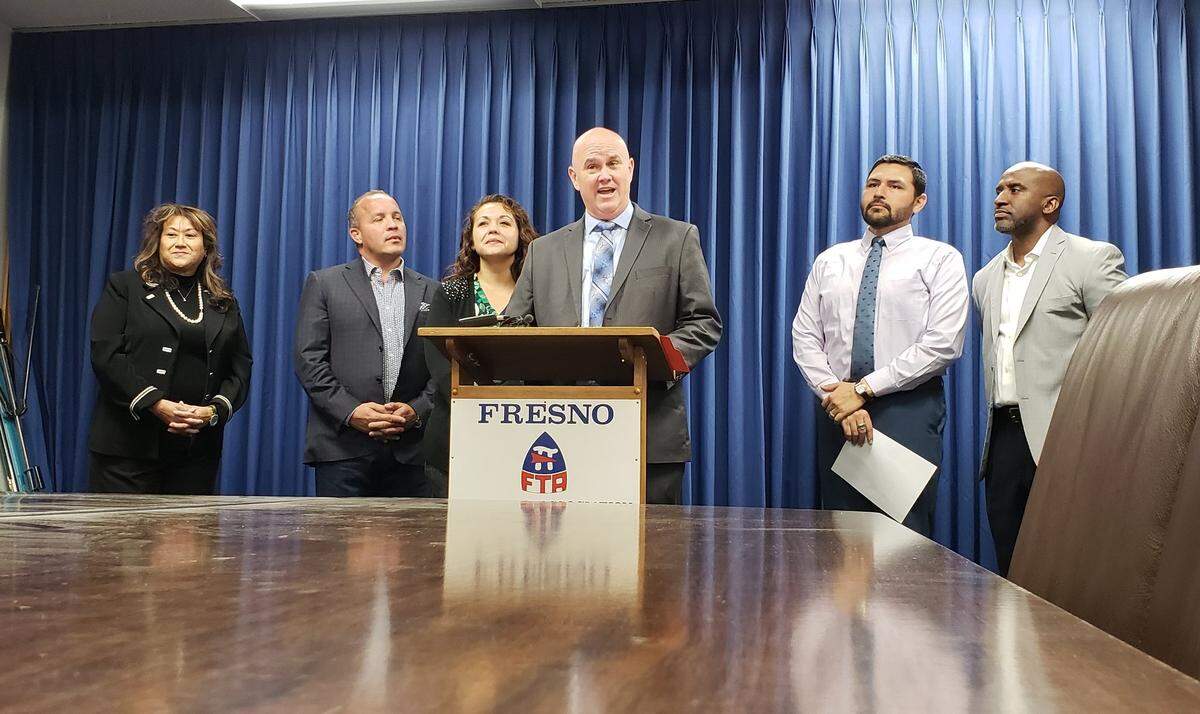
“It was a difficult and stressful time for us all,” Nelson said. “We’re trying to de-emphasize focus on the adults and instead refocus on the students.”
The district has taken a series of steps this year to make class sizes more manageable, Nelson said, including eliminating combination classes in elementary schools and reducing the ratios for secondary school language classes. Transitional kindergarten has also been given more classroom space on campuses where that is possible, or additional instructional aides to reduce student-to-staff ratios when space can’t be found.
Case loads in special education classes are another issue the district will continue to work on, according to Nelson.
However, the district board has stopped short of considering a parcel tax for this election cycle, which was part of the FTA’s bargaining agreement and would further help fund smaller class sizes.
The union’s executive director, Louis Jamerson, said Fresno teachers are paying attention to the national narrative, which also has included a series of TIME Magazine covers of teachers sharing their financial struggles.
“Some think of escalation as a negative, but for us, it opened doors,” Jamerson said.
“Parents would come to us and ask, ‘What’s going to happen to my kid if there’s a strike?’” Jamerson said. “And we would ask them, ‘What if this is an opportunity to change how Fresno Unified operates for a generation? Is a five-, seven- or even 30-day strike worth that?’ And most would say, ‘OK, I see.’”
Bonilla said the next year will be defined by how well Nelson and the district implement the changes that all parties agreed to back in January. The union is “committed to bargaining differently,” according to Bonilla, which includes joint labor management meetings. Next week, the principals of each school site will meet with teacher representatives in a first-of-its-kind gathering at the district, Bonilla said.
“Eventually I’d like to be turning away teachers because everyone wants to work here, and I want our students to be successful academically,” Bonilla said. “The question is what are we doing daily to meet those long-term goals?”
This story was originally published October 3, 2018 at 3:38 PM with the headline "In a year since Fresno teachers voted to strike, here’s what’s changed at the district."