Fresno Unified created a program to preserve Hmong language. Here’s how it’s working
In 2018, parents from southeast Fresno’s vibrant Hmong community shared some troubling observations with Fresno Unified educators.
Their kids weren’t learning how to speak the Hmong language like they had in their youth. They couldn’t converse with their grandparents in Hmong. They were concerned whether future generations would preserve the language.
So, the district became one of the few in the country to offer a dual-language immersion program in which students receive instruction in Hmong and English. The Hmong curriculum, built from scratch by Fresno Unified educators, serves students as young as age 3 to middle school and, soon, high school.
At Balderas Elementary in Fresno’s Roosevelt neighborhood, students can begin learning Hmong alongside English in preschool. The program launched at Balderas in 2020, and it’s grown alongside its inaugural cohort of students, who are currently in the fifth grade. Next year, the school will introduce an opportunity for sixth graders.
While the state provides English- and Spanish-language curricula, Fresno Unified created its Hmong dual-language program from scratch. Doua Vu oversees the Hmong program, and she told The Bee that it was established after members of Fresno’s Hmong community — the second-largest in the nation, after the Minneapolis metropolitan area — asked for help preserving the language, the script for which wasn’t developed until 1953.
“We are a people without a nation. We’ve always historically resided in different countries,” Vu said. “In all the countries that we’ve lived, we’ve always learned how to speak the language of that country, so Hmong was never formally taught.”
On a recent Wednesday morning, Balderas’s TK and kindergarten classrooms were filled with kids singing in Hmong. Colorful wall displays showcased vocabulary words in English and Hmong.
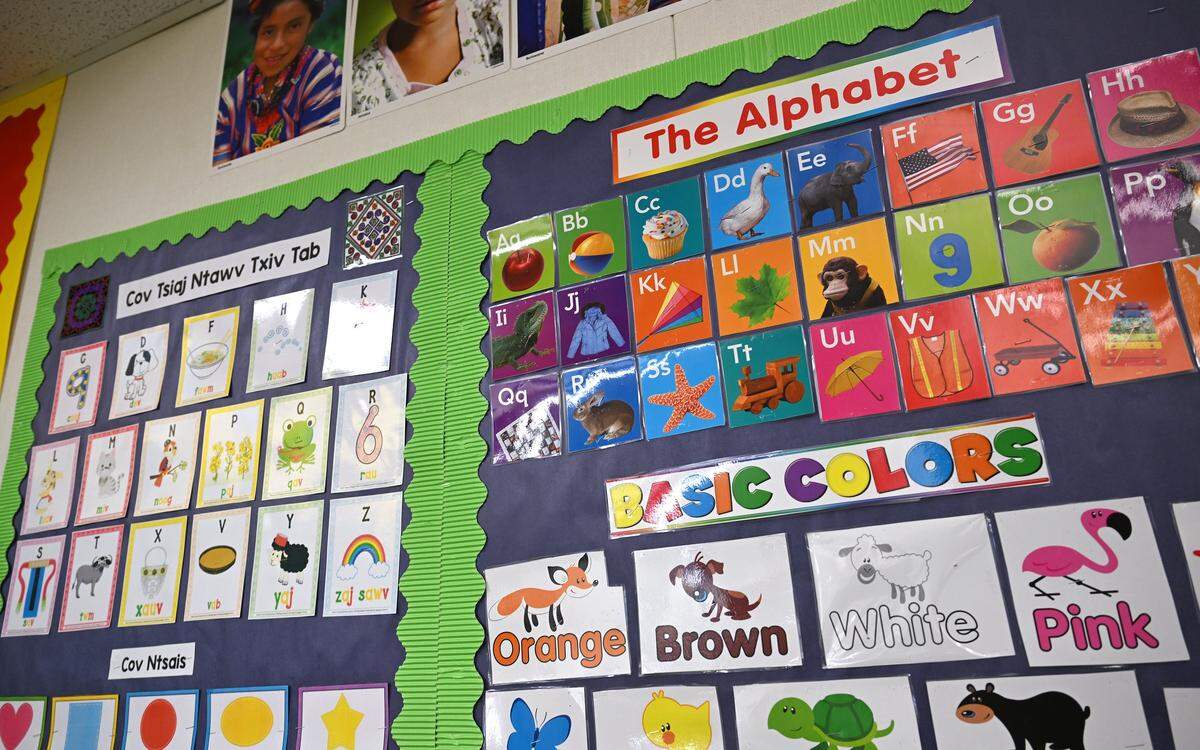
Kindergarteners begin learning the Hmong language with single and double consonants, then triple and quadruple consonants. Students are also gradually introduced to the eight different tone markers, which differentiate the meanings of words.
Students begin writing complete sentences in Hmong in first grade. Later grades showcase their Hmong linguistic skills through projects such as reports about Native American tribes and annotations of topographic relief maps of the Sierras that feature Hmong and English labels.
The program utilizes a 50:50 model, meaning that half of the instruction is delivered in Hmong, and half in English.
Vu said students initially receive science and social studies instruction in Hmong, while other subjects are delivered in English. As students progress through elementary school, they gradually receive Hmong-language instruction in topics outside of science and social studies.
Third grade students’ assignments of describing their family in Hmong, titled “Kuv tsev neeg,” proudly adorned classroom walls. In a fourth grade classroom, students’ “class jobs” are written in Hmong and English, and books in both languages are kept in a reading corner decorated with dolls in traditional Hmong garb and a small wicker table.
During instruction, parallels between the state-provided curriculum and Hmong culture are drawn, such as connecting the American Revolution to the Secret War in Laos or highlighting the clan system when discussing indigenous tribes.

Vu added that Hmong Americans who emigrated from Laos have two primary dialects: “white” and “green.” She said Fresno Unified’s materials are provided in both dialects, and while most teachers use the white dialect, some can speak and utilize both with students.
The district’s Hmong dual-language immersion program is open to all students, regardless of their background. Some students have become trilingual in English, Hmong and Spanish.
The program was initially launched at Vang Pao Elementary, and the district’s inaugural Hmong DLI cohort is now in eighth grade at Sequoia Middle School. When the class begins ninth grade at Roosevelt High School next year, Roosevelt will offer a pathway for them to continue their studies in both English and Hmong.
“Next year, students will continue the DLI program at Roosevelt High School, where similar to middle school, they will take two courses in Hmong and four classes in English,” Vu said.
Aside from the Hmong DLI program, Vu said the district offers Hmong Heritage Speaker courses at all of its high schools, which are open to all but were “designed for students of Hmong heritage who no longer speak or speak limited Hmong.”