
Fresno-area college students are doing better in English, math. Here’s what changed
About five years ago, Reedley College math instructor Jim Gilmore left a work conference in near disbelief.
He had just been shown data suggesting remedial education in community colleges was failing. Although he liked to think himself pragmatic and sensible — he is a mathematician after all — he didn’t want to believe the statistics were real.
“They didn’t seem to jive with what we’ve seen in the classroom,” he said. “We all have stories about a student who started at an arithmetic class, five or six levels below a transfer-level course, who made it all the way through the system.”
But the truth is, he said, it was very few students who made it to the top.
Remedial courses were created to help students who were deemed not ready for college-level math and English. A student who took a placement test at Fresno City College and scored poorly could be placed in college arithmetic and have to make their way up through elementary algebra, intermediate algebra, and statistics before they could transfer to a university. STEM majors needed more classes.
But as more faculty around the state started to see the information, many realized that remedial courses might be just another obstacle to student success and graduation.
“Every time you add another class that they have to take before they get to transfer, that’s another chance for them to disappear on us,” said Julie Kehoe, a math instructor at Reedley College. “The longer the journey that we create for them, the worse off they are than if they just started in that transfer-level class and toughed it out.”
So in 2017, Assembly Bill 705 was passed, allowing students to bypass remedial courses and enroll in transfer-level courses. New data shows that the law is making great strides in student success.
But there are still gaps in equity among Black and Latino students that must be closed, according to Katie Hern, an English professor at Skyline College in San Bruno and co-founder of the California Acceleration Project. And not every college is implementing AB 705 the same way. The Central Valley is one of the strongest implementers in the state, but even across the region, the number of students enrolled in remedial courses at each college still varies.
From Hern’s experience in the classroom, she said she’s learned “that students were a lot more capable of meeting more challenging course requirements than traditional remedial classes were giving them credit for.”
And even with the statistics, one of the most pervasive obstacles to implementing AB 705 is getting teachers and counselors to discard the long-held notion that remedial courses are what students need, according to Kehoe.
“AB 705 was a hard pill for people to swallow,” she said. “They didn’t like the state telling them to do this.”
Unburdened by remedial classes, Central Valley students excel
At Reedley College, only 22% of students were admitted into English 1A, the transfer-level course, in fall 2015. Only 12% passed that term, according to data from the Public Policy Institute of California. Math fared even worse.
In fall 2019, a year after AB 705 took effect, 100% of students were entering into English 1A, and of those, 50% were passing their first time.
And the achievement is not unique to Reedley.
Research into the second year of AB 705 by the California Acceleration Project has shown that completion rates in English and math have skyrocketed at colleges across the state since students have been allowed to enroll in higher-level courses.

More California students passed a transfer-level course in fall 2019 than did so in 2015, before the passage of AB 705. Students are now passing math and English in one term in greater numbers than they were in two or three terms in 2015, according to data from the Public Policy Institute of California.
Statewide, about 57,000 more students passed college composition with a “C” or better after AB 705, and 31,000 more passed transfer-level math, according to the PPIC report.
San Joaquin Valley colleges lead the way implementing AB 705
Reedley is now at 100% of students entering into transfer-level courses, whether they intend on transferring or not.
Porterville College and College of the Sequoias, in Visalia, are too.
Most community colleges in the Valley report 100% (or very close) of their students enrolled in transfer-level English. Math still lags behind.
That’s true at Fresno City College, the region’s largest community college, where only 87% of students enter math at transfer-level.
Because the college has a large population and a number of different programs that don’t require transfer-level math, the goal is not to get to 100%, according to Robert Pimentel, the vice president of Educational Services and Institutional Effectiveness.
“We serve a variety of populations that may feel like they are not ready for something like that right off the bat,” he said, “and we allow them to do that.”
Pimentel said any student has the right to take the higher-level course, but some chose not to. Others don’t have to.
Whether all students could benefit from taking the higher-level courses is still up for debate.
Darnell Harris, the interim director of Institutional Research, Evaluation and Planning at Reedley College, said there was a conversation at Reedley about whether to have all students go into transfer-level courses. It came down to “data that suggests that if given the option to self-select, students will place themselves lower.
“It’s our obligation to make sure that we give the students the best opportunity possible,” he said, “and allowing students to self-select in a lower course may not be the best option to go to further their education.”
He also acknowledged that it might be easier to offer all transfer-level courses at smaller colleges that offer fewer programs.
“Everyone thinks they’re bad at math,” Kehoe said. “They’re going to place themselves lower if you give them that option.”
For students who need extra help, the courses are taken alongside an extra class that offers support. Tutoring and student support services have also been expanded.
Gilmore said many students are only lacking specific skills, such as not understanding fractions. That can be taught in the co-requisite class.
Bypassing remedial classes helps California community college students
The variation in implementation means that a student’s success could vary depending on which college they attend. The Sacramento/Far North and South Central Coast lag behind other areas of the state, according to the California Acceleration Project. The Central Valley, Inland Empire, and Bay Area led the way in transfer-level student enrollment.
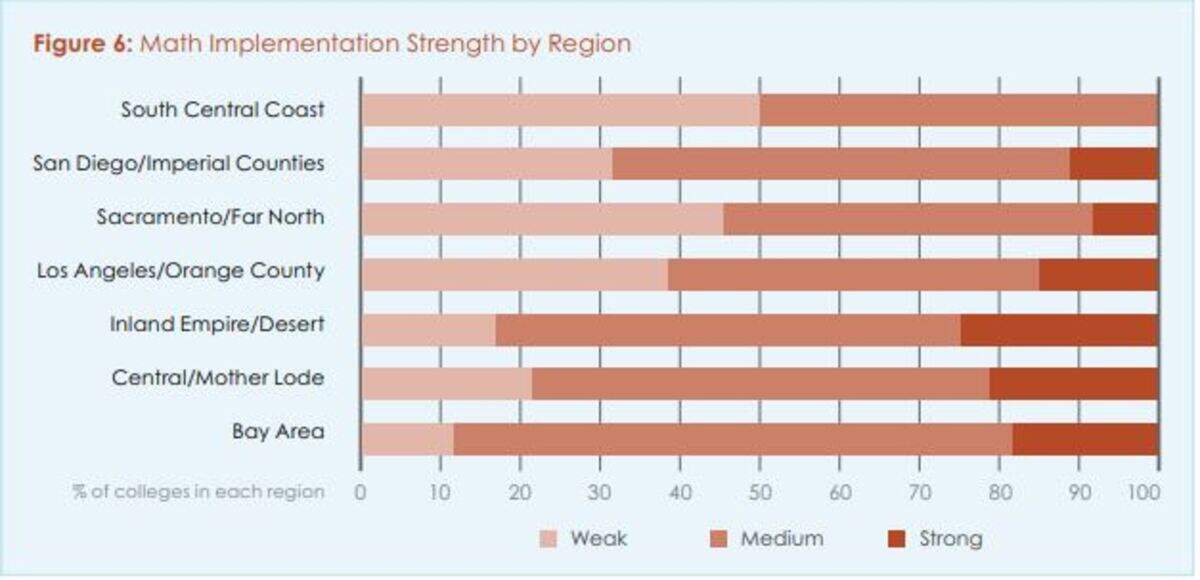
Researchers with the Public Policy Institute of California found that students continue to be steered into remedial courses, especially math, by recommendations from counselors and self-assessments. If a college’s placement policy is not publicly available, students don’t understand their rights, the research concluded.
AB 705 has been a hard sell for some, Gilmore said.
“I think that a majority of our department is in favor of what we’re doing now, but we’re still not all in agreement,” he said.
Harris said he, too, was a “non-believer in the data” at first.
“There are a lot of folks who put a lot of hard work into student success and making sure that we do everything possible to help students be successful,” he said. “How could we be this bad across the state? Everybody on the call said the same thing: ‘No, we can’t be that bad.’”
According to some teachers, the disbelief could be because instructors have spent years focused on remedial curriculum. Or because many have seen their success rates fall slightly after AB 705, driving the idea that it’s not working.
“I think I have seen a few more failures than I would have,” said Rebecca Snyder, an English instructor at Reedley College. “I spent most of my career in those basic skills (so) embracing this meant saying that 20 years I’d invested of my life was probably not the right thing to do. So that was hard.”
Even with the uptick in failures, more students are passing transfer-level math and English at Reedley than ever before, according to Harris.
In 2017-2018, about 2,500 students took English 1A, the transfer-level course. The next year, when AB 705 took effect, it was 3,400, Harris said.
The success rate dropped from about 57% to 54%, but an extra 900 students had access to the class, and 400 more passed.
That’s 400 more students who are closer to getting their degrees, Gilmore said.
Kehoe said the drop is because classes are no longer filled with the kind of students who have always had access: “the most accomplished students, who are good at standardized tests and know how to navigate college and have parents who are educated,” she said.
“Even though it makes us look a little bad as teachers because our success doesn’t look as good, we’re seeing a lot more students make it through.”
And that access is paving the way for better equity among Black and Latino students, who were more likely than white students to have been placed in lower-level courses, according to Hern.
“It was a driver of structural racism,” she said. “It’s sort of like making them start further and further away from the starting line of the race of college.”
Black and Latino students saw the greatest gains from AB 705, according to the California Acceleration Project, tripling completion in English, and quadrupling it in math, statewide.
Although the gap is closing, colleges still disproportionately enrolled Black and Latino students below transfer level, according to the CAP report. While 20% of white students were enrolled in remedial courses in 2019, 24% of Latino and 29% of Black students were.
“The one structural component that remains is that when colleges keep offering so many remedial courses, that the students who are more likely to end up in them are still Black and Latinx students,” she said.
Hern said now the burden is on the college to show a student should not enter a higher-level course. She has not heard of an instance where a college could prove that, she said.
Hern is optimistic that graduation rates in the next few years should reflect that, since students have fewer obstacles to transfer or graduate, more are completing college.
She says faculty, staff, and administrators who are hanging on to the concept of remedial courses are coming from a place of compassion, but it’s outdated thinking.
“You’re worried that they’re going to struggle at the higher level course, so you think that it is kind and compassionate to have them start in a remedial class that you believe is going to be less hard for them,” she said.
“But it’s misguided. It actually makes the student less likely to ever complete that transfer-level course.”
The Education Lab is a local journalism initiative that highlights education issues critical to the advancement of the San Joaquin Valley. It is funded by donors. Read more from The Bee’s Education Lab on our website.
This story was originally published January 26, 2021 at 5:00 AM.