
Thousands of Fresno students chronically absent as schools weigh return to classrooms
Thousands of Fresno students are chronically absent from school this year compared to last year, and the overwhelming majority of those students are Hispanic, poor, and in the sixth-grade and below.
The chronic absenteeism rate has jumped nearly 10% from the last school year, Fresno Unified School District data shows. So far, 22.8% of Fresno Unified students are considered chronically absent, which means students miss at least 10% of school days. During the 2019-20 school year, 13.8% of students were chronically absent.
The data was collected from the first 42 days of school from the current and prior school years, said Kristi Jackson, attendance coordinator for Fresno Unified. The students who are chronically absent have missed four or more days of school so far, she said.
“The reason we’re still seeing that is … not everyone had technology,” Jackson told The Bee. “They may have had a computer but no WiFi. Quite a few students who missed school are because of the absence of technology.”
During the first four weeks of school, the percentage of students attending virtual classes increased but so did the percentage of students with unexcused absences.
If those students don’t miss more days of school, they won’t be considered chronically absent as the school year progresses, Jackson added.
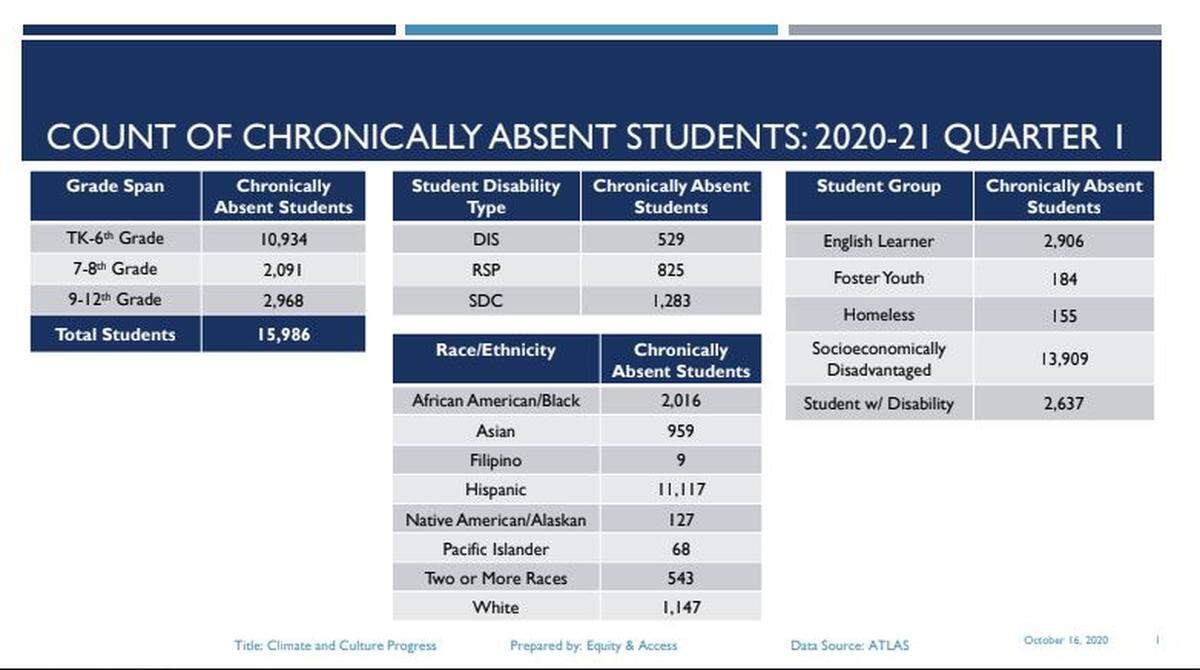
Almost 16,000 Fresno Unified students are considered chronically absent so far, according to data from the district, and 10,934 of those students are in the sixth grade and below.
There are 2,091 middle school students who have been chronically absent and 2,968 high schoolers, the data shows. As of Sept. 25, 7,410 students had at least one unexcused absence.
“There are some parents who just don’t want to do it,” Jackson said. “I’ll be honest, some parents have said, ‘We just want to drop our kids and come back when school comes back.’”
The law states that children can’t just be dropped from school, Jackson said, and Fresno Unified is working with those parents to find options that work for them, but many families aren’t communicating with the district. Communication is also a problem during typical school years, she said, but since the pandemic began, that issue has been heightened.
The majority of chronically absent students are Hispanic, about 11,000, or Black, about 2,000. However, Black students only make up 8% of Fresno Unified’s student population, while Hispanic students make up about 68% of the population.
Most chronically absent students are also socioeconomically disadvantaged, almost 14,000 out of the 15,986 students who have missed four or more days. Out of those students, 2,906 are English learners, and 2,637 have a disability.
What caused the spike in chronic absenteeism in Fresno schools?
One big reason chronic absenteeism spiked is the unique circumstances everyone is in — the coronavirus pandemic.
Some factors that have been heightened because of the pandemic are language barriers, poor WiFi connectivity, and many parents are essential workers.
“Many parents out of the 75,000 (students) are not involved or not able to be involved,” Fresno Unified Trustee Terry Slatic said. “Kids are sitting at home by themselves sometimes, and kids are just not into it for whatever reason, and nobody is there to make the kids (learn).”
There are also language barriers, and it’s difficult for parents to navigate new apps and programs if they don’t know English, Jackson said. Fresno Unified’s Parent University has been holding technology support modules in other languages like Spanish and Hmong to help parents.
“Parents have to be willing to support their kids,” Jackson said. “They can’t just drop them off and have us do that work.”
Students that are homeless aren’t always in the same place, so it’s hard to locate them, Jackson added, and sometimes those students don’t always have electricity or WiFi. Homeless and foster youth were among the student populations most likely to be chronically absent, Fresno Unified data indicated.
If students have poor internet connectivity, they could be missing class because they couldn’t log in, Fresno Unified Trustee Elizabeth Jonasson Rosas said, not because they don’t want to be at school.
The number of Fresno Unified students who missed class because they weren’t able to connect to technology went from 6.9% in the first week of school to 1.5% in the fourth week of school.
“From personal experience, internet connectivity can sometimes be an issue,” she told The Bee in a phone interview on Wednesday. “Earlier today, I was dealing with not having enough bandwidth. I had to contact the internet provider, and it’s the same issues families are facing, especially if they have two to three kids.”
There are also some students the district hasn’t been able to locate and might have switched to another school district who are still being marked absent, Jackson said. There were 636 students who were disenrolled from Fresno Unified in late August, district data found, and officials have located about half of those students.
About half of the disenrolled students who have been located have moved to other local districts, and 22% have enrolled in a charter school. 5% are now at private schools, and 12% are enrolled in other school districts in California. 12% were re-enrolled into Fresno Unified.
Jonasson Rosas said she expected more students to enroll in charter schools, in part because some charters have had programs completely online and “that might have elicited more confidence.”
Charter schools are also smaller and have specialized programs, Jonasson Rosas said.
“I fully expect us, once there is a vaccine, and, once go back to school in person, we’ll regain a lot of those students,” she told The Bee.
Fresno Unified officials are still weighing how and when to return students to campuses.
Schools in Clovis began bringing small student cohorts to campus on Wednesday and said more students would be phased in slowly in the coming weeks with a near full return expected in mid-January.
Fresno’s Central Unified schools won’t begin returning students to classrooms until after the New Year.
Are there any solutions?
Well before the global pandemic Fresno Unified has had chronic absenteeism rates that, at one point, nearly doubled the state average. To be considered chronically absent, a student had to miss more than 10% of the school year.
During the 2016-17 school year, 17.8% of Fresno Unified students were chronically absent, according to data from the California Department of Education. That same school year, 10.8% of students in the state were chronically absent.
Fresno Unified’s chronic absenteeism rate dropped slightly in the 2017-18 and 2018-19 school years to 17.1%. However, the state-wide percentages continue to climb. In the 2017-18 school year, 11.1% of California public school students were chronically absent and 12.1% of students in the 2018-19 school year.
Fresno Unified staffers have established a protocol for attendance. The first two days a student is gone, the district calls the parents each day, Jackson said, and the third day a student is absent, they get a home visit.
“It’s a protocol for intervention so that we can make sure we’re not letting any kids slip through the cracks,” Jackson said. “There were a lot of kids who needed devices at the beginning of the year. That’s why we have a lot of kids missing the first week, and it put them in chronic absenteeism.”
At its peak, Fresno Unified employees were making 800 to 1,000 home visits every week, Jackson said. The number of home visits has since tapered off.
Jackson said some parents don’t answer the phone or door, and the district loses communication with families. Parents need to update their addresses and contact information in the Atlas portal, the program Fresno Unified uses.
Slatic said all students should be required to turn their cameras on during video lessons so the district can ensure students are present and safe.
Fresno Unified teachers have said although attendance numbers have been increasing, they can’t count on that because most of their students keep their cameras off. It’s difficult to know if students are on the other end of the screen.
The Education Lab is a local journalism initiative that highlights education issues critical to the advancement of the San Joaquin Valley. It is funded by donors. Read more from The Bee’s Education Lab on our website.