
Most students in Fresno’s Central schools won’t return to campus before the New Year
Fresno students in the Central Unified School District won’t be returning to campuses until after the New Year, despite the county receiving a green light for all grades to reopen schools this week.
Schools are allowed to reopen — under strict coronavirus-safety precautions — because Fresno County remained in the red Tier 2 under California’s color-coded Blueprint for a Safer Economy. Small cohorts of students with special needs returned to campuses on Tuesday.
During Tuesday’s night’s regular school board meeting, the Central Unified trustees unanimously approved a school reopening plan with elementary students returning to campuses Jan. 11, after winter break. Middle and high school students would continue distance learning “with the possibility of returning in the spring,” the plan said.
“Could we open tomorrow? Yes, we could,” Trustee Terry Cox said during the meeting. “But should we open? I don’t think we should.”
She said staffers need to feel comfortable and safe returning to campuses to provide students with quality education. Children are also not immune to COVID-19 and can carry the virus into their homes.
“We can’t predict what the next few months are going to bring,” Cox said. “So I think coming into the season we still have no immunization. I think this is not a time to change what we’re doing. Instead, we need to focus on being successful at our online education.”
The board will evaluate the reopening plan in December.
Having students return in January would minimize disruption in the current grading period and minimize exposure from the upcoming flu season, Assistant Superintendent Ketti Davis said during the board meeting.
Although Trustee Phillip Cervantes noted flu season in Fresno County lasts from January to March.
“I share a lot of the same views as people who are very, very conservative about opening schools and the risk factors,” he said during the meeting. “I’ve lost two family members to COVID, and it impacts a family greatly.”
Cervantes said he wants students to return to campuses but “at what price is that going to bring? At what detriment is that going to bring?”
Elementary school students who choose to return to school in January won’t be going back full time. A schedule has not been finalized, but groups of students could be on campus two days a week for four hours and learn at home in the afternoons.
There were four options Central Unified trustees considered. One of the plans had all grades returning to campuses, but “we don’t believe this is a good idea, and we believe we face significant challenges when it comes to our secondary students’ return,” Davis said.
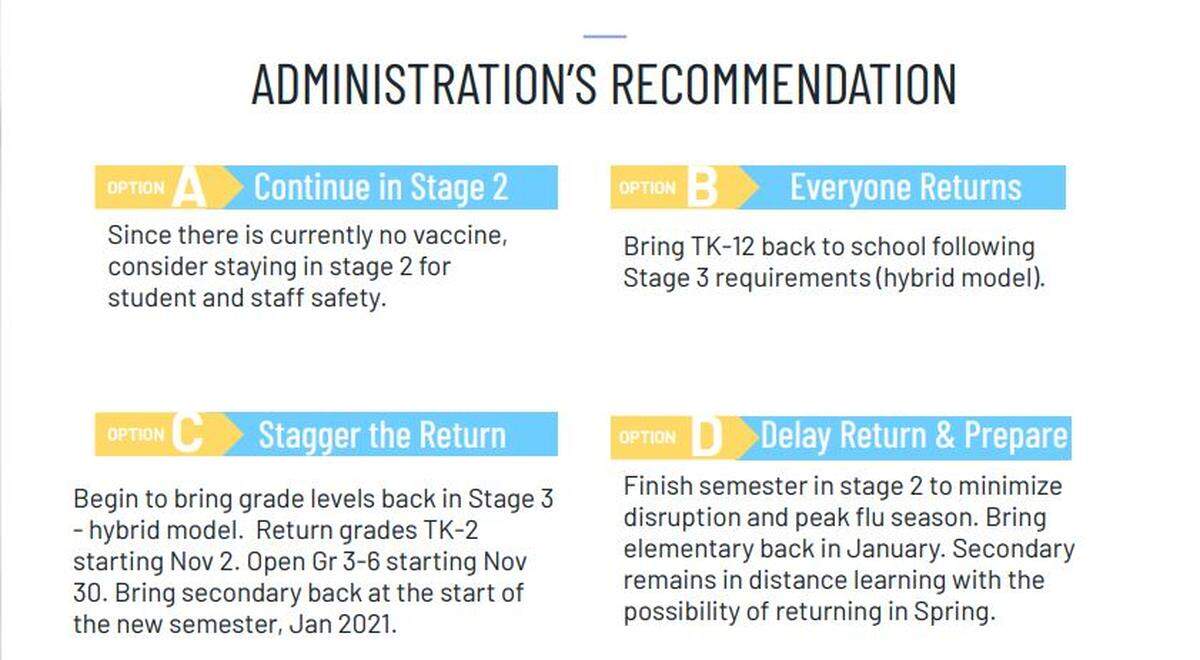
The district also plans to apply for a waiver that, if approved, would allow sixth grade students and younger to return to schools even if Fresno County backslides into the state’s most restrictive purple Tier 1. Dozens of elementary schools in the San Joaquin Valley have already been approved for waivers.
What happens if somebody tests positive for COVID-19?
If two or more people in one classroom test positive for the coronavirus within a 14-day period, that class would have to return to distance learning full-time, Central Unified officials said.
If three or more people are infected at a school site or the district office in a 14-day period, the school or office will also have to close until the infection has passed.
School officials said they would work with the Fresno County Health Department to determine when students and staff could safely return following an outbreak.
Letters will be sent out to staffers and families if someone does test positive.
Central Unified officials said opening and reopening schools could be disruptive to learning, and the process requires careful management.
Each school site will have a nurse or licensed vocational nurse to conduct contact tracing when an infection occurs, officials said.
Any student discovered suffering COVID-19 symptoms would be placed in an isolation room until a family member can pick them up. Employees with symptoms would be sent home.
Each month, 10% of the staff who have contact with students will be tested for COVID-19, a guideline set by the county and state health department. Staff will be chosen randomly.
Do teachers want to return to campuses?
During Tuesday’s meeting, district officials said a recent survey showed “most” staff members felt comfortable returning to campus, but teachers at the meeting said the district misrepresented the survey’s results.
About 1,200 employees responded to the district survey, and 31% of staffers said they were not comfortable returning. About 26% said they were comfortable returning but had concerns, and 24% were “somewhat comfortable” returning.
Only 19% of district employees said they had no concerns returning to school, according to Central Unified’s survey results.
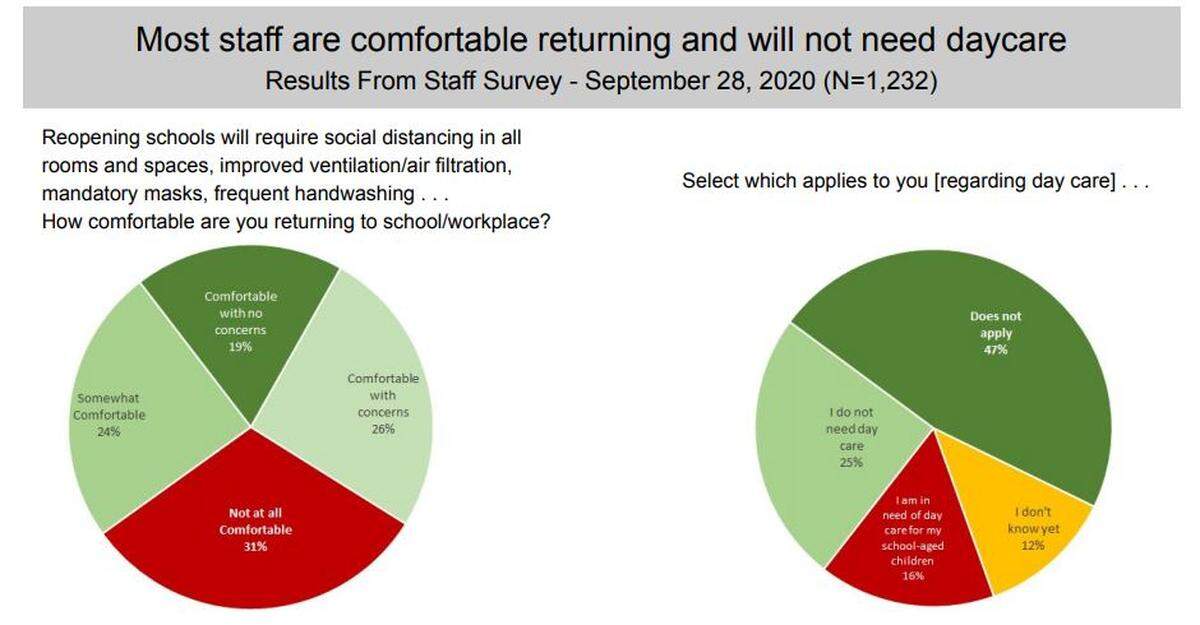
“To say that most staff are comfortable returning would certainly not be the case,” Central Unified Teachers Association President Judee Martinez said during the board meeting.
The teachers union put out their own survey, Martinez said, and out of the 571 respondents 72% said they do not feel safe returning to school under the district’s reopening plans.
The district plans to send out a parent survey by early next week, officials said.
What will school look like in January?
When students return to campuses, there will be air purifiers in classrooms, the health office, and the front office. No-touch thermometers and health screeners will be at school entrances.
Students and teachers will wear masks and remain six-feet apart. District officials said there would be “structured movement patterns” on each campus to reduce close contact.
Teachers will have glass screens for their desks. Face shields, gloves, gowns, and N-95 masks will also be provided.
Handwashing stations and portable hand sanitizing stations will be set up at each campus as needed.
For students who take the bus, masks will also be required, windows will stay open, and hand sanitizer will be provided. There will be two students per bus seat, and siblings will sit together.
Students getting on and off school buses will be staggered to maintain social distancing.
For elementary students, breakfast will be served in their classrooms, and small groups of students will be able to eat lunch outside or in the cafeteria at staggered times.
The Education Lab is a local journalism initiative that highlights education issues critical to the advancement of the San Joaquin Valley. It is funded by donors. Read more from The Bee’s Education Lab on our website.