
Solving crimes, acing tests, building bridges. What this Fresno school program does right
The Education Lab is a local journalism initiative that highlights education issues critical to the advancement of the San Joaquin Valley. It is funded by donors. Learn about The Bee’s Education Lab here.
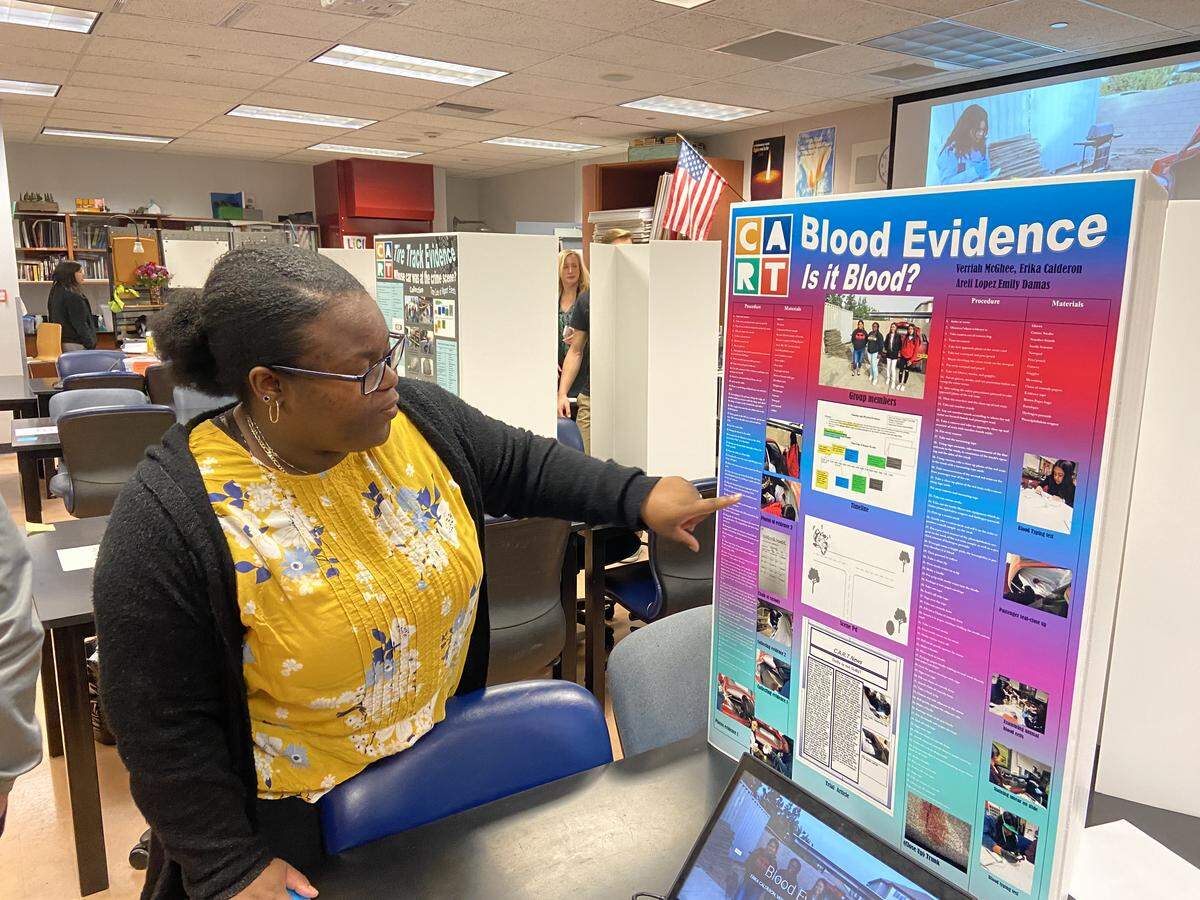
Verriah McGhee is a high school student who solves murders during class.
They’re not real murders, but she gets school credit for solving them - and she said the “cases” really helped her excel in English and science classes.
The 17-year-old from southwest Fresno spends half of her school day learning about forensic science in The Center for Advanced Research and Technology program in Clovis. Fresno Unified and Clovis Unified School District joined forces 20 years ago to implement the career technical education program, also known as CART.
McGhee said she knew CART could open up interesting opportunities, but she said she almost didn’t apply because she wasn’t sure she wanted to mix with students from Clovis.
“Before I met anyone at Clovis Unified, I felt like they kind of looked down upon us,” said McGhee, who attends Edison High School in Fresno. “But then getting to know them, I know that’s not true. That’s just the stereotype that people have.”
CART wasn’t created to bridge the divide between two vastly different school districts - or significantly boost test scores - but since its opening in 2000, that’s what happened, officials said.
CART students score higher on tests
The career technical education program teaches English and science to juniors and seniors from Fresno and Clovis with an eye toward helping students find a future career.
There are 13 labs available ranging from biotechnology, business and marketing, to law, psychology and multimedia. Students spend half the day at CART’s campus in Clovis and the other half at their home schools.
Data shows students from both districts who enrolled in CART consistently do better on a college readiness exam than their peers. Within the last five years, a greater percentage of eleventh-grade CART students met or exceeded standards on the Smarter Balanced Assessment Consortium test than eleventh-graders at their home districts.
About 77% of Fresno Unified CART students met or exceeded the SBAC English Language Arts standards last school year, versus 45% of students at Fresno Unified.
Fresno CART test scores are a bright spot in a district that has struggled to meet state testing standards.
But even in Clovis, where students typically perform above state standards, CART students also outperform their peers on average.
About 88% of Clovis Unified CART students met or exceeded SBAC English standards versus 82% of Clovis students outside of CART.
Although these scores are impressive, it’s one of the only data sets that measure CART student success. CART only has the SBAC English results because that’s a subject taught in the program. Students take the math portion of the test at their home schools because CART doesn’t teach math.
Other ways to gauge success
CART doesn’t keep track of how many of its students end up going to college or other types of career training programs after graduation, but one study done by the Irvine Foundation found CART increased college enrollment.
The study, done in 2011, compared community college and university enrollments between CART students and “matched comparison students.” Data shows CART students had a higher community college enrollment between 2002 and 2008. CART students also surpassed non-CART students in university enrollments, the report said.
The classroom environment at CART helps keep students engaged, making it easier for students to excel, said Laurie Hayes, a teacher in the biomedicine lab who’s taught at the program since it opened.
“It’s very, very hands-on and students work on project teams,” Hayes said. “I think that’s what makes it so fun.”
Erin Andrade, a science teacher in the forensic science lab, said student discipline isn’t an issue in the program, at least in part because students are enthusiastic about their schoolwork.
“These kids see how science and English matters in the real world,” Andrade said. Students learn these subjects by looking at police reports, profiling psychopaths or con artists, and analyzing DNA or blood splatters at mock crime scenes.
“These are the kids that are watching ‘Dexter’,” Andrade said. “They want to learn this stuff.”
A bridge between communities?
What sets CART apart from any other career technical program in the state is it’s run by two districts in cities that are “extremely” different, said Rick Watson, CART’s CEO. That’s part of the reason why navigating CART has also been challenging, he said.
“Clovis is a kind of white flight bedrock community of Fresno and more socioeconomically well off,” Watson said. Fresno has a higher low-income population and more diversity.
Clovis is almost 70% white with a median household income of nearly $72,000, according to the U.S Census Bureau. Fresno’s median household income is about $47,000 and almost 50% of the population is Hispanic.
“There’s been kind of a divide that has been developed between Clovis and Fresno on a lot of different fronts,” Watson said. “School districts are not immune to that.”
While there’s no data measuring the program as a social experiment, teachers and students interviewed by The Bee all said there’s plenty of anecdotal evidence of CART bringing together students from different backgrounds.
Sloane Bayer, a 17-year-old Clovis Unified student, said she was aware of the stereotypes between both districts before she started at CART. Bayer said she feels like she exists in a kind of social bubble at Clovis North High School. She said that feeling doesn’t exist at CART.
“Here I can pop a million bubbles and all of us are like big hugs and just like one happy family in our class,” she said. “It’s a totally different vibe, just because it works like that.”
Meeting new young people with common interests is another way CART officials say helps bring students together.
“It’s an inspiring experience for kids to get to know people who are not like them,” said Jeremy Ward, the executive officer for college and career readiness at Fresno Unified. “There’s something really great about that, it removes barriers.”
Would this work in other schools?
Other school districts from across the nation have looked to replicate CART.
One of the major challenges implementing programs like CART comes down to money. At least part of the reason Fresno and Clovis joined forces on the project was to split the bill for the pricey program. And funding the program gets more expensive each year. Costs have nearly doubled over the last five school years from about $2,659,697 in 2015-16 to about $4,591,098 today.
But other districts are figuring out models that work for them.
School officials from Santa Monica, San Francisco, Washington and South Carolina have all come to check out the program, Hayes said.
Most recently, Madera Unified School District built a program modeled after CART, Madera Technical Exploration Center, but for middle schoolers.
Madera Unified is the only district in the state to create such a program at the middle school level, said Alyson Rocco, the principal of Madera Technical Exploration Center.
The program is offered to eighth-graders and has six labs: agriculture, entrepreneurship and marketing, health science, manufacturing and engineering, media and performing arts and public safety.
Starting career-driven learning at the middle school level can get kids thinking about what careers they are interested in at a younger age, Rocco said. The hope is students will find a lab they want to pursue through high school.
This story was originally published February 13, 2020 at 9:52 AM.