‘We didn’t do it!’ Squaw Valley residents vent anger at moves to change town’s name
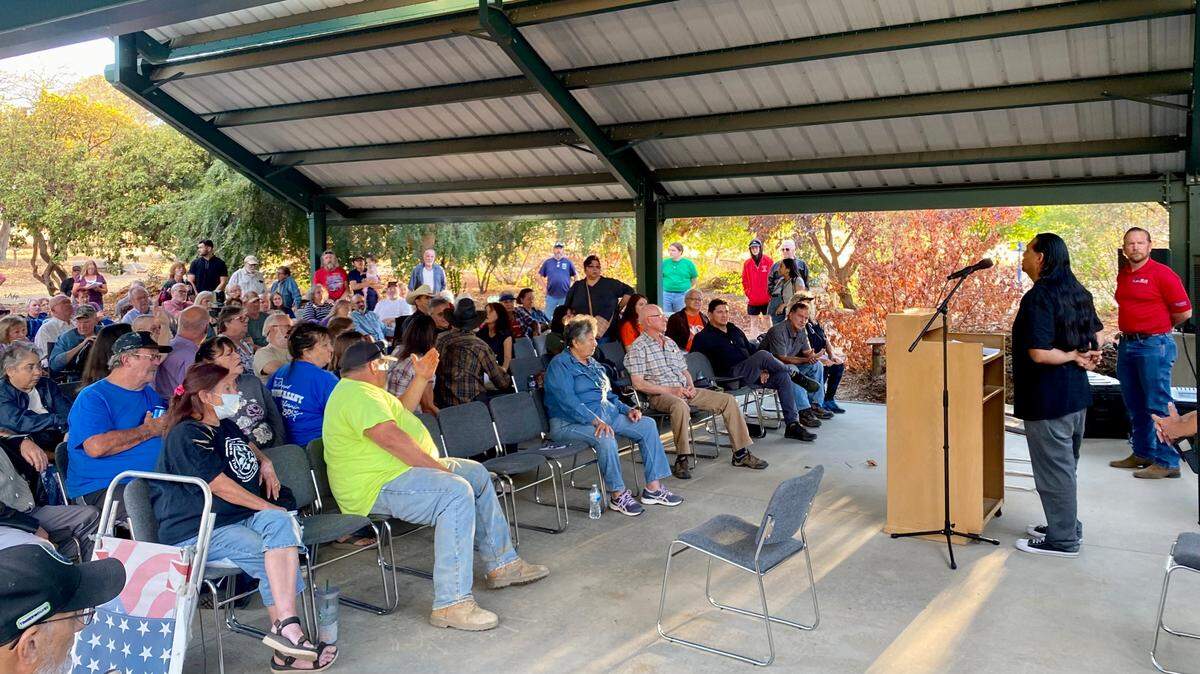
Anger defined the first public meeting in Squaw Valley about federal, state and local forces working to change the name of the rural Fresno County town.
It was hosted by Fresno County Supervisor Nathan Magsig just days prior to what many speculate will be Gov. Gavin Newsom signing AB 2022, a state law passed last month that would remove “squaw” from names across the state.
THE LATEST: Governor takes action
The word is now widely considered a sexist slur, but not to most who spoke during Tuesday night’s meeting outside Bear Mountain Library, including some who identified as Native American.
The state law – and a federal review underway – follow a two-year campaign to change the town’s name, led by a local Native American man, Roman Rain Tree. Magsig previously insisted that if there was to be a meeting, it should be led by Rain Tree in Squaw Valley. Rain Tree saw it as Magsig’s responsibility – especially as interest in a change increased, including via a change.org petition with more than 36,500 signatures. Still, Rain Tree tried to host meetings about the issue at an activity center connected to the town’s library, but said his requests to use the facility were denied.
For many living in Squaw Valley, the outcome of this saga is anger and confusion. Much of it was directed at Rain Tree during Tuesday’s heated meeting, attended by at least a couple hundred people.
Magsig spoke briefly during the meeting, giving almost all of the allotted hour and a half to attendees for questions and comments. Most were against a name change. Their reasons included concerns about erasing history and language; feelings that the town wasn’t named in a racist or sexist way; defensiveness – that residents weren’t involved in atrocities of the past; frustration that they had not been contacted to share their input; concerns about the cost of changing personal documents if a name change happens, and worries that a name change could interrupt services they receive.
AB 2022 states California would cover costs associated with a name change, but Magsig said he doesn’t know if that will include related costs incurred by residents. The bill requires the word be removed by Jan. 1, 2025. Magsig recently asked Newsom to veto it, citing a lack of local involvement – despite Assemblymember Joaquin Arambula, D-Fresno, coauthoring the bill, and Assemblymember Jim Patterson, R-Fresno, being among those from the region who unanimously passed it in the state Assembly.
Those who spoke in favor of a name change at the Squaw Valley meeting this week were consistently interrupted and yelled at, despite Magsig asking the crowd to give everyone a chance to be heard. Those who spoke in favor of keeping the name Squaw Valley were met with cheers and booming applause. Laughter also punctuated the meeting, including after one man asked if he’d have to someday change the name of his hoe farming tool and backhoe tractor. At least half a dozen Fresno County Sheriff’s Office deputies were present to keep peace.
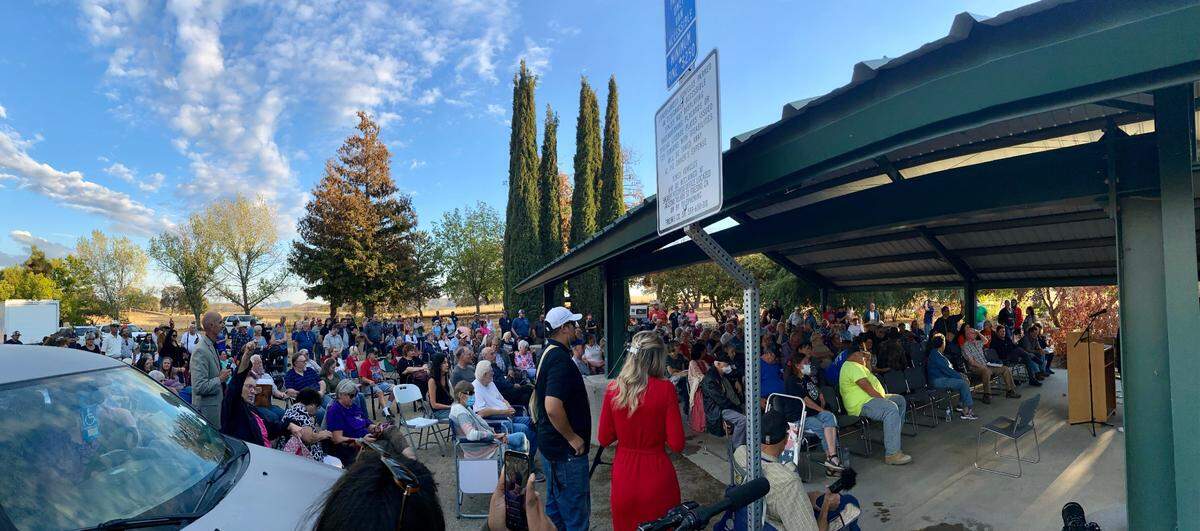
Rain Tree said the meeting was hurriedly organized without his involvement, although he has been working to change the name for the past two years through his campaign, Rename Sq**w Valley Fresno County.
He was shocked to see a Native American woman – who is not involved in the renaming campaign, doesn’t serve as a member of tribal government, and is OK with the name Squaw Valley – be interviewed by Magsig instead of him on Friday during a Facebook Live where Magsig announced the Tuesday meeting.
It was ironic, since the woman, like Rain Tree, also lives in Fresno but grew up in the Squaw Valley area. Magsig has repeatedly said any name change proposal needs to come from local residents, and has often portrayed Rain Tree as an outsider.
Rain Tree has not been featured during one of Magsig’s regular Facebook Live updates, despite him going to Fresno County Board of Supervisors’ meetings several times to ask supervisors to put the issue on one of the board’s agendas.
Native American voices and Squaw Valley history
There are mixed feelings among American Indians about the word “squaw.”
“It runs the gamut about what people think about the name,” Magsig said of his conversations with Native Americans, “but I will tell you, by and large, communications I’ve had with most of the tribes here locally, what they say is regardless of how we feel, the residents should decide for themselves what their name is to be.”
“To my people, to my ancestors, it’s meant woman, that’s all it’s ever meant,” RoseAnn Dominguez, who identified as a member of many local tribes, said of the word “squaw,” met with thunderous applause.
The word is not indigenous to Western tribes but was spread throughout the U.S. Some have described its usage as akin to the extremely disparaging C-word, a slur for a woman’s genitalia.
“I’m not taking away the fact that some people may find that word offensive,” Dominguez added. “I don’t, and I think my family’s history should have a stake in my family’s home.”
Like many in the audience, Dominguez expressed frustration that Rain Tree didn’t ask for her input.
Rain Tree said he’s talked with a number of native people and leaders, including those of the Dunlap Band of Mono Indians, Wukchumni, Wuksachi and Choinumni tribes, which he identifies as a member of, or related to. He said some expressed support as individuals, including the vice chairperson and a tribal council member of the Dunlap Band.
Magsig said while he’s unsure which tribe is the most connected to Squaw Valley, his research has pointed him to the Wuksachi tribe.
Ken Woodrow, recognized by many agencies as chairman of the Wuksachi tribe, was yelled at during the meeting when he started to share the history of California’s genocide against American Indians. He said Squaw Valley was filled with indigenous women when it got its name because native men were murdered for state bounties.
“In 1855, the governor of California put bounties on our heads,” Woodrow started, followed by someone who shouted, “That has nothing to do with it!”
“This is our history,” Woodrow continued. “This is the true history. ... What happened to the men? The men were chased down and they were decapitated.”
His words were met with a large outcry of groans, people saying “no,” and comments interrupting him, including one woman who shouted, “We didn’t do it!”
Dominguez said she doesn’t recognize Woodrow as chairman, adding that the tribe doesn’t have a leader, and the last time it did, it was her, when the tribe was petitioning for federal recognition. Most tribes in the Squaw Valley area are not federally recognized, making their leadership and organization less clear. The California Native American Heritage Commission maintains a list of tribes in the state that lists Woodrow as chairman of the Wuksachi tribe.
Another speaker, Lesley Hooper, offered a sunnier version of the area’s history, saying the place was called Squaw Valley because the native men were off hunting. She referenced Helen Clingan, as did some others, for providing the information. Clingan and her husband, Forest, owned a local store and published a local history book titled, “Oak to Pine to Timberline.”
It references something similar to Hooper’s account, that the native men could have moved to higher elevations to hunt during the hot months. The book also shows at least some American Indian residents were offended by the word decades ago.
“Incidentally,” the Clingans wrote, “the word ‘squaw’ originates in the East from the Algonquin word for woman, of whatever tribe. It was never used by western Indians, and many of the Indian women feel that it is insulting.“
The book was written in 1985, their daughter, Susan Loucks, told The Bee for an in-depth story about the renaming campaign early last year. It states the “most credible” of Squaw Valley’s origin stories is that the valley was named after a depression in a rock resembling the imprint of a woman’s moccasin, “and since it is pointing into the valley, it designates the entire valley as woman’s land, giving Squaw Valley its name.”
It states the least credible tale is that the men were “killed off in battle,” since “the Squaw Valley Yokuts were a peaceable people who spent little if any time at war.”
The Yokuts is a regional term that encompasses many traditional tribes.
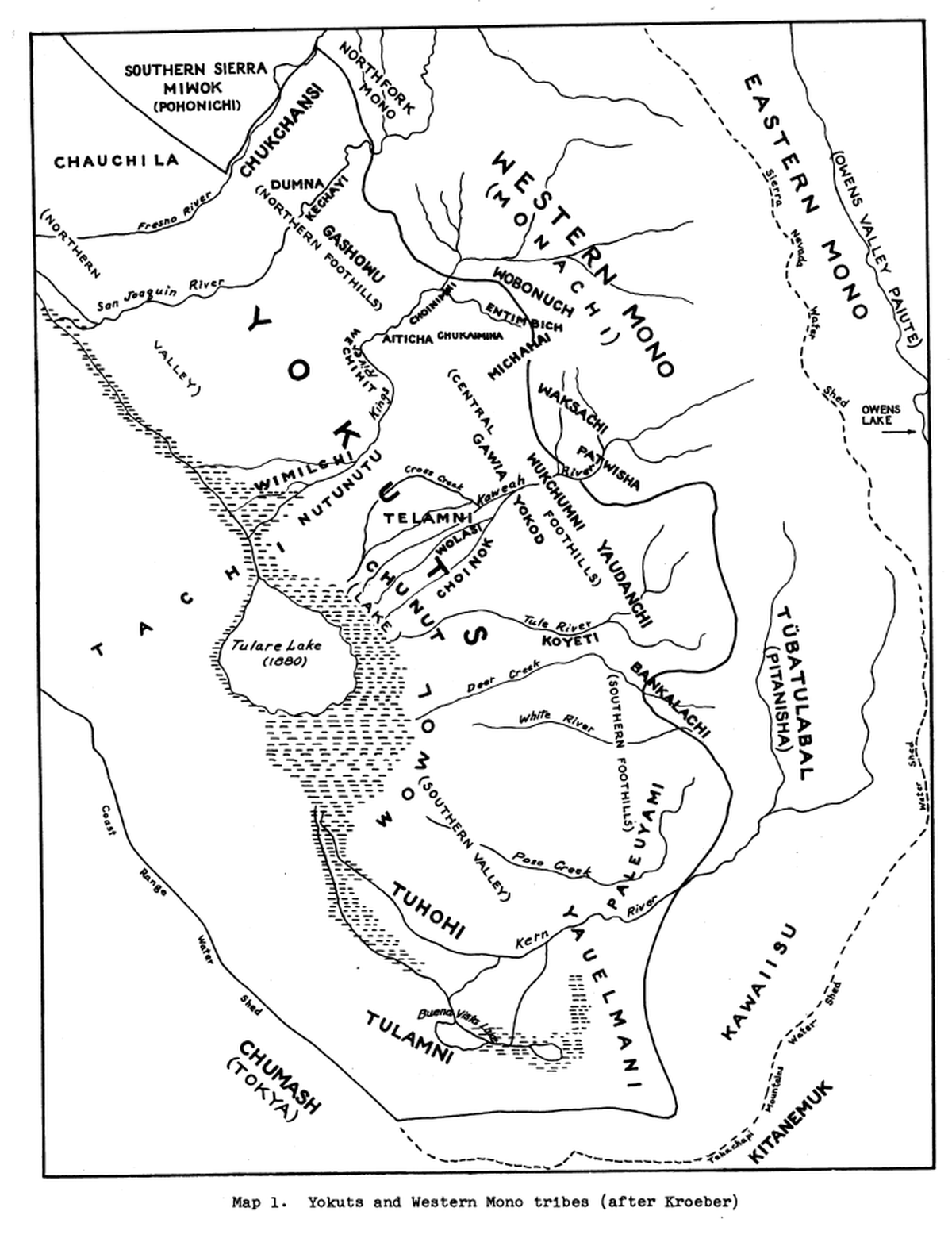
The Fresno County Historical Society told The Bee last year that the first recorded non-native people came to the place in 1869.
One speaker at this week’s meeting, who said she is related through marriage to one of the town’s founding families, said there were “true injustices” that happened in other communities, but “not here.”
Those settlers arrived during a prime time for injustices against Native Americans in California, however, recounted in “An American Genocide: The United States and the California Indian Catastrophe, 1846-1873,” written by an associate professor of history at UCLA. In 1852, state legislators dismissed 18 treaties with at least 119 California tribes and placed them in a secret file.
The town’s post office was established in 1879. According to “History of California Post Offices,” it was named because “the predominate inhabitants of the valley were Indian women.”
Rain Tree recently told The Bee the town was named “during a time when America didn’t care if anyone was offended by the s-word. But times have changed for the better and so has America.”
Elizabeth Hutchins-Kipp, tribal chairperson of Big Sandy Rancheria in Auberry, one of three federally recognized tribes in Fresno County, told The Bee that her tribe is standing firmly in their neutral position about the renaming issue, what she said should be decided by the community of Squaw Valley.
“I know some individuals that live in the area, and they are fine with the name of Squaw Valley, and do not want it changed,” Hutchins-Kipp added, “and they have lived in that area for years.”
She said her tribe was also not involved in the recently named San Joaquin Butte, which replaces Squaw Leap, the name of a cliff in her area. The new name was announced earlier this month by the Interior Department, along with the removal of “squaw” from nearly 650 other place names across the U.S.
What’s next for the Fresno County town?
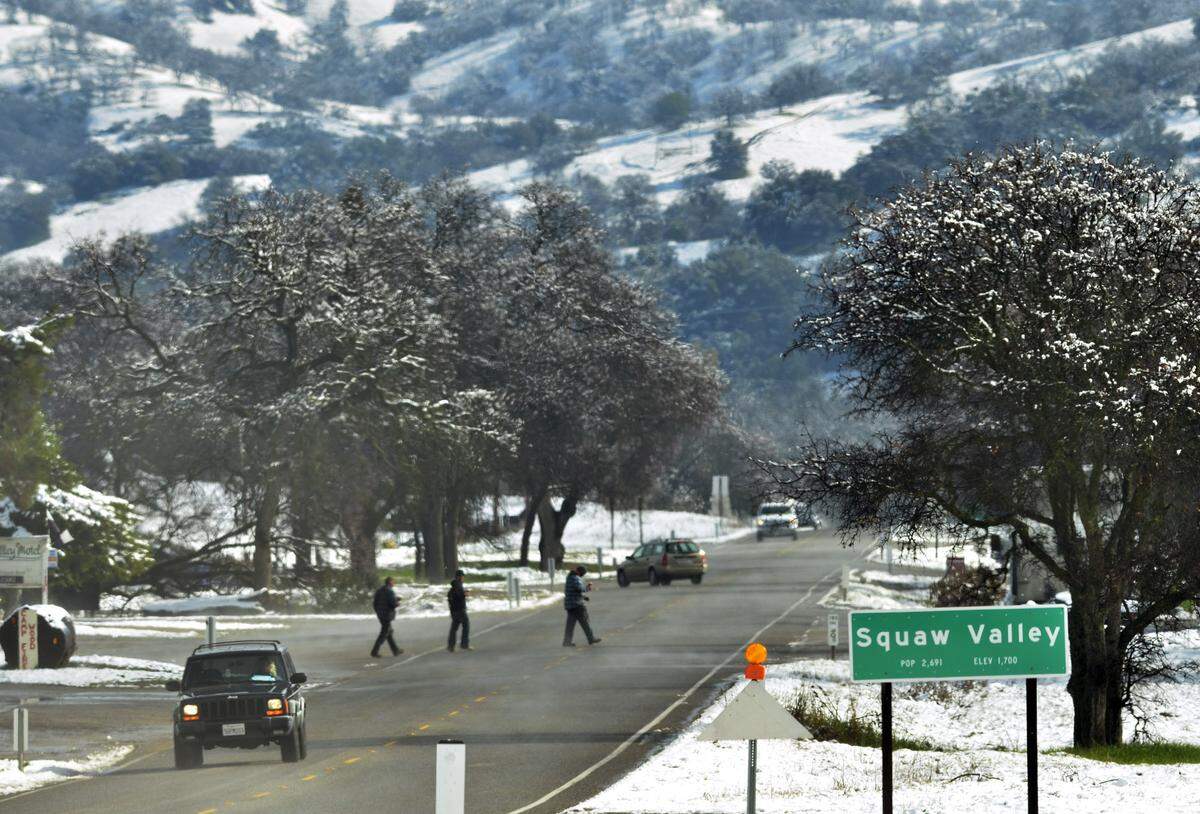
The Interior Department didn’t rename the town of Squaw Valley, along with six other locations it considers unincorporated populated places, because there are “unique concerns” regarding those places’ renaming, which remain under review.
The Interior Department and its U.S. Board on Geographic Names have declined to share what the unique concerns are, how it’s conducting its review of those seven places, and if there is a way for the general public to comment, beyond its normal name change application process. There was a public comment period earlier this year about efforts to rename “squaw” place names, led by a task force created by the Interior Department.
Four Fresno County places were renamed this month in the Sierra foothills and mountains above the central San Joaquin Valley, including the physical basin of Squaw Valley, which is now Yokuts Basin. Yokuts Valley is Rain Tree’s preferred new name for the Fresno County town. He sent a name change proposal to the Board on Geographic Names in January.
Magsig told The Bee that the Fresno County Board of Supervisors recently received a letter from the U.S. Geological Survey, which is connected to the Board on Geographic Names, “stating that many place names in Fresno County were changed” and asking the Board of Supervisors “to share what names the community may want for Squaw Valley.”
Almost no time was spent during the Squaw Valley meeting talking about what could be the town’s new name, which seems likely to change by either state or federal law.
“The name cannot be kept, the law (AB 2022) has already been passed, and what we really need to be talking about is what would be an appropriate name for our community,” Linda Tubach said. Other speakers defiantly proclaimed that the new town name should be Squaw Valley.
Newsom has until the end of the month to sign the legislation. He’s signed bills related to native people in the past on California Native American Day, which is this Friday. But without the governor’s signature it would still become law, unless there was a veto.
“Are we able to keep the name Squaw Valley at all? I don’t know,” Magsig said at the start of this week’s meeting, “but again, it’s important for the residents of this community to communicate clearly about what their desire is, and I’m going to communicate that to the governor’s office, I’m going to communicate that to the president of the United States, as well as the Department of the Interior.”
Magsig’s office is planning to mail a questionnaire to each Squaw Valley household this week, asking them to weigh in about the name change proposals, and giving residents a chance to suggest new names for the town. In response to a question, Magsig said additional people within the same Squaw Valley home who want to offer more comments can email him at district5@fresnocountyca.gov.
Magsig hopes to get the mailers back by Oct. 7 and present findings at the Oct. 11 Board of Supervisors meeting.
Rain Tree’s outreach included hosting an online forum with the American Civil Liberties Union in June 2021. Tedde Simon, an indigenous justice advocate for ACLU of Northern California, was among many who tuned into this week’s Squaw Valley meeting virtually via livestreams posted on Rename Sq**w Valley Fresno County’s Facebook page.
“It’s not about Roman, it’s not about one person,” Simon said of the name change proposals, “it’s about an entire people who are made invisible because of settler colonialism, because of attempted genocide. ... The place had a name before settlers arrived there, and that place has its own life and dignity and identity that it could be returned to, and that the whole community could then participate in and be a part of, and then some.”
Simon said it was disappointing to see Magsig “really do absolutely nothing to try and provide information about what is going on.”
Far from the educational meeting Rain Tree first envisioned, Rain Tree spent much of his speaking time on Tuesday waiting for people to stop yelling at him. He didn’t get to talk about his personal connection to Squaw Valley, his motivation, or the reason “squaw” is offensive to him and his family. Many attendees appeared unaware of some of the basics of the local renaming campaign. Rain Tree and Magsig largely blame each other for that.
Magsig described the meeting as “very eye-opening,” because “it was clear to me that the majority of the attendees clearly indicated they do not want a name change, and they also felt like they have been left out of the process.”
This story was originally published September 22, 2022 at 8:25 AM.