
Half a billion dollars for a sinking California highway? Gavin Newsom may OK it
AI-generated summary reviewed by our newsroom.
- Gov. Newsom may approve $500M to widen Highway 37 despite known flood risks.
- Caltrans plan adds lanes but raises road only 8 inches, ignoring sea rise data.
- Experts warn the project delays adaptation and risks taxpayer waste and flooding.
Gov. Gavin Newsom may greenlight a half-billion-dollar effort to widen a North Bay highway that Caltrans has acknowledged is sinking under its own weight.
The plan before Newsom would raise low-lying parts of Highway 37 no more than 8 inches. A document from a 2011 meeting shows that a Caltrans official told attendees that the corridor needed to be raised at least 6 to 7 feet to accommodate sea level rise. By 2016, the consensus was that the highway needed to be raised 10 feet.
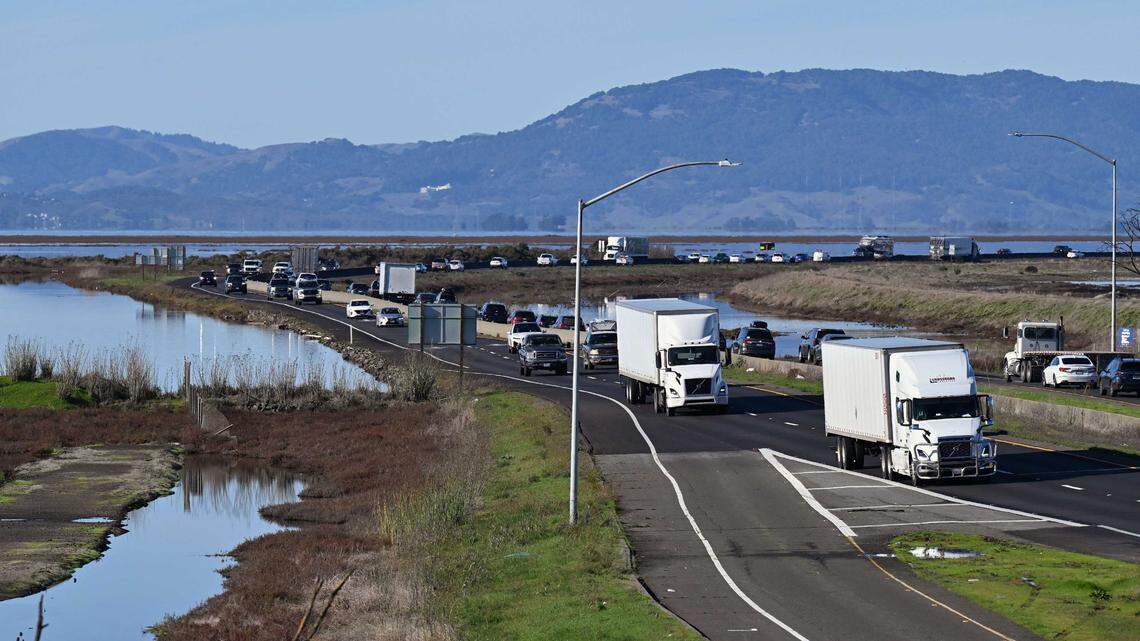
Assemblymember Lori Wilson, D-Suisun City, has championed the plan to add lanes to Highway 37 as it arcs through a marsh between Solano and Sonoma counties. Each side will have a general-purpose toll lane and a carpool lane. Wilson has said this expansion will ease traffic for her constituents. Her bill — AB 697, which would streamline construction in the wetland habitat — sailed through the Assembly and the Senate unanimously. It is now awaiting Newsom’s signature.
Documents from two 2015 meetings with Caltrans officials show that two experts discussed the highway “settling” or “sinking.”
According to meeting minutes, Fraser Shilling, a professor and director of the Road Ecology Center at UC Davis, reported that “maintenance in Caltrans said that there are stretches of the highway where they are adding a foot of new highway every year because the highway is sinking.” In an interview this month, he said the minutes were slightly off: It was a foot every few years, and he added that as new layers of pavement stacked up, the sinking accelerated under the extra weight.
Shilling, who worked with Caltrans for years to envision a different Highway 37 design that would be resilient to sea level rise, said that if the state moves forward with the current project, the sinking roadway should be renamed after Wilson and the governor.
“When the Lori Wilson Highway floods, we’ll know who to blame,” the professor said. “You could call it the Newsom-Wilson highway. ... This is a waste of money — it’s a lost opportunity — and eventually it’s gonna be a new, avoidable catastrophe.”
Newsom’s office declined to comment because it involved pending legislation. Wilson said, “It’s a needed road.” Her constituents, many of them low-income hospitality workers in wine country, get stuck in traffic; she believes this expansion will help them.
“We have to have a fix,” she said, “and if we wait for the ultimate fix, the perfect fix, it will be 20 years.”
Highway 37 stretches 21 miles, connecting Highway 101 in Marin County with Interstate 80 in Vallejo. About half of the roadway is a two-lane segment between Sonoma County and Mare Island, outside Vallejo. A draft Highway 37 corridor plan published by Caltrans in 2010 suggested that the agency might widen the existing two-lane segment.
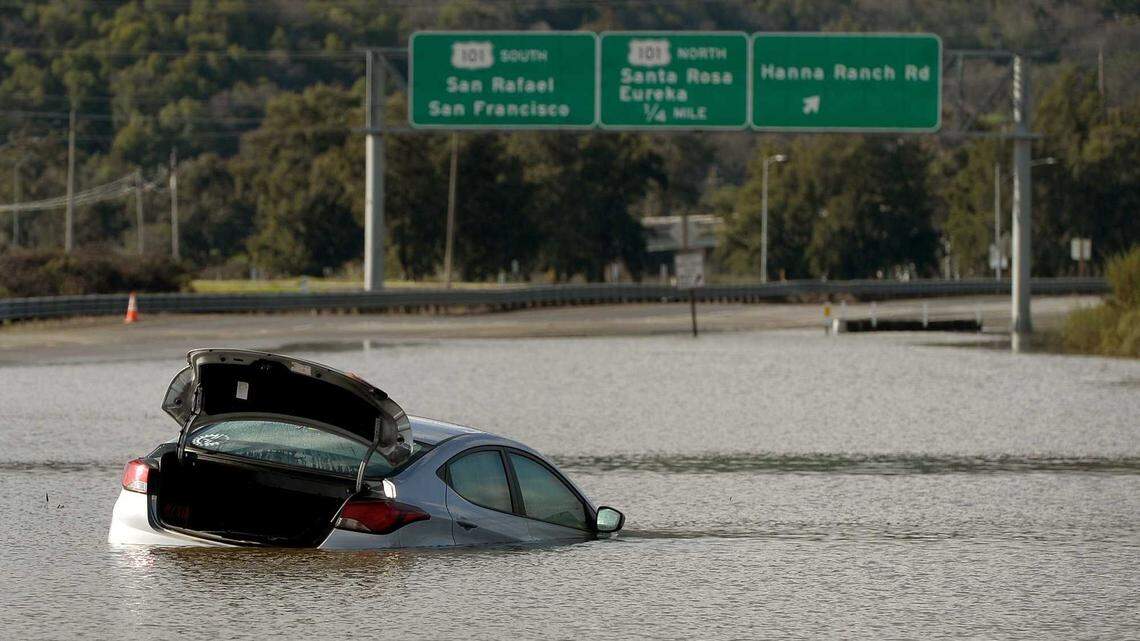
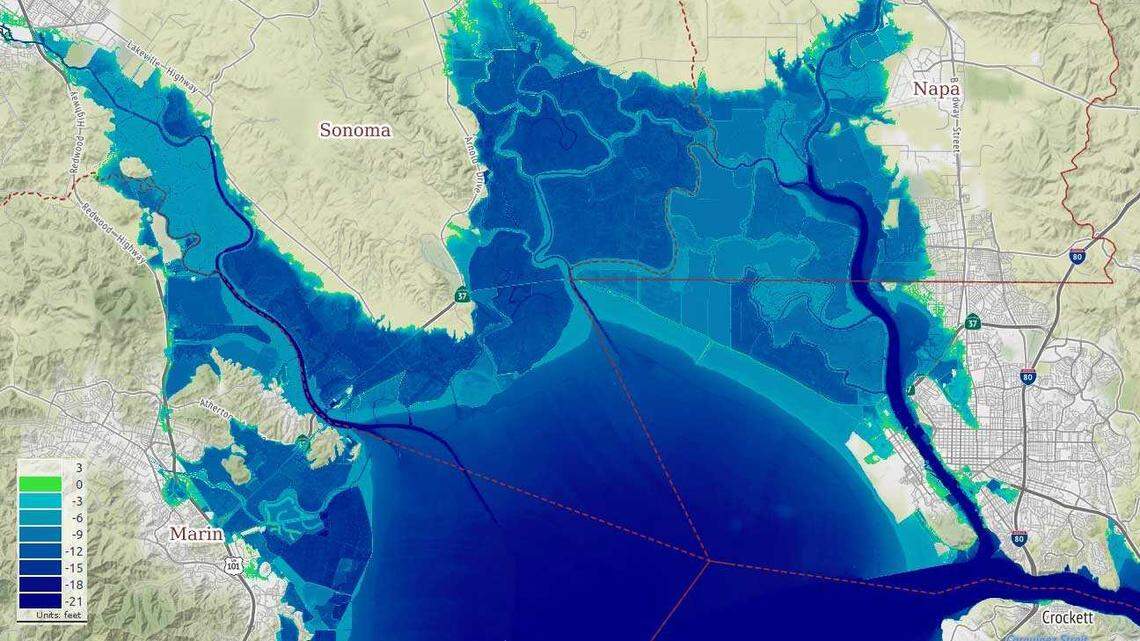
But Caltrans acknowledged at the time that extreme storms — which are becoming more common with climate change — or even very high tides could flood the low-lying roadway. And with 24 inches of sea level rise, water would slosh over parts of the road during average high tides. With no sea level rise at all, certain parts of the expressway would flood during a storm that has a 20% chance of occurring any given year — not even a particularly bad or uncommon storm.
Sea level rise is difficult to forecast, but Caltrans now says it estimates facing a foot of sea level rise by 2050. A foot would still cause shallow flooding right next to the roadway and flood significant parts of the highway during those same storms that have a 20% chance of occurring any given year.
The 2011 draft corridor plan said that by 2040, “37 will at least have to be protected from flooding due to sea level rise and wetland restoration.”
But that will not happen with the current lane-adding project. Instead, Caltrans has said, the project to widen the existing structure by 2029 “does not address sea level rise.”
The Sacramento Bee sent a summary of this story to Caltrans’ spokespeople and posed two questions about how the current project would account for the highway sinking as well as aging nearby levees. After requesting a three-day extension to reply, a spokesperson for the agency did not answer either of the questions. In response to a previous story about the highway, Caltrans spokesperson Bart Ney told The Bee that it “does not directly address projected sea level rise but will help prepare for future sea level rise risks while addressing near-term public issues. ... There is no direct estimate on how long certain sections of this project will hold up to sea level rise if no ultimate project is built to handle the rising waters.”
Caltrans will make some improvements to minimize flooding on the road, including coordinating the changes with a marsh restoration.
Wilson has argued that additional lanes are necessary in the short term for low-income commuters who travel from Solano County — where housing is more affordable — to their jobs in Sonoma and Marin counties — where housing for most people is unaffordable. She authored AB 697, which would carve out exceptions to endangered species protections for construction on 37. With the carveouts, the projected $250 million effort to add one eastbound vehicle lane would have a larger window for construction, making it far more feasible. A westbound lane is also planned.
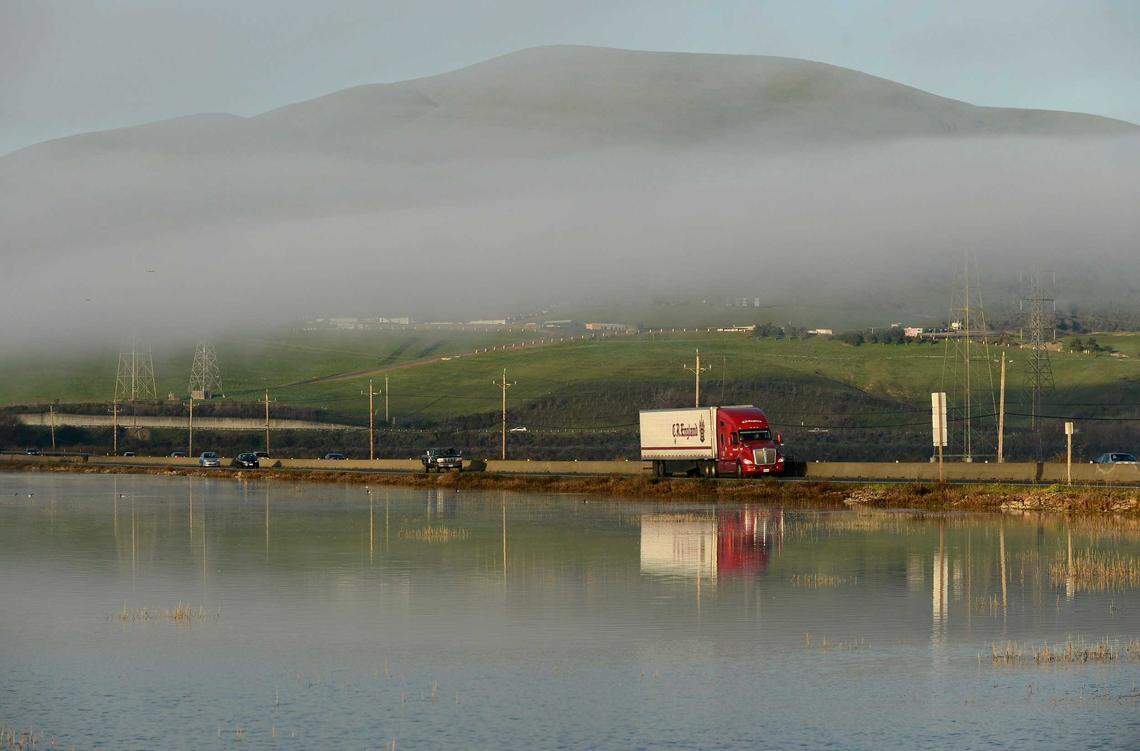
Caltrans officials have characterized the road widening as an expensive but necessary “interim project” while they wait for funding for the better but much more expensive “ultimate project”: building a causeway that might cost $10 billion to lift traffic above rising seas. Critics have compared the interim project to throwing taxpayer dollars into the ocean.
‘Undesirable’ highway plan
More than a decade ago, Caltrans was warned that adding to the highway was risky. Engineers from a consulting firm, AECOM, were brought on to do a risk assessment of Highway 37 in 2015, according to minutes from meetings and presentations made by those engineers. In their risk report, AECOM engineers considered the option of rebuilding a road on the existing highway. Minutes from one meeting on April 21, 2015, show that one of the consulting engineers said that they were including a rebuild as an option in their reports so that everyone could see what a bad idea it was.
According to the document, the engineer said, “it’s undesirable. If you keep it on the table you can see that undesirability.”
That plan still had an adaptive advantage over Caltrans’ current plan, however: AECOM’s engineers envisioned raising the existing highway about 7 feet.
As the then-co-director of UC Davis’ Road Ecology Center, Shilling helped lead a group of more than 200 local stakeholders to work with Caltrans on alternative ideas for Highway 37 between 2011 and 2016. Multiple high-ranking Caltrans officials supported this work, which sought to develop a “stewardship model” to integrate transportation planning with marsh rehabilitation. The state agency repeatedly said that it would not finalize its own plan until the stakeholder process had concluded — so that officials could use the lessons gleaned from the process.
Reflecting on those commitments in 2025, the professor was appalled to see that the plan that Wilson and Caltrans have pushed forward this year is essentially the same flawed plan he reviewed in 2011.
“As if we learned nothing in 14 years and after millions of dollars spent on various studies,” he said. “You’re either gonna lose the highway, or you’re gonna elevate it.”
Surrounded by sinking levees, rising seas
The stakeholder process was supposed to be a new model for transportation planning.
“Highway 37 had the opportunity, and it’s not a lost opportunity,” said Sonoma Land Trust ecologist Julian Meisler, “to be just an incredible partnership between environment and transportation.”
Meisler was involved in the stakeholder meetings with Shilling, and, in his role with the Sonoma Land Trust, he is now helping Caltrans with the marsh restoration elements of its freeway-widening project. On May 24, 2011, at a meeting at which eight Caltrans officials were present, Meisler explained part of the mechanism that was causing the highway to sink. According to the minutes — which are typically not exact quotations but do capture the meaning of what was said — Meisler explained to Caltrans officials and other attendees that as peaty soils in the marsh become oxidized, “land sinks to BSL (below sea level).”
At the same 2011 meeting, Joe Peterson, who worked on hydraulics for Caltrans, gave a presentation. The minutes say that part of his presentation said planners “need 6-7 (feet) of elevation to get out of 75-year effect.” His presentation said that “levees and road-beds settle from their own weight,” and that “fewer but more concentrated events will overwhelm hydraulics.”
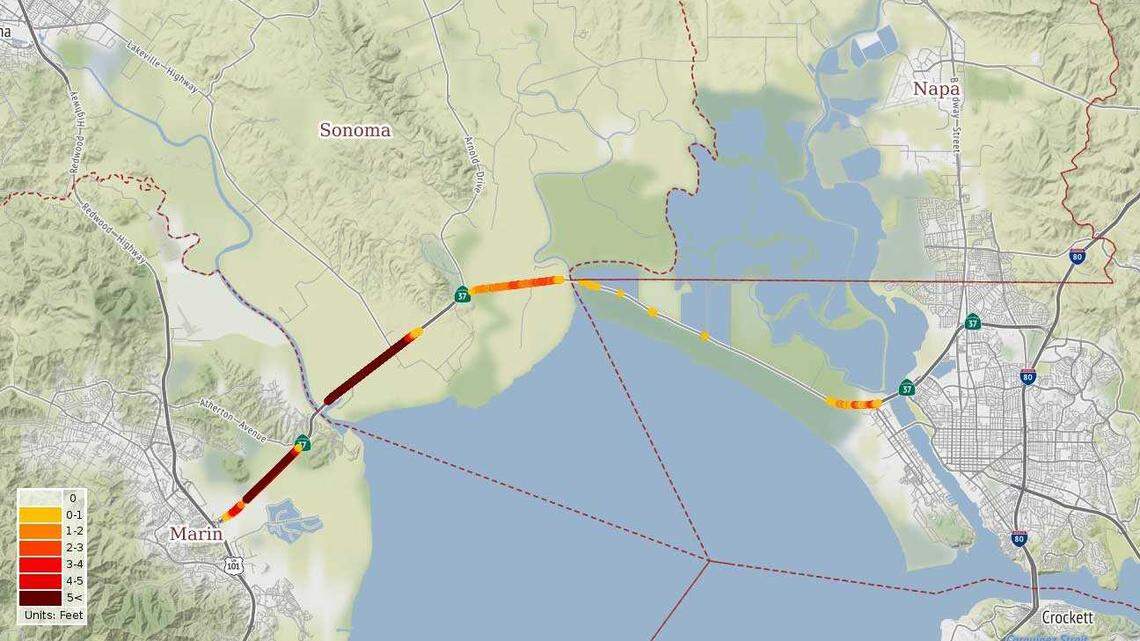
In other words, the sinking expressway was surrounded by sinking levees, which could be overwhelmed by the more intense and more frequent storms already occurring due to climate change.
Furthermore, most of the levees aren’t even levees. “I would just call them berms,” said Jeremy Lowe, a geomorphologist at the San Francisco Estuary Institute who has worked on the causeway plan. They’re mostly maintained by farmers on private farmland, and they don’t meet the engineering standards of a levee.
“Berm is just a generic name for any mound of mud,” he said. “They’re not built to protect communities.”
Private levees and berms likely to fail
On Dec. 5, 2011, the minutes say that the group discussed how “Sea level rise is (a) big issue because (it) threatens (the) highway because portions are at or below sea level.” Erik Alm, who became the contract manager for the stewardship process and who is now chief of the Caltrans District 4’s Office of Regional and Community Planning, was at the meeting.
The minutes say that Alm said “doing nothing is not an option,” and also, “This process is an opportunity to plan for strategies including sea level rise and more.”
Alm told the attendees that Caltrans had not yet made any final decisions because officials were “waiting for this process to identify best options.”
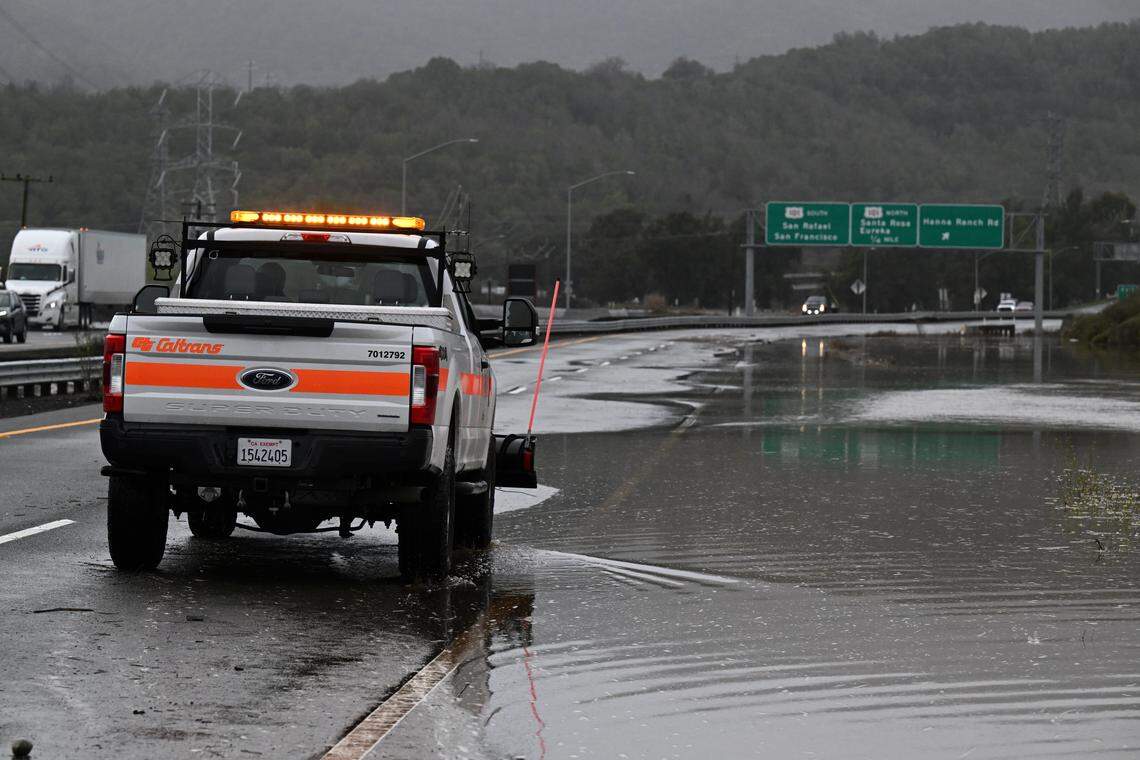
At a meeting on Feb. 10, 2012, the group — which included Alm and other Caltrans officials — discussed the possibility that a private berm or levee would fail. This came to pass later that decade: In 2019, levee breaks and levee overtopping in Novato led to flooding on Highway 37, and lanes were closed for almost a week; in 2017, a storm and a levee break led to a closure that lasted almost a month.
The topic kept coming up before those crises. At a meeting on Jan. 29, 2015 — which included a transportation planner from Caltrans’ headquarters, Dillon Miner; a Caltrans District 4 landscape architect, Joaquin Pedrin; a Caltrans District 4 branch chief for system planning, Ina Gerhard; a District 4 planner, Rob Bregoff; and a Caltrans transportation and climate change planner, Dick Fahey — the group discussed that it was probable that nearby berms, dikes and levees would not be sufficient to protect the highway from storms.
Minutes from the Jan. 29, 2015, meeting show that Shilling said a main focus of the stakeholder process would now be “how can we get something done fast in a reasonable timeframe because of (congestion) and risk of flooding and failure of the highway.”
At a meeting on April 21, 2015, minutes show that engineers from the consulting firm that did a risk assessment, AECOM, presented draft maps of flooding scenarios for Highway 37. With 12 inches of sea level rise and a 100-year storm surge — a previously rare event becoming more common with climate change — parts of Highway 37 would be under multiple feet of water. Typically, each day has two high tides, one of them higher than the other; the engineers found that on one part of Highway 37, with 24 inches of sea level rise, parts of the road would flood at the average daily higher high tide.
At the next meeting, on Aug. 21, 2015, the minutes show an AECOM engineer said, “There are segments of the levee system that become vulnerable in the 12-24 inches (of sea level rise) change. It’s hard to assign an exact time but somewhere between now and 2050.”
By May 2018 — after Highway 37 was closed for almost a month in 2017 due to flooding from a storm and high tides, as well as berm failure — Shilling was saying publicly that Caltrans had to choose between building the causeway and moving the highway inland to avoid the marsh altogether. The planning process, he wrote in the trade publication Roads & Bridges, was “approaching a critical juncture.”
But while Shilling saw only two options, Caltrans still sees a third: spending half a billion dollars adding lanes to the existing highway while waiting on funds for the causeway.
Some environmentalists back project
Meisler said the marsh restoration elements of the project are an urgent and time-sensitive matter. The highway blocks flows into and out of the wetland habitat, cutting off healthy functions of the ecosystem; additionally, restored lands would need time to mature and become more resilient to sea level rise that will affect them, too. Caltrans has agreed to open up more channels under the roadway, raise the bridge over Tolay Creek in Sonoma County and open the channel underneath to allow more movement of water.
The longer the marsh restoration is delayed, the harder it will become. Meisler said the restoration work needs to start “as soon as possible to have the best chance of these marshes persisting over time.”
As a result, environmentalist organizations such as the Sonoma Land Trust, where Meisler works, and Audubon California have signed on to help ensure that Caltrans handles the marsh in the best way possible. But despite their involvement, both Meisler and Casey Skinner, a director of Audubon California, distanced themselves from the main point of the project: to widen the existing road.
Meisler characterized the Sonoma Land Trust’s involvement as a necessary compromise.
“We’ve never put out anything in support of the interim project. What we’ve done is not oppose it. And I know that sounds — whatever, you could put an adjective to that. But it’s important,” he said. “In an ideal world, absolutely, we would love Caltrans to be going straight to the elevated causeway. There’s no debate about that.”
But the elevated causeway, largely because of its high price tag, has an uncertain future.
“We’re talking about $10 billion,” Meisler said. “It’s hard to find $10 billion unless you’re building B-1 bombers.”
On the phone, Skinner was likewise full-throated in Audubon California’s support of marsh restoration and far more measured in what she said about widening the road.
“Any opportunity we have to restore this habitat,” she said, “is so important. It just doesn’t exist in the way that it should.” But she declined to comment on whether she supported AB 697 — which, if signed into law, would allow Caltrans to disturb or harm endangered species, including endangered birds, during a longer construction window.
Shilling said he understood that some environmentalists viewed their participation as “not letting the perfect be the enemy of the good.” He also said, “If you keep running down that road, everything is degraded. It’s a lost-cause approach; it’s a losing proposition. … You have to defend the good.”
Focusing on the interim project, he said, was also a more expensive route for taxpayers in the long-run.
“There is no economist out there who would say it’s cheaper to wait for the emergency,” he said. He recalled the flooding and closures in 2017 and 2019. By putting off a project that is resilient to climate change, he said, “You’ve hugely increased the cost of adaptation…not just due to inflation. Now you’re having events.”
This story was originally published September 30, 2025 at 5:00 AM with the headline "Half a billion dollars for a sinking California highway? Gavin Newsom may OK it."
CORRECTION: Casey Skinner is the San Francisco Bay program director for Audubon California. An earlier version of this story misstated her title.
