
California awards $73 million to expand highway threatened by sea level rise
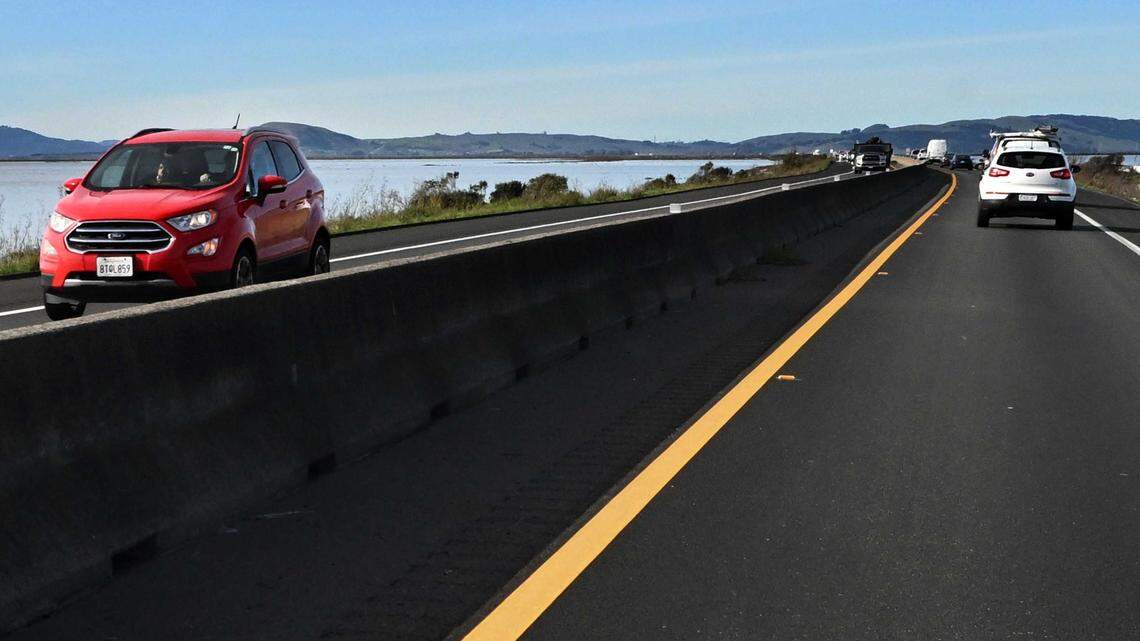
The California Transportation Commission approved a suite of grants this week — including a $73 million award to widen a Bay Area highway expected to be underwater due to sea level rise by mid-century.
The Highway 37 project will ultimately add one lane in each direction on the route, which runs from Interstate 80 in Vallejo to Highway 101 in Novato and passes through marshland above San Pablo Bay. The low-lying highway is vulnerable to sea level rise. This week, a Caltrans spokesperson, Vince Jacala, said that “segments of the Highway 37 corridor could become inundated by 2050 due to projected sea level rise.” Caltrans’ earlier estimate was less optimistic: “With the projected sea level rise, most of the existing (State Route) 37 will likely become permanently inundated by the mid-century and even as early as by 2040.”
At the commission meeting Thursday, a Caltrans director, Doanh Nguyen, contradicted Jacala and the agency’s environmental report and said that the project would only be vulnerable to intermittent flooding by mid-century.
“It doesn’t mean that by 2050, the corridor will be underwater,” he said. “It just means that, based on the risk assumption level, there will be higher frequency of flooding in the corridor.”
The interim project does not address sea level rise, but it would raise the height of the lanes at a few of the most flood-prone areas. The Tolay Creek Bridge in Sonoma County would be replaced by a structure that’s 5 feet higher, and a 4,400-foot stretch of the highway would be raised as much as 8 inches. Caltrans says that a foot of sea level rise is expected by 2050 under the second-worst climate change scenario that were studied.
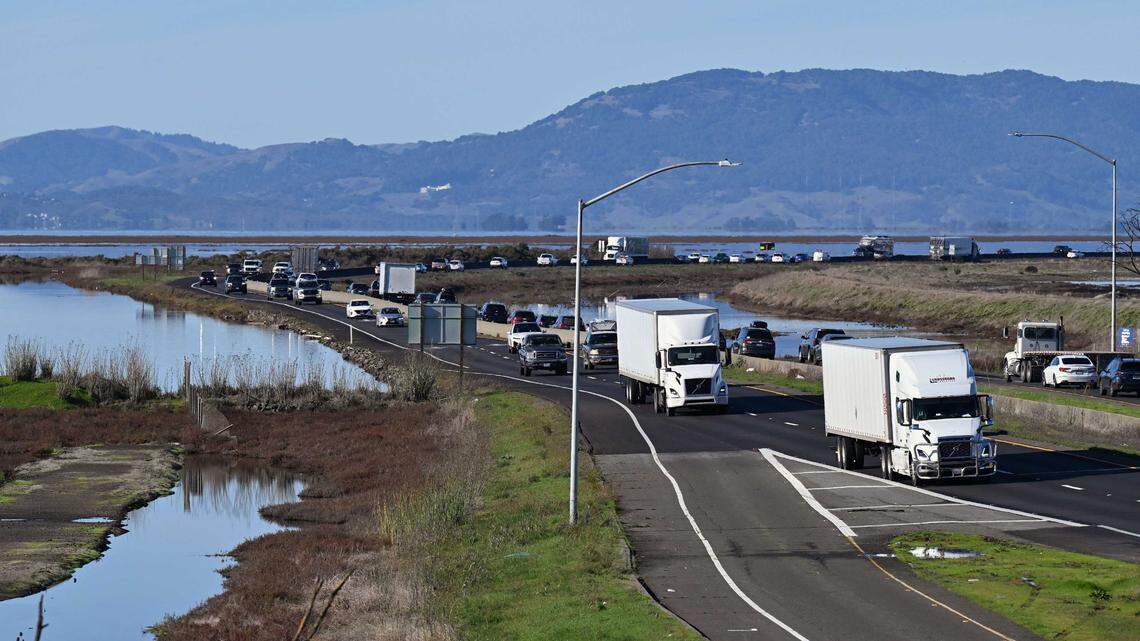
Highway 37 was one of two projects whose potential problems “stood out” to Commissioner Zahirah Mann; she asked Nguyen and an applicant for a Los Angeles County highway expansion project to come up to the podium to address the concerns. Nguyen told the commission that the structure was intended to last 100 years, until 2030.
The current highway-widening project would only add a $250 million eastbound lane; Caltrans has estimated that construction on the lane will be completed in 2029. The westbound lane would be a separate project. These additional lanes on the existing highway are considered a stopgap measure; Caltrans has a plan to build an “ultimate project”: an elevated causeway that would still be functional with sea level rise. The causeway, however, is not funded and is expected to cost $10 billion.
At the commission meeting, critics lambasted the effort to widen the existing highway during public comments. Most of them cited Caltrans’ earlier projection that the roadway could be permanently inundated as early as 2040.
Dohee Kim of the Greenlining Institute said, “(State Route) 37 is an irresponsible investment into a highway project that will literally be underwater.”
Sofia Rafikova, a policy advocate with the Coalition for Clean Air, said, “The CTC will spend $73 million on a project that will be unusable by anyone in a few decades.”
Others supported the project, arguing that it would ease the commute of relatively low-income workers who travel from homes in Solano County to jobs in Marin and Sonoma counties. Widening the highway was an equity issue, they said.
The commission awarded the grant through the commission’s Trade Corridor Enhancement Program, funded by a gas tax created in 2017 by Senate Bill 1. The commission’s parent agency, the California State Transportation Agency, has discouraged highway-widening projects in general. In 2021, CalSTA said in a report that “highway capacity expansion has not resulted in long-term congestion relief and in some cases has worsened congestion, particularly in urbanized regions.” CalSTA cited “induced demand,” a proven phenomenon in which adding lanes causes people to drive more, which ultimately leads to more traffic.
Highway 37 was one of six Trade Corridor Enhancement Program projects approved Thursday that aim to expand highways.
This story was originally published June 27, 2025 at 11:43 AM with the headline "California awards $73 million to expand highway threatened by sea level rise."
