
What is Fresno Arts Council, the group at center of embezzlement investigation?
The Fresno Arts Council has long served as one of the area’s choice non-profits; a hugely influential organization that’s likely under the radar of those not steeped in city politics or its arts and culture scene.
That was before it admitted losing $1.5 million in an alleged embezzlement case.
At issue were public funds, tied to $5.7 million set aside by Measure P and administered through the arts council under a five-year administrative services agreement it signed with the city in 2023. The city manager called news of the possible embezzlement a “crisis” and the mayor and members of the city council said they were “appalled by the lack of safeguards” put in place by FAC.
Fresno police initiated an investigation with the help of the FBI, but as of Friday no suspect had been named and no arrest had been made.
Of course, the city’s choice to trust the arts organization wasn’t without reason.
Following the passage of Measure P sales tax in 2018, the city was looking at a surge of money (estimated at the time to be $10.5 million or more for year one) that it needed “to invest in competitive grants for nonprofit organizations that support and expand access to arts and cultural programming.” That money was ostensibly under the control of the city’s parks department — and what did it know about art, or so went the thinking among arts groups in the area.
The Fresno Arts Council seemed an obvious choice for help, and its appointment came at the urging of multiple organizations, including the Fresno Art Museum, Fresno Philharmonic and African-American Historical & Cultural Museum, whose executive director called the arts council “the only organization in this city with the expertise to represent us.”
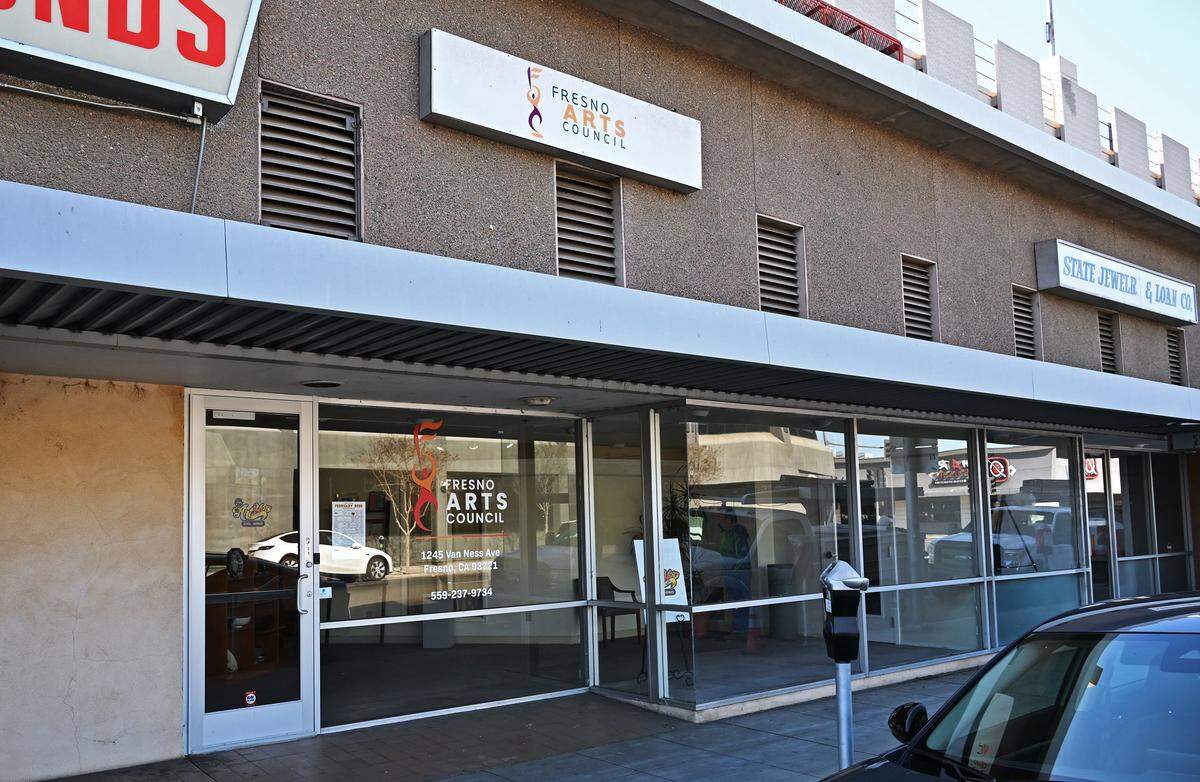
What is the Fresno Arts Council?
Started in 1979 as the Fresno County Arts Alliance, the organization began as an umbrella organization for some 20 arts groups. Among its work was advocacy (in 1984, started a committee to lobby for county supervisors for arts funding) and recognition (in 1985, it hosted the inaugural Horizon Awards to honor excellence in art).
It operated as the Alliance for a decade, before becoming the Fresno Arts Council.
That change only made official “a generic term the city council had already adopted,” according to Fresno Bee reporting at the time.
“They’ve designated us the ‘city arts council,’” then-executive director Phylise Walker told The Bee. “Fresno Arts Council is more specific in telling what we do, and it’s easier to say.”
Functionally, things remained the same.
The Arts Council was still a service organization for cultural arts groups in the county, “acting as liaison between them and government agencies.” And even then, a main responsibility was dealing with money. In the late ‘80s, the Arts Council oversaw funds being allocated by the city council and California Arts Council, according to The Bee.
Over the years, it continued that role.
In the early 2000s, it was tasked with allocating monies from the short-lived Measure A, Arts to Zoo tax. It gave out $200,000 in grants in 2001, The Bee reported. More recently, in 2020 it provided funding to artists and projects via the Fresno Arts Safety Net Fund and the FAC Cares Grant, along with other public and private entities (see: the San Pablo overpass pillars, which were paid for by Caltrans’ Clean California Beautification grants).
According to its website, the Arts Council also dispersed grants for Rural Arts Access Fund, which was supported in part by the National Endowment for the Arts.
But the Arts Council isn’t just a monetary pass-through.
Over the years, it’s offered the arts scene logistical support in ways both mall and large.
Its office was a ticket outlet for local events, back before the days of online ticketing.
Its members led committees and helped inform on matters of public art, especially controversial pieces (several nude paintings that were banned from display at Fresno’s City Hall in 1992 or the mural that went up at the Neighborhood Thrift store in the Tower District in 2009).
In 1990, the Arts Council began a centralized directory of Fresno artists.
That same year it hosted the days-long Art and Soul Regional Cultural conference.
In 1992, it hired its first Folk Arts Coordinator, after a three-month community survey that found Fresno was “very rich in folk artists, particularly in the ethnic field,” The Bee reported. The council’s work in folk arts would eventually spin off as its own nonprofit, Alliance for California Traditional Arts.
For a time, Fresno Arts Council was seen on ads presenting the Fresno Children’s Playhouse theater group. There were also arts scholarships, a blues music festival and the continuation of Horizon Awards, now in its 41st year. In the mid-2010s, the organization spearheaded efforts to install Fresno’s first poet Laureate, a move that would spur its own set of cultural events, including the annual LitHop festival.
But perhaps the council’s best known cultural contribution came in 1996, when it partnered with a group of downtown artists (Frank Arnold, Sharon and Frank Alexander, Robert Ogata and Jane Whitehurst) to create a first Thursday open house for local galleries and arts studios.
The event, known as ARThop (and later Arthop or ArtHop) wasn’t new. Other cities were hosting similar first-of-the-month events as a way of getting people into gallery and arts spaces.
In Fresno, those spaces just happened to be grouped in and around downtown. “It was intended that people would move from one gallery space to another, from one part of downtown to another,” Fresno Arts Council’s executive director Lilia Chavez said, explaining the event to the Bee last year.
The event became synonymous with downtown’s emerging cultural scene, especially along Fulton Street and the burgeoning Brewery District. By the late 2010s, ArtHop had become a full-on street party.
The ‘death’ of ArtHop and Measure P controversy
There were semantic interpretations of course, and a public that didn’t differentiate between officially sanctioned ArtHop events (at dozens of gallery and studio spaces across downtown) and the rest of what was happening on the first Thursdays each month.
So, when the city essentially halted the street event in 2024 (citing safety concerns and the trash left by up to 15,000, mostly younger people), the public took that as the death of ArtHop.
There were those who saw the regulations as the Arts Council trying to wrest control of the public, and mostly grassroots, event. ArtHop has since returned.
The local arts site The Munro Review, which has an extensive archive of reporting on Measure P, wondered if the response to ArtHop was linked to the Downtown Fresno Partnership and a $200,000 grant application that was kept from being evaluated in the funding process, according to reporting on the site.
Arts organizations were expressing concern over Fresno Arts Council’s handling of Measure P even before news of the embezzlement. As far back as 2024, there were questions of lack of transparency in the scoring and the grants applications process. There were also accusations of bias; that well-established organizations got the bulk of the funds and that the Fresno Arts Council president interfered in the selection process.
This wasn’t helped by months-long delays in the distribution of funds since 2024.
On Tuesday, the city said it had terminated its contract with Fresno Arts Council and would be taking over distribution of Measure P arts and culture grant funds.
This story was originally published February 17, 2026 at 5:30 AM.