
Seniors face higher rates of violent crime in Fresno County than statewide average
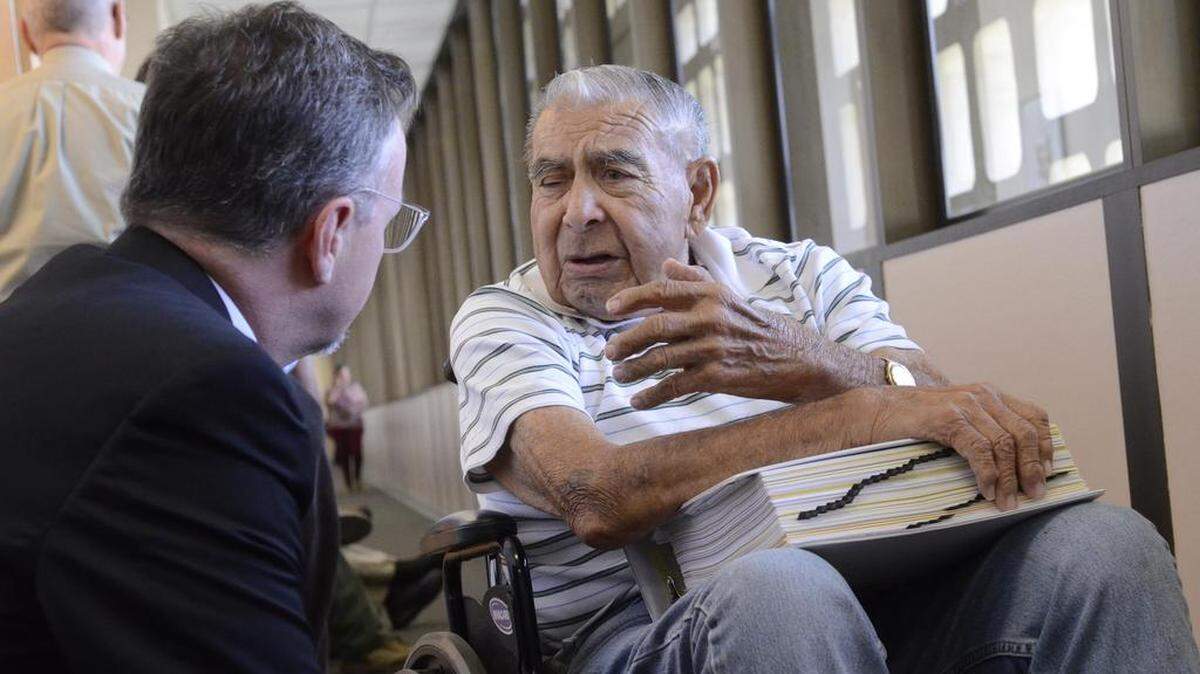
When Josef Martin, a 92-year-old disabled World War II veteran, was robbed and beaten by three teenage boys in his Fresno home in 2013, he became one of the unwilling faces of an unfortunate statistic confronting Fresno County: The rate of violent crime against senior citizens is higher here than other central San Joaquin Valley counties, and also higher than California’s overall average.
An analysis of data from the state Department of Justice indicates that in 2016, the rate of violent crimes – homicide, rape, robbery and assault – against victims age 60 and older was higher in Fresno County than all but 10 of California’s 58 counties. Seniors were victims of 285 violent crimes that year in Fresno County, including seven homicides, one rape, 78 robberies and 199 assaults.
“For our elders, their golden years are supposed to be free from harm and sorrow, but for many of them, it’s far different,” said Tim Donovan, a prosecutor in the elder-abuse unit of the Fresno County District Attorney’s Office. Donovan is the man who prosecuted the teens who attacked Martin in 2013. “Obviously the gravity of elder abuse is far greater than anyone can imagine. And unless people become aware of the gravity of the problem, we can’t talk to the more substantive causes.”
Fresno’s total population of people over age 60 is estimated at 152,818, or more than one in five residents. The number of crimes committed against them translates to a rate of 18.6 violent crimes for every 10,000 people. That compares to a statewide rate of 15.7, and represents the eighth straight year in which Fresno County’s rate exceeded the state’s.
In California, crimes against senior citizens are singled out under the state Penal Code because of older victims’ particular vulnerability to crime and abuse. When legislators in Sacramento adopted Penal Code Section 368, they declared that seniors “are deserving of special consideration and protection … because elders and dependent adults may be confused, on various medications, mentally or physically impaired, or incompetent, and therefore less able to protect themselves, to understand or report criminal conduct, or to testify in court proceedings on their own behalf.”
The law specifies that if someone is convicted of causing “great bodily harm” to a senior over the age of 65, he or she can be sentenced to three years in state prison if the victim is younger than 70 or five years if the victim is 70 or older. A conviction for offenses that cause the death of a senior can result in a five-year prison term when a victim is under 70 or seven years if the victim is 70 or older.
Donovan said the law is a valuable tool in cases of serious injury or death of a senior citizen because it provides for felony charges in assault cases. “We may not be able to prove murder or manslaughter, but with (Penal Code) 368, the enhancement can build an abuse case up to 11 years in prison,” roughly equivalent to a sentence for manslaughter, he said.
In 2016, seven Fresno County residents age 60 and older were victims of homicide, according to figures reported to the state by local law enforcement. One rape against a senior was reported, along with 78 robberies and 199 assaults.
The violence isn’t committed only by strangers, said Michael Reiser, Adult Protective Services program manager for Fresno County’s Social Services Department. Increasingly, his agency is dealing with incidents of violence committed by adult children against an elderly parent who is their caregiver, in a dynamic similar to domestic violence.
Madera County is right behind Fresno County in violent incidents that victimize seniors, with a rate of 17.3 violent crimes per 10,000 seniors in 2016, and like Fresno has also exceeded the statewide rate since 2009. In fact, Madera County had a higher rate than Fresno in each of the three years before 2016.
At 5.6 violent crimes per 10,000 senior residents, Kings County had the lowest rate in the four-county Valley region in 2016. That was a significant drop from 2015, when the rate was 16.8 crimes per 10,000 senior residents. The primary difference was a decline in the number of assaults and robberies against older victims.
San Joaquin County, in the northern San Joaquin Valley, had the state’s highest rate of crimes against seniors at 36.5 per 10,000 older residents in 2016 – a rate nearly double that of Fresno County. Sparsely populated Colusa County was second with a rate of 35.2, while San Francisco (33.7), Alameda (26.6) and Santa Cruz (25.5) rounded out the top five.
Other counties with higher rates than Fresno County were Del Norte (23.1), Los Angeles (20.7), Merced (20.4), Sacramento (19.5), and Stanislaus (18.8). But in counties with very small populations, such as Colusa and Del Norte, even one or two more or fewer crimes against seniors can make a dramatic difference in the rate in any given year.
Tragic incidents
Donovan said that because there are so many violent senior crimes, he’s in court every day dealing with the cases. “It’s hard to think of any one case because there are just so many,” he said.
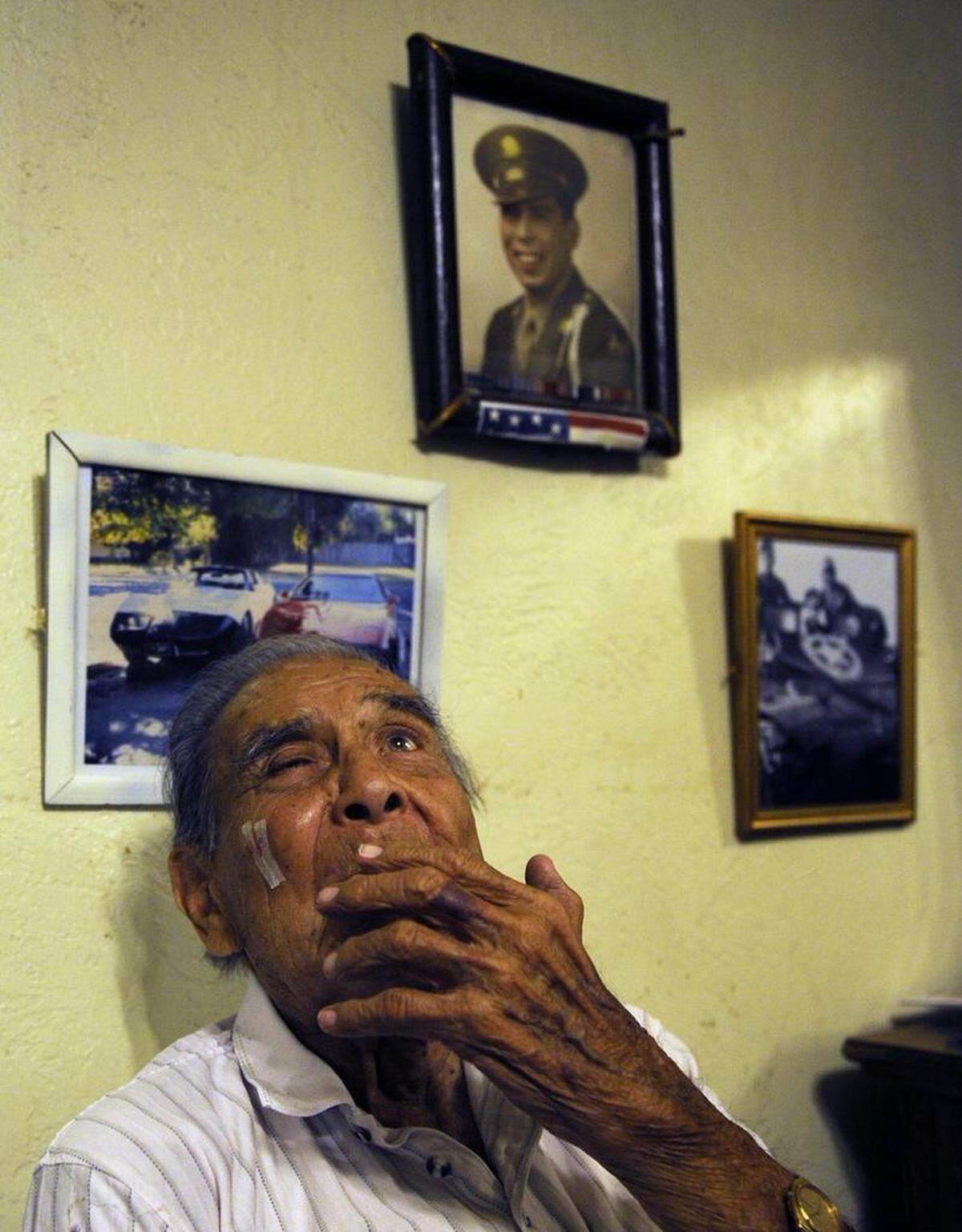
But the home-invasion robbery of Josef Martin’s modest home in east-central Fresno in October 2013 incensed the community because of the brutality of the crime and the inability of Martin, who was blind in one eye and hard of hearing, to defend himself. In the early morning hours, he woke up to find a gun barrel stuck in his mouth and being told to “shut up” as the three young robbers ransacked his home. They took two rings off his hands and stole other jewelry as well as money hidden under a rug in his bedroom. He was thrown onto the floor of his bedroom closet before the robbers made their getaway.
Martin, who died this year, lived alone after his wife died in the spring of 2013. He was a decorated Army veteran who fought in Europe in World War II, including the Normandy invasion and Battle of the Bulge.
“Here’s a man in his 90s, he lived by himself, and he liked to sit on his porch every day and watch the people,” Donovan said. When the three came into Martin’s home, “it’s pretty clear that they knew he was there. At his age, he was such a heavy sleeper that they could easily have left him alone and taken what they wanted. But one of the three just decided to be mean and pistol-whipped him.”
The assailants were 16, 15 and 12 years old at the time of the attack. The two younger boys confessed to their involvement. The oldest pleaded no contest on the eve of his trial in adult court and was sentenced to 17 years in prison.
Donovan also was the prosecutor in the case of Steven Minamoto, who was convicted of felony elder abuse that led to the death of his mother, 81-year-old Kauro “Kay” Minamoto in August 2015.
Kauro Minamoto had lived in Kingsburg and Fresno for most of her life but lived in Squaw Valley for 14 years prior to her death. Fresno County sheriff’s deputies were called to her home after a passerby saw her on the ground next to her son. An investigation determined that Kauro Minamoto fell and hit her head, went into a coma and died from her injuries, Donovan said.
“It was a suspicious elder death, and it was very difficult for a number of reasons,” Donovan recalled. “It’s subject to interpretation what happened – did he forcefully push her intentionally, or was it an accident?”
In a court hearing, investigators testified that Steven Minamoto gave different and conflicting accounts of what happened: that his mother had simply fallen; that the two were standing next to the car and when he opened the door, it nudged her and she fell; or that the two had argued and he pushed her because he was in a hurry to go to Fresno.
Steven Minamoto served nearly 160 days in jail before he was formally sentenced to three years of felony probation. It’s a punishment that Donovan said he believes was fair under the circumstances. “In this instance we had an individual with a serious mental illness who is not going to be cured,” Donovan said. Family members sent letters to the court on Steven Minamoto’s behalf seeking to make sure he received needed mental health care.
No simple solutions
Reiser, the county’s Adult Protective Services manager, said his agency tries to promote awareness and caution in elderly clients to protect themselves from strangers. “We talk with them about safety, home security, to be more aware of their environment,” he said. “Don’t just open the door when someone knocks.”
“And we tell them to keep their doors locked,” Reiser added. “So many of them remember when Fresno was a small, rural farming town and not a big city, and they’re still thinking of a time when it was OK to leave the door unlocked at night. … We have to tell them, ‘This is not the same Fresno that you grew up in as a child.’ That’s a struggle, as well.”
Donovan, the elder-abuse prosecutor, encourages family and neighbors to check in regularly with older residents to make sure they are safe and well. If an older senior is a victim of a violent crime but has limited mobility or another disability, he or she may not be able to reach a phone to call for help.
“We can make people more aware of financial abuse-like scams; we can do things to try to prevent that,” Donovan said. “But the difficulty with physical abuse or violent crime is that we have a limited ability to prevent it. … We find out about it after the fact, when they’re taken to a hospital and doctors or nurses report it to law enforcement.”
But what if the violence is inflicted not by a stranger, but by a loved one? “In the past 18 months we’ve had some very violent incidents where older adults are taking care of adult children who have mental health, substance abuse or developmental issues,” Reiser said, “and the adult child has attacked, and in a couple of instances murdered, their (elderly) parent.”
As medical science increases the life expectancy of people with developmental disorders, more elderly parents find themselves taking care of their children well into adulthood. “But (the parents) are getting older and more frail, and that puts them at greater risk if the adult child becomes violent,” he added. “They want to take care of their children, and in many cases still see them as children, but they’re more vulnerable.”
When an adult child becomes abusive or violent, it can often go unreported. When Adult Protective Services does learn of an incident from a client, “we try to communicate our concerns when situations become volatile,” Reiser said. “It’s very difficult to tell a 75- or 80-year-old woman who’s been caring for a child her entire life that she’s not safe anymore. There’s a social and emotional dynamic: ‘This is my child, my family.’ And it may be the only remaining family they have left.”
Case workers can help a client seek a restraining order and connect a senior with other victim services. “It’s really emotionally challenging and difficult for them to set that line in the sand,” Reiser said.
But it’s not a sure solution. Reiser recalled a case in which a woman sought and received a restraining order after her son grew violent and hit her. When deputies went to the home to remove him, the son fled. “He showed back up a few days later in the middle of the night and killed her in her sleep,” Reiser said. “A restraining order is only a piece of paper. It’s only as effective as whoever is enforcing it.”
Tim Sheehan: 559-441-6319; Twitter: @tsheehan.
This story was originally published April 19, 2018 at 12:26 PM with the headline "Seniors face higher rates of violent crime in Fresno County than statewide average."