
Football didn’t work out for him at Fresno State, but he still gets his day in Bulldog Stadium

Football did not work out at Fresno State for Marc-David Bien-Amié, who was the most intriguing prospect in former coach Jeff Tedford’s first recruiting class, a massive 6-foot-5, 365-pound offensive lineman who, even at that size, was stunningly quick and athletic.
He was everything that offensive line coach Ryan Grubb was looking for in rebuilding a thin position group, but a series of knee injuries ended his career. He got into just one game. It was at Nevada in 2018, a 21-3 victory, the third of seven wins in a row for a team that would go on to win the Mountain West Conference championship and then the Las Vegas Bowl.

Bien-Amié did not get to play in front of the Red Wave even once, but on Saturday he will be on the big stage at Bulldog Stadium in a cap and gown to receive a bachelor’s degree in sociology.
He will graduate, which is not the end but just the latest step in an improbable football journey that runs through three countries and is tied together by a natural disaster and a dream.
“With what he has been through in life, 95% of us will never have to go through a fraction of what he already has at 20-something,” Grubb said. “You hear his story and you’re like, ‘Wait, what? He did what?’”
30 seconds of terror in Haiti
Bien-Amié doesn’t like to think about the earthquake and doesn’t talk about it very often, but it all started there.
It’s 2010 in Port-au-Prince, Haiti, where Bien-Amié grew up. He was 11 at the time and went to school, enjoyed the outdoors and nature, would plant and tend to fruit trees in the yard. Every once in a while, he’d kick a soccer ball around with friends. “That’s where I got the feet to move, being this big,” he said.
Mostly, though, it was just normal kid stuff.
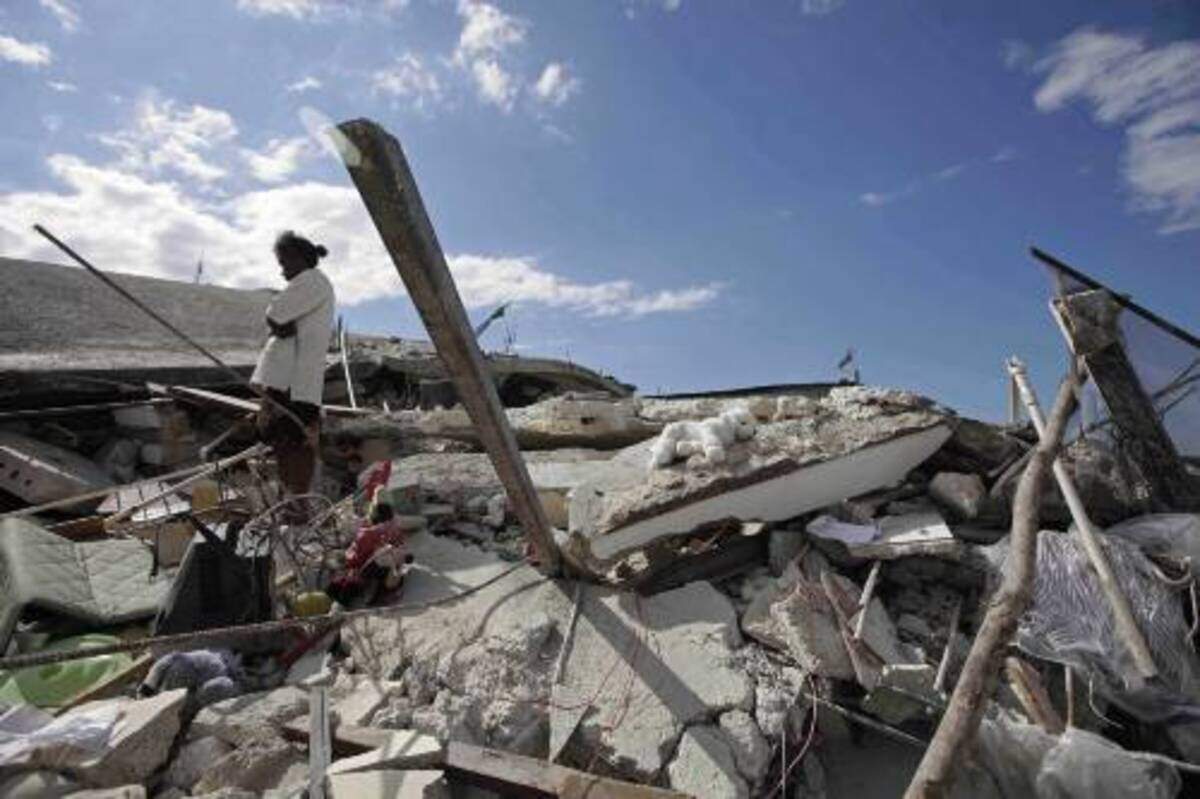
That all ended at 4:53 p.m. on Jan. 12 when a catastrophic earthquake struck Haiti. The magnitude: 7.0. The quake was centered near the town of Léogâne, which is just west of Port-au-Prince, the capital city, maybe 15 miles or so, and Bien-Amié was right in the middle of it.

“I’ve seen people die,” he said. “It’s not a pretty scene in my head. I saw buildings falling. I saw buildings falling on people, with people inside. I saw people digging holes and digging up people. It was pretty bad.
“I’m grateful that none of my immediate family were harmed, but that day … I did not see my father in like a week, because we thought he was dead and he thought we were dead. I was with my mom and someone had my little sister somewhere. We thought she was dead. It took a couple of days before we found each other again because it was just chaos everywhere.”
The quake devastated an already struggling nation. More than 250,000 homes and buildings were damaged or destroyed including the Presidential Palace and Port-au-Prince Cathedral; an estimated 1.5 million people were left homeless. The death toll was reported to be anywhere from 100,000 to 160,000 to 220,000 to 316,000, and still is under some dispute.
What is not: it is one of the deadliest earthquakes in history.
Finding Fresno State
Port-au-Prince was hit by a cholera epidemic later in 2010, in October, as the country was struggling to recover from the earthquake. Then, in November, Hurricane Tomas brushed by Haiti bringing torrential rain, tropical storm force winds and more death, more destruction.
But that’s just the start.
Bien-Amié made it out of the country with his mother and sister. They fled to Montreal – he had been born in Canada. They lived with friends of an aunt for a short time, then in a small apartment.
“I didn’t have a bed, didn’t have a couch, didn’t have a TV. No nothing. But it wasn’t that bad. I was like, ‘OK, at least we’re not dead. I’m here. I’m going to school.’ I never complained about my situation. I always saw it as like a phase: ‘OK, it’s going to get better at some point.’”
Eventually, his mother was ready to move back to Haiti. But by then Bien-Amié had found sports, basketball first, and more than anything else he saw opportunity and lobbied to stay.
“The whole point was to continue with my education,” he said. “There was more opportunity and there’s a lot of uncertainty in Haiti, a lot of insecurity. The environment was not great for me. That’s the reason why they decided, ‘OK, we’re going to let you live there.’ They ended up leaving me in Montreal and hoping for the best, but my head was well placed on my shoulders and I knew exactly what I wanted.”
On his own at 15 and 16 years old, Bien-Amié went to school and practices and workouts and at night he found work to pay the bills, taking a number of jobs including one that fit better than most.
“I was young so I was not necessarily supposed to be a bouncer, but that’s what I did,” he said. “I had the size for it.”
He had a one-bedroom apartment, but few amenities, sleeping on an old couch. Nothing came easily. He did also have that burgeoning dream of the United States and a Division I football scholarship, and after high school and on his way to Collège Montmorency he met Yves Dossous and started to create more opportunities every day.

Dossous had lived it. He made it from Montreal to the U.S. and played football at Kent State in the late 1990s. He works in finance now, but also coaches area kids, keeps them on a path academically, takes them to camps in the U.S. to introduce them to the possibilities at U.S. universities and to introduce those possibilities to them.
“It’s a way for me to give back the opportunity I received myself,” Dossous said.
One year it was 40 kids on a bus, hitting 12 camps in the U.S. in 16 days.
Bien-Amié worked out in the mornings before school with Dossous and 10 or 15 other players and attended his camps, but it was a long time before he opened up about where he had been, what he had seen, and how he was trying to make it all work basically on his own.
Now, they are close; family. “Shout out to Yves Dossous,” Bien-Amié said. “He is someone I’m really grateful for. He saw me struggle and he was like, ‘Man, I can see you’re determined to be somebody.’ He had us work out, no complaining. He took a bunch of kids like me and said, ‘If you want to make something of yourself then make sure you get your grades right and come to work out every day, which we did.”
“Yves got Marc on a path,” Grubb said. “I credit a lot for what Marc became to Yves. He was an unbelievable mentor. He has an incredible work ethic. He had seen kids who had been in the same situation as Marc and kept mentoring and mentoring and working through things.”
At Collège Montmorency, Bien-Amié played right guard and defensive tackle and learned the Canadian game.
Zero translation is required for 6-5 and 365, though.
“He was a bad man,” said Frédéric Morissette, who was the receivers coach when Bien-Amié played at Montmorency and is now the head coach. “Sometimes an O-lineman is especially good in pass pro or in run blocks, but he was good at all of it.”
Building a brand, from north of the border
Grubb first saw that at one of those camps, at Ohio State. Bien-Amié was big and raw as a football player, but Grubb fell in love with his potential. Grubb was at Eastern Michigan at the time, as was now-Bulldogs coach Kalen DeBoer. They offered a scholarship and Bien-Amié committed and when DeBoer and Grubb were hired by Tedford at Fresno State, Bien-Amie decided to follow.
It took awhile for Bien-Amié to get his transcripts translated and through university admissions and compliance. At one point, the football staff was told, ‘No.’ They were told that it was not going to work, to move on. But they kept at it, and Bien-Amié finally made it to campus, well behind the rest of a class that included running backs Ronnie Rivers and Jordan Mims, defensive end Arron Mosby and offensive linemen Dontae Bull and Syrus Tuitele, who just signed a free agent contract with the Buffalo Bills following the 2021 NFL Draft.
But Bien-Amié stood out, as he had at Collège Montmorency.
“The first time we saw Marc-David, he was taller and bigger than everyone and on top of that he moved like a cat,” Morissette said.
He was even bigger when he first got to Fresno State, 380-plus pounds.
“We always heard we had another big guy coming in and when you hear the words big and guy …” said former Bulldogs tackle Nick Aibuedefe, who is now pursuing a master’s degree in business administration. “To describe Marc, I would use the word massive.
“He’s a massive human being, and with that body type you don’t see too many individuals that can move the way he can and bend, have the flexibility that he has and the athleticism. It’s just really shocking.”
“I can remember after his official visit out here in Fresno I sat him down and I said, ‘Marc, I’m worried about your weight,’” Grubb said. “I want to say his official measurements were 6-5 and ⅛ and that day we had him at 383, and so I said, ‘Marc, I really feel pretty strongly you’re going to have to play in the 340s. We have some work to do. We talked about agility and movement and that he needs to lean up.
“So he goes home and he’s like, ‘OK, Coach, I got you.’ And the next day we talk and he says, ‘Coach, I’m going to go play some pickup basketball. I’ll send you some film,’ and he sends me a video of him dunking the ball at 383 pounds, and I mean easily. Like, boom, he puts it down. He’s laughing on the video. ‘I got you, Coach, I got you …’”
One bad knee
Grubb has no question that Bien-Amié would have been an NFL guard, if not for the knee injury that ended his Fresno State career. All of the pieces are there, physical and intangible.
“He was going to be special,” Grubb said. “He would have been a different kind of guy.”
The knee would not cooperate, though.
“He fought and fought,” Grubb said. “That was a heart-wrencher for me, honestly. That was about as tough as anything I’ve had to go through as a coach, to see what that kid has had to go through.
“I know where his heart was and how badly he wanted to play football and succeed and make Fresno State proud, and to see that taken from a guy that is so serious about it and wants it so badly was really difficult.”
There was frustration – asked what he remembers most about that one game in a Bulldogs uniform, it’s not the two touchdowns by Rivers or the first start for Marcus McMaryion, but wanting to do more. More for his teammates, more for his coaches and more for Fresno State.
“I was angry with myself – I wanted to do so much for my team,” he said. “Circumstances didn’t let it happen.”
But, Aibuedefe said, Bien-Amié never got off track.
“It’s never something easy to take in when you hear your career playing football is just over, especially if this is something that you wanted to continue doing,” Aibuedefe said. “But he maintained a very good GPA and he is going to graduate this weekend. I think he handled the situation great, because there are a lot of people in the world these days that if you put them through obstacles like that they’d just shut down completely.”
And, that’s the thing. Bien-Amié will graduate, which also goes back to Haiti and the earthquake and that spartan apartment in Montreal.
“I told myself, also, when my parents trusted me to be by myself in Montreal, that I had to make something of myself because they struggled and they trusted me enough to become somebody,” Bien-Amié said.
What’s next for Bien-Amié?
“That’s why whenever I’m doing something, I feel I just have to make them proud. Just graduating Saturday, from leaving Haiti, to trusting me being by myself, and now I’m about to graduate with a bachelor’s degree, I think they’re going to be proud of me.”
They will not be the only ones.
There’s Morissette: “The first day, I remember that this was his goal. It was part of his journey to come to Montmorency. He wanted a shot to go to the States. For a guy like this, it’s a great thing to see that. Even with his knee injury he came out with a diploma and that’s the greatest thing he could do. I’m really proud of him.”
There’s DeBoer: “I know in Marc’s mind there’s probably a little bit of an empty feeling of what he wanted to do on the football field, but in the end the one thing they can’t take away is his degree and the other part is, we always say this, it’s the integrity you push forward through life with. Marc has done an awesome job in both of those areas. I’m just super proud of what he embodies as a person and also what he has accomplished here.”
There’s Dossous: “I don’t think that many people get to live that many ups and downs in their life, in terms of the earthquake, this life, and then the opportunity to change your situation through football and even that wasn’t a straight line. … Fresno State will have played a key role in changing his life and that’s one thing, the teachers and all the people involved from the training staff to the people in the cafeteria to the people who keep the campus clean, we all do that, right, we forget that what we do can have an impact on people’s lives far greater than we can imagine. That’s an example.”
And, Grubb: “I really wanted him to potentially explore coaching and mentoring, because I think there’s something in Marc that a lot of people don’t have and I think he has a story to tell kids that when Plan B is forced on you, life isn’t over. Marc didn’t want Plan B, either, but he sure wasn’t going to let it stop him. Nothing stopped him.”
Bien-Amié wants to give football another chance or at least to get back in shape and see if the knee holds up, maybe get a shot in the CFL, before putting that Fresno State degree to work.
“If that’s not it, if it’s not going to happen, I’m still grateful I had the opportunity to come to Fresno,” he said.
Whether in the U.S. or in Canada, he wants to find a way to give back to the community.
“My parents were in Haiti so I had to make sure that I made them proud somehow, some way. Earning a scholarship was the first step and then I had to get that degree, no matter what. After the injury, it was pretty hard mentally and physically, also. But I fought through it and I’m graduating Saturday. That’s the goal – when you go to college, at the end of the day, getting that degree is very important.”
This story was originally published May 15, 2021 at 5:00 AM.