
Bruce Farris: A storied career
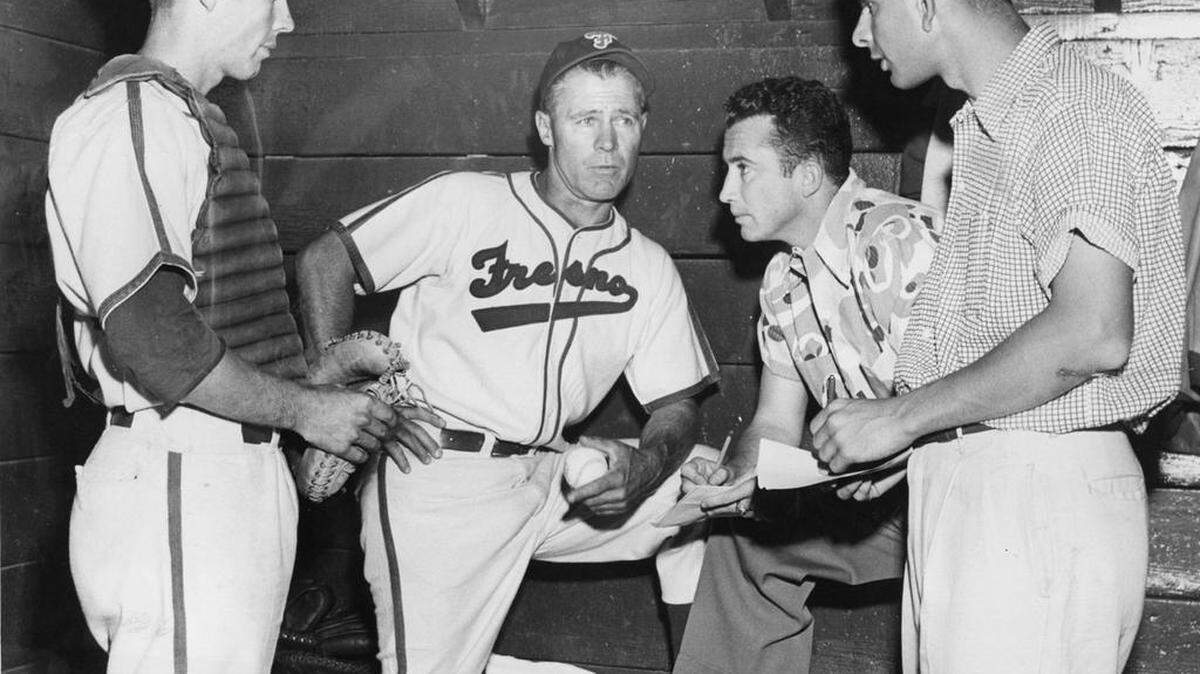
Editor’s note: This farewell column by sportswriter Bruce Farris first appeared in The Fresno Bee on Dec. 26, 2000. Farris died May 6, 2015.
“For it is by grace you have been saved, through faith — and this not from yourselves, it is the gift of God — not by works, so that no one can boast.” — Ephesians 2:8-9.
Even though I wasn’t aware of it at the time, it was by the grace and direction of God that an enthusiastic, sports-loving, but very green 21-year-old reporter came to work at The Fresno Bee sports department June 14, 1948.
The hiring was on a trial basis, but the job became permanent in September of the same year.
Fifty-two years later, at age 73, it’s time to scale back.
Beginning in January, I will work 121/2 hours a week. I will write an outdoors column, outdoors features and a fishing report.
No more stories on golf, football, baseball, basketball, track and field, bowling, swimming and diving, boxing, equestrians, horse racing/breeding, gymnastics, volleyball, handball, ice hockey, ice skating, judo, auto and motorcycle racing, rodeo, skiing, soccer, softball, tennis, weightlifting, wrestling, motor boats or yacht racing.
I may have left out a few, but I have written some stories, or a lot of stories, about each of these sports.
I probably will miss golf most of all. I hope to have more time to play the game I learned when I was 17 with a set of left-handed clubs borrowed from revered Fresno State football coach Jimmy “Rabbit” Bradshaw, courtesy of his son Jimmy Jr.
I also plan to do more fishing.
My hiring by Bee sports editor Ed Orman had to be by divine appointment. I did know sports, but I had never written a story for print until my senior year at Fresno High.
I never really had a clue what I would do for a job, because I couldn’t hit well enough to play professional baseball. It all started for me as sports editor of the school paper and yearbook at Fresno High.
At Fresno State, I was a sports writer the first year and sports editor the second.
I worked one year as the total sports staff for the Fresno Guide, where I was paid 10 cents for every column inch I wrote.
I also spent some time working for Ed Piston in the sports information office at Fresno State.
Finally, I was secretary and public-relations man for the 1947 Class C California League Fresno Cardinals. That was the sum total of my experience as a writer.
Not an impressive résumé. Certainly nothing to boast about. Today, I wouldn’t have been given the time of day.
Our offices then were in the old building on Van Ness and Calaveras avenues (which later became the Fresno Metropolitan Museum). It was there I climbed the stairs for the first time as a 5-year-old with my mother, Ruth, to visit my father, Ross, a Linotype operator.
My father hated the ice and snow of Michigan, where I was born, because he had lived in it for all but the four years he was in the Marines. With the Great Depression limiting jobs, he loaded up everything we owned in our Essex and moved to California in 1931. I was 4. Except for three years in Reedley and six months in Bakersfield, Fresno (and now Clovis) has been my home.
My father worked 50 years as a printer and finished his career with a 50-year certificate. He was only at the Bee a short time, but worked in job shops in Reedley and Bakersfield. He then was mechanical superintendent of the Guide before moving to the Bay Area.
My first desk at The Bee was a typewriter stand, complete with the oldest Royal machine in the office, and one small drawer. I was stationed only a few feet from Orman’s huge rolltop desk. Our sports department shared a small room with artists Art Buhl and Milt Young.
I was fourth man on the staff behind Orman, Omer Crane and Bert Dahlgren.
I had to pinch myself. Imagine! Being paid to cover a baseball game, a sport I loved with a passion.
We made carbon copies of our game stories to put on a spike so KMJ radio (also owned by McClatchy) could pick them up for its newscast. The entire sports staff worked those dreaded split shifts each Saturday to get the Sunday green section out.
We came in at 6 a.m., worked until about 11:30 a.m., went home and returned at 3:30 p.m. to work until midnight.
I was fortunate, because many Saturdays I was covering a game here or on the road.
Smoke permeated throughout the editorial room. Nearly everyone puffed on a cigarette, a pipe or a cigar. Drinking, with a few exceptions, was a way of life. Veteran Valley editor Michael Keyes once remarked, in jest, I think, that Tom Meehan and I were “disgraces to the profession” because we didn’t drink.
I would be remiss in not recalling that Orman and the late John Voenes founded the Fresno Athletic Hall of Fame. Tom Sommers, Bob Duncan and current president Pete Mehas have done a fine job of building on what Orman and Voenes started.
Another sure indication of divine guidance came in 1954 when an attractive blonde named Barbara Harper, working in the Bee business office, came to my desk and introduced herself.
Fresno State football standout Calvin Bell, one of her classmates at Delano High, had suggested she do so. Our first date was a high school football game. One year later, Sept. 4, 1955, on an afternoon with the temperature at 100, Barbara and I were married.
Forty-five years later with three children and seven grandchildren, the miracle continues.
My first managing editor was fiesty H.R. “Mac” McLaughlin. He retired a year later. Eight sports editors and counting. Writers and editors such as Terry Betterton, Bill McEwen, Eddie Lopez, Vic Pellegrino, Andy Boogaard, Lisa Burnett, Ron Orozco, Jeff Davis, Danny Edwards, Ken Robison, Bob McCarthy, Tom Meehan, John Rich, Rich Marshall and my deskmate for the past year, David White.
No newspaper has better people.
The transitions have been many.
From regular typewriters to electric typewriters, scanners (a two-year disaster) to computers, even a brand new computer system just a year ago.
Watching the change from hot type to cold type to pagination.
Calling in stories by telephone, using Western Union (the office was only two blocks from the old building) for local stories and Western Union operators from the site of big events, to portable computers and finally laptops.
Moving to our present building in 1974. Switching from an afternoon to a morning paper.
When I attended Fresno High, the only other high schools in Fresno were Edison, Fresno Tech and Roosevelt.
When I joined The Bee, the biggest annual sporting event in the city was the West Coast Relays. The greatest athletes in the world visited Ratcliffe Stadium.
It was also our busiest weekend of the year. The entire sports staff, many reporters from city side, news aides and the whole photography department participated.
All but two or three pages of our Sunday green section and a column or more on Page 1 of the main section were devoted to the WCR. The pole vault always ran late. I recall telephoning from a table adjacent to the pole vault pit at nearly 1 a.m. to make the final edition when Bob Seagren set a WCR record.
Of all the great athletes I ever met, none was a more humble gentleman or internationally recognized than Cornelius A. “Dutch” Warmerdam. His close friend, Payton Jordan, longtime Stanford University and U.S. Olympic coach, called Warmerdam “the last true amateur.”
It is easy to forget that some of the greatest athletes came from this area. When a German Olympic track and field coach made a trip to this country, one of his stops was Fresno just to see Warmerdam. He told me in his heavy accent, “I don’t know about this country, but in Europe, the biggest name is Warmerdam, Warmerdam.”
In the same category are Bob Mathias, Rafer Johnson and Tom Seaver.
I covered some Fresno State sports the year I joined the staff, mostly football and baseball. Within three years, everything at Fresno State was my beat until the early 1970s.
Golf became my principal duty, but in 1975, Jim Forbes moved to the front desk, and sports editor Bob Molander handed me the outdoors assignment. I was 48. It was a whole new learning experience. I’m still at it.
Even with shortened hours, I still will write about people, the real joy of my career. The greats, near-greats and not-so-greats.
Those whose names are firmly encased in Halls of Fame and internationally recognized. Others who are mainly household names in our area.
Some who maybe had one game or one play that forever endeared them to their school’s followers.
But a flood of memories.
There are so many names and sports I could mention, all special, it would take a book. Some very brief highlights.
Football
One memorable interview while I was at Fresno State was with the legendary Amos Alonzo Stagg, 83 at the time and coaching College of the Pacific in Stockton. He told me about his promising young quarterback Eddie LeBaron.
I also remember Stagg and his wife, Stella, scouting Bulldogs games from the press box. Stella always diagrammed plays.
Saw my first Rose Bowl game in 1947, the first year the Big 10 and Pac-8 (at the time) signed a contract to send their champions each year. One of my favorite games.
Covered several classic USC-Notre Dame games, including in 1972 when Anthony Davis scored six touchdowns against the Fighting Irish, one on a 100-yard kickoff return. That same night, I covered Fresno State-Long Beach State, and on Sunday, the Rams-49ers. Full weekend.
The East-West Shrine Games in usually freezing Kezar Stadium when both teams had eight to 11 first-team All Americans. It was the premier All-Star game for many years, and Kezar Stadium was sold out.
The Big Game between Stanford and Cal, where Clovis’ Lloyd Merriman starred.
Saw my first Fresno State football game in 1938 and didn’t miss too many from then until the early ’70s. Fresno’s starting tackles, Ernie “Go Dogs” Benck and Bob Hoffman, worked for my father at the Guide.
My most memorable game was the Mercy Bowl in 1961 when Fresno State routed highly favored Bowling Green 36-6 in the Los Angeles Coliseum.
The game was played to benefit widows, children and survivors of the 1960 plane crash in Toledo, Ohio, which took the lives of 26 Cal Poly players. Fresno State beat Cal Poly the week before the accident.
In the Mercy Bowl, Fresno State was outweighed and outmanned, but coach Cecil Coleman launched an air attack from the opening play with quarterbacks Jon Anabo and Beau Carter, which surprised and frustrated the big but slower Bowling Green team.
Bowling Green coach Doyt Perry boasted his team could play with anyone in the Big 10. But Coleman’s Red and Blue teams (they substituted every 71/2 minutes) dominated every phase after blocking an extra-point attempt that made it 7-6.
Fresno finished 10-0 and No. 3 in the small-colleges poll. Coleman was a stern but excellent coach. His assistants Kenny Gleason, Bob Burgess and Bob Van Galder complemented him to a T.
Coach Clark Van Galder did more with fewer scholarships than any Bulldogs coach I covered. His 21-21 tie with Pacific when the Tigers were one of the best teams in the West was a minor miracle. The whole Van Galder family impacted football in this city.
I was a spectator in the press box at the official opener of Bulldog Stadium (something I never thought I would see in my lifetime) when Fresno State played and defeated Oregon.
During the time I covered the Bulldogs, perhaps the best running back pound for pound was Dale Messer. He had sprinter speed and was durable and versatile. The strongest big running back was Dean Philpott. He could have played for any team in the country.
Two of the best junior college coaches ever, Hans Wiedenhoefer and Clare Slaughter, turning the Rams into the state’s best.
Sitting in the crow’s nest at Sanger High and watching Tom Flores perform for the Apaches, then for Pacific and the Raiders. He coached the Raiders to two Super Bowl titles. His top assistant was Sam Boghosian, whom I followed through Fresno High, UCLA as a player and an assistant coach at UCLA and Oregon State before joining Flores.
Les Richter, Fresno High, of the California Golden Bears and the Los Angeles Rams. He, along with Charle Young and Daryle Lamonica, were high school players who could dominate a game on their own. Richter still is the only professional player to be traded for 11 players.
Darryl Rogers as a player, amateur and pro, and as a coach at Fresno State, San Jose State, Michigan State, Arizona State and Detroit Lions.
Jim Sweeney. We first met when he coached the Montana State Bobcats. Dennis Erickson was his quarterback when the Bobcats thundered Fresno State in Bozeman. The assistants he funneled into head or assistant jobs, the players who reached superstar status in the NFL and his “stadium building” teams are a testimony to his impact at Fresno State.
Baseball/softball
The first name that comes to mind is Pete Beiden. He influenced baseball in the central San Joaquin Valley as no one else has. Three of his pupils — Bob Bennett, Len Bourdet and Ollie Bidwell — were premier coaches in college, junior college and high school, respectively. Many years ago, every high school coach in the Valley at that time had played for Beiden. It was my privilege to cover most of the games and players he coached at Fresno State and some of those with Bennett as coach.
The Fresno Cardinals and the Fresno Giants. So many nights sitting in the press box never knowing what to expect. You could name a Hall of Fame lineup from the players who performed in the fastest Class C (Cardinals) or Class A (Giants) teams in the country. One player? Pitcher Larry Jackson who won 32 games for the Fresno Cardinals and four in the playoffs, then later starred in the majors.
Standing around the batting cage at Candlestick Park with longtime San Francisco Chronicle baseball writer Bob Stevens, watching a batting-practice home run exhibition I will never forget. Orlando Cepeda, Willie Mays, Willie Kirkland and Leon Wagner of the Giants, and Eddie Mathews, Del Crandall, Hank Aaron and Joe Adcock of the Braves. Each player took one swing and hit the ball into the stands. This went on for several rotations and very few balls stayed in the park.
The weeklong free Fresno Bee baseball schools, where nearly 600 boys from all parts of the Valley took part for several summers at Euless Park. Beiden, Monte Pearson, Jack Savory, Jud Simons, Hal O’Banion and Alex Metzler were just a few of the teaching staff. Many of Fresno’s finest players got their start or polished their skills at these schools.
The Fresno Twilight League, where the best players in the area from high school on up played in the evenings at Holmes Playground, climaxed by the City Championship Series.
Al Radka’s famous Hot Stove League dinners, which attracted some of the best players. Willie Mays came once, Willie McCovey many times. Johnny Bench. Joe Morgan. Radka enticed eight to 10 every year because of the treatment they received.
During World War II, I watched some of the best baseball ever played in Fresno. Sundays, the Hammer Field Bombers and Roma Wines teams would combine to play visiting teams from other state air or army bases loaded with major leaguers.
Softball was such a big part of the sports scene early in my career and before. Some of the best played for the world champion Fresno Rockets, Hammer Field and Hoak Packers. That has carried on with Fresno State.
Basketball
Covering the NCAA Tournament in 1968 when UCLA beat North Carolina in the finals in Lew Alcindor’s (Kareem Abdul-Jabbar) junior year and again in 1972, Bill Walton’s sophomore year when Florida State was the finalist. Memorable interviews with John Wooden then and later at a Fellowship of Christian Athletes camp.
Covering the Bulldogs when they played home games at Roosevelt High, at what is now the North Gym and at Selland Arena. Remembering that for every brilliant Lonnie Hughey, Gary Alcorn, Maurice Talbot or Len Tucker was a group of gritty competitors such as George Sarantos.
Harry Miller was in my estimation the finest Fresno State coach before the arrival of Boyd Grant. Miller learned his basketball in Indiana where the sport was a religion. In his first season, Miller’s team upset top-10-ranked Arizona State in Fresno. Many of his home games were standing-room only at the campus gym.
Dutch Warmerdam, one of Fresno State’s finest players, was coach when I began covering the team. He was coach when the basketball gymnasium was built on campus. The night it opened, it rained and one corner of the gym leaked.
Warmerdam was followed by Clark Van Galder, Jerry Tarkanian’s coach who taught firehouse basketball, but only did it for a year. Bill Vandenburgh was next. One of his biggest wins was a 1957 upset of University of San Francisco the year after Bill Russell graduated. Phil Woolpert’s great NCAA championship teams with Russell and K.C. Jones beat Fresno State home and away. Ed Gregory, who followed Miller, also had some fine teams. One big moment was an upset of one of Tark’s best Long Beach State teams.
There may have been players do it before, but George Yardley of Stanford was the first I saw dunk a ball. It was during a game with Fresno State in Palo Alto in 1948.
High school basketball classics between Edison, coached by Elam Hill, and Fresno High, led by Joe Kelly. Ditto for JC battles between Kelly and Polly Wilhelmsen of College of the Sequoias, and later John Toomasian of Fresno City and Tom Gilcrest of COS. Fresno’s state title won by Kelly in the Roosevelt gym with a team powered by Alcorn, R.L. Benson and Odell Johnson.
Sitting next to Harlem Globetrotters front man Jesse Owens and conversing with him the whole time we watched the famous basketball team do its thing. During another Trotters appearance in the old Fresno Ice Rink, the ice underneath the wooden floor created a thin layer on the floor and prompted the Trotters to do their act in slow motion.
Covering the Warriors-Lakers exhibition game in Selland when Magic Johnson was a rookie. Another between the same teams when Jerry West sprained an ankle.
Track and field
J. Flint Hanner was coach at Fresno State well before I began writing. Warmerdam was his assistant. With the exception of baseball and wrestling, no sport has had so few coaching changes. Hanner retired in 1960, Warmerdam in 1980, Red Estes in 2000 and now Bob Fraley takes over.
The great dual meets with San Jose State, Stanford, Michigan and UCLA. The West Coast Relays, Modesto Relays, Coliseum Relays, world records galore. The National AAU meets in Bakersfield and the one in Fresno. Sprints, hurdles. In those days I handicapped all the meets. Great fun.
The first U.S.-USSR dual meet at Stanford. Coach Payton Jordan directed a sensational two days that filled every seat. I sat at a press table adjacent to the finish line with famed sports editors/writers Bill Leiser, Paul Zimmerman, Bob Brachman, Maxwell Stiles, Russ Newland and Art Rosenbaum, among others, and felt a little in awe. The U.S.-Russia meet in Los Angeles couldn’t quite capture the spontaneous jubilation of the first.
The state high school meet in 1953 was switched from Southern California to Fresno at the last minute because of weather problems. Leamon King of Delano swept the 100 and 220 sprints, and Bob Seaman of Reedley won the mile.
Some of my favorite Fresno State runners and jumpers. Darel Newman, Sam Workman, Charley Craig, Ervin Hunt, Ancel Robinson, Mike Agostini, Sam Workman, Les Laing, Herbie Turner, Jack Wilcox, Erki Mustakari, John Warkentin. Fresnans who went elsewhere Gene Johnson, Randy Williams, Phil Conley, Maxie Parks.
Covering the U.S. Olympic trials in Lake Tahoe, where I first saw the Dick Fosbury flop that forever changed the high jump.
Bob Mathias, the 17-year-old boy wonder from Tulare who won the 1948 and 1952 Olympic decathlon gold medals and inspired Rafer Johnson of Kingsburg to do the same. No better and graceful runner than Tommie Smith of Lemoore. Lee Evans was almost as fast, but a pounder. He could run down a cheetah.
Fresno City coaches Paul Starr, Erwin Ginsburg, Bob Fries and Ken Dose producing a number of state champions.
Golf
In 1973 at the Crosby Pro-Am, I walked inside the ropes for the first time, and Jack Nicklaus won the tournament. This year I was inside the ropes for the last time at the U.S. Open, which also was at Pebble Beach, and Tiger Woods won. The best golfer of the century and the best ever. Difficult to top that. My most memorable moments covering PGA Tour events were either at Pebble Beach, the Olympic Club and the Riviera Country Club.
All the Fresno City Amateurs. Again, the people. Not only winners, but the participants. Double-winner Conrad Nilmeier used to report high school golf scores for The Bee when he was at Roosevelt High. Mike Paniccia and son Danny are the first father-son to win. Mike Barr and Joey Rassett won while still teen-agers. Director Bill Finn was so much help.
Some of the best club professionals anywhere: Paniccia, Gary Bauer, the patriarch Steve Menchinella, Bob Silva, Allen Ehnes, Howard Roseen, Gordon Knott, Ray and Art Forrester, Steve Adams, John Echols, Chuck Banks, Ron Goering, Hap Rose and the venerable duo of Art Melville and Grant Halstead.
The joy of covering most of the Fresno Juniors so ably directed by Len Ross, one of the finest human beings I have ever met. Ditto for his wife, Vel. Watching a never-ending string of youngsters go on to college and professional careers.
So many officials, Dick Mefley, Frank Parr and John Sirman, were a big help to me.
Tim Norris, still Fresno State’s only first-team All-American; Bill Glasson, who grew up only a few blocks from us; Joe Acosta Jr.; Mike Springer; Jerry Heard; Shelley Hamlin; Joan Pitcock; and Kathleen Scrivner.
Mike Watney, former Fresno City champion, Fresno City and Fresno State star, who has been a fixture as Bulldogs coach for 22 years.
Looking forward to our first USGA Amateur Championship in October at the San Joaquin Country Club, even if I won’t be covering it.
Now, if you don’t mind, this is where I will end it.
This story was originally published May 7, 2015 at 7:24 PM with the headline "Bruce Farris: A storied career."