
Fresno students sound off on Costco hot dogs, foster care, one’s legacy, top speech | Opinion
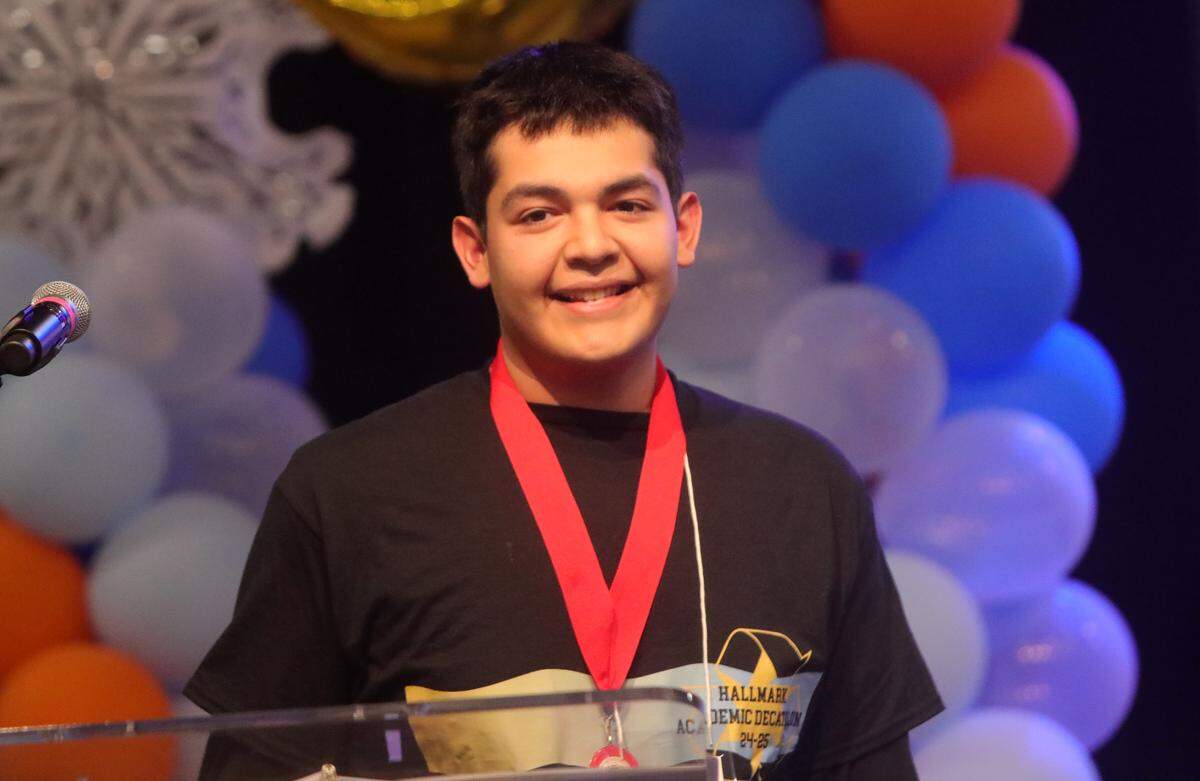
Fresno County Superintendent of Schools Michele Cantwell-Copher just concluded the 43rd annual Fresno County Academic Decathlon held Feb. 1 at Sunnyside High School. Hallmark Academy of Sanger captured the team title, ending a 5-year winning streak by runner-up University High. Hallmark Academy will compete at the state Academic Decathlon March 20-23 in Santa Clara. University High’s Madeline Hu was the top-scoring individual with 9,523.4 points.
The Bee, in coordination with the Office of Education, is pleased to present this year’s four winning speeches that have been lightly edited.
— Juan Esparza Loera, Bee opinion editor
The impact of misinformation
In 2022, a tweet was put out stating that the price of the Costco hot dog would be raised by $1 due to inflation. This sparked an outrage. People were panicking, from the average person doom-scrolling during lunch break all the way to the House of Representatives, who retweeted the news with great concern. People were scared that a staple of Costco, nay, the free world, served as the post-pandemic financial tipping point.
I mean, the price of the hot dog had remained unchanged since 1985, the era of the fall of the Berlin Wall and the end of the cold war... capitalism had won in the 80s, but would it now fall one giant sausage at a time? Perhaps not, since one main detail that the public would overlook is that this story was completely fake. The original tweet was actually put out by a parody account meant to elicit a response of humor.
So the $1.50 hot dog seems to be safe, for now. But this situation does call to mind how people can take information at face value. All it took was a flashy headline to send the internet into an uproar. It makes us wonder, how do we even fall for this? In media, it has always been difficult to discern what’s true. Perceptions can become misleading, and observable facts and details can be intentionally misconstrued.
Perhaps, these impacts of misinformation are found most prevalent in the field of news media. In the era of the newspaper, their popularity made them quite susceptible to misinformation. This intentional deception fell under the old term “yellow journalism.” The exaggeration of a few key details or downright falsehoods can sometimes end up influencing U.S. diplomacy, as was the case in the events leading up to the Spanish-American war.
In the 1890s, relations between Spain and America were strained due to the revolutionary movement within Cuba. When an explosion sunk a U.S. battleship in Havana Harbor, initial reports concluded that the explosion occurred on board, and various media outlets seized upon this event to push for war on Spain. Clearly, the most extreme impact of misinformation happened here... it caused a war! Here we see “yellow journalism” weaponizing current situations and distorting related facts in order to push an agenda.

And here we are in 2025, in a complicated environment where the line between fiction and reality became even more blurred. The rise of social media around 2007 birthed a mass communication revolution, where it became as easy as ever to access and view information not only from one’s friends, one’s community, and one’s nation, but from around the globe.
It’s just as easy to announce a baby shower as it is to put a bunch of world leaders’ faces on a couple of guys hanging around on a beach somewhere with the caption, “Uncovered! The Prime Minister of England’s secret meeting with Putin!” We used to ask “is it true?” but now we must also ask “is it even real?” and maybe most importantly, “what is the purpose in telling me this?”
The truth has always been tricky, serving equally to inform us or enslave us to our fears. What do we do? The answer is perhaps two-fold. Good old intuition can still help, but we can also lean on technology. Ironically, the same portal of misinformation weaponized to cater to our fears can also be a resource to root out the truth. So be a truth seeker.
Challenge the algorithm, ask the questions, look for the source, because being able to get to the truth may set us free after all.
Foster care fixes needed
Imagine this: you wake up, expecting today to be like any average workday. You brush your teeth, walk the dog, you might even talk to your family before grabbing your keys and heading to work. Now imagine that the police show up at your workplace, demanding that you pick up your entire life and move to a different city within the next week. You are only allowed to bring the clothes on your back, and no matter how hard you plead, no matter how much you cry, you have to leave your stuff, your home, and your family with no indication that you will ever see any of these things again.
This isn’t the plot of some Orwellian dystopia. Every day, tens of thousands of people – children in fact – suffer through this exact scenario in the foster care system. Just last year, 17-year-old Jacob Doriety committed suicide because of the failings of this overworked, flawed system. He was moved 50 different times, and when the government could not find adequate foster homes, they sent Jacob to hotel rooms and rehab centers. Today, I want to specifically talk about two glaring issues in the United States’ foster care system: a lack of trained foster parents and a lack of stability for kids.

One of the harsh realities of foster care today is that the number of foster kids in the system far outweighs the number of foster parents – especially qualified ones – available. According to the University of Chicago, the total number of foster kids in 2023 was between 350,000-400,000, but the number of licensed foster homes was only around 200,000.
Additionally, the rate of foster parent retention – or the rate of foster parents who decide to continue foster parenting – is also decreasing. This is because foster parents frequently experience a lack of agency support, poor communication with case workers, and no say in a child’s future. In aggregate, this means that the system is running on borrowed time.
As the number of foster parents decreases, local, state, and federal governments are scrambling to find housing for all of these kids, resulting in situations where kids are being placed in group homes, college dorms, or even prison cells. As a community, we need to support foster parents – whether monetarily or through advocacy – in order to make sure that each child has a roof to sleep under each night.
However, we as a community must also individually support each and every child who enters this system. I believe that foster children do not receive nearly enough emotional or physical support, considering how traumatizing their circumstances are. Think about it. Each foster child had a family, a home, or a support system from which they were torn away. This scenario is already nightmarish for any emotionally-developed adult, so imagine how confusing and scary this is for a five-year-old who may not fully grasp concepts like “abandonment” or “the law.”
According to the American Academy of Pediatrics, up to 80% of children in foster care have some significant mental health need, but these needs often go ignored in the system. Additionally, many of these kids’ physical health needs are ignored due to the difficulty of tracking their medical paperwork. According to a report by the Government Accountability Office, 12% of surveyed foster kids received no routine healthcare and 34% received no immunizations.
It is about time that we confront this reality, work together, and find solutions in order to ensure that every child gets the chance at life that they deserve. I must admit, I was ignorant to what foster care even was until I encountered Jacob Doriety’s story, but once I became aware, I knew that I needed to spread awareness about this issue. And now that I have shared this information with you all, I hope that you consider aiding these children yourselves, whether it be through donations, volunteering with foster organizations, or even becoming a foster parent yourself! After all, these are our most vulnerable citizens, and if we do not help them, who will?
A modern day hero
Dearly beloved, we are gathered here today to honor a life. Here lies Axel Daniel Buchdid. A modern day hero. He achieved world peace, solved world hunger, cured countless diseases, and, even saved little kittens from trees. His days alive will certainly be remembered the world over. In many cities, statues will be erected to honor his accomplishments. He was an honest, courageous, and ambitious man whose legacy will span generations!
This is everybody’s dream: praise, glory, remembrance! Why though, why do we crave to not be forgotten? You may think this is a morbid train of thought, but the truth is we all think it. Rationally speaking, being forgotten is not all that bad! Every embarrassment and mistake will be forgotten, and anyway, why do we care? It’s not like we will be there to care ... wait, but that’s the exact reason we won’t be there.
When faced with death we can not be rational, the cold hard truth of our future non existence is, understandably, frightening. That is why we dream of legacy, to leave a permanent mark, a footprint on the fabric of reminiscence.That is why we want to be remembered.
This, however, raises another even more important question. What qualifies as “remarkable”? What does it take to be remembered? According to the American Psychological Association, personalities consist of our traits, drives, values, and interests. We ARE the things we experience, and grow with. Well that means one thing: NOBODY will be remembered forever. Never be
remembered? What?! I can still remember the greatest musicians: Beethoven, Mozart, Bach. I still remember the mathematicians and scientists who have changed our world: Newton, Einstein, Fibonacci. But do I REMEMBER them? I know their names, but is the name synonymous with who the person was? I don’t remember what they were like, what their favorite things were, or what they did in their free time.
What makes each individual’s personality unique could never be fully recalled. The fact is the memory is not in the history book, the archived file, or even the tombstone. The greatest achievements of history do tell us something about the people who made them, but never the whole story.
So are we doomed to irrelevance? We are not. While I did not know Beethoven personally, his family, and friends did. While I did not know my great great great great grandfather personally my great-great-great-grandfather did. We are already an important part of the lives of everybody we hold close. We create impact every day through our words, and actions. To spend our whole lives chasing a goal that has meaning to everybody is honorable, but not fulfilling, as it is not from our own desire to do good, but the selfish desire to be thought about.
“Remarkable” does not mean solving an international problem. It means serving the people you love. Remembrance involves not the extraordinary, but instead, the mundane. Personally I have faced the question of legacy as a cancer survivor, and I have made my decision. I am determined to be remembered for what makes me and, as a result, others happy. Like the time I played with my little brother, or the time I helped my mom.
The impact you have on people through personal actions is a legacy that goes beyond remembering your name, and is only felt through the future positive changes you inspire. So let’s go back and make things simpler.
Some day they’ll say, “Here lies Axel Daniel Buchdid, son, brother, friend, but most importantly, himself.”
How to deliver a great speech
As my esteemed audience is likely very aware, every year, the gracious volunteers of the academic decathlon donate their time to listen to students give their speeches. The topics of these speeches range from heartwarming emotional stories to informative pieces on the world’s most pressing issues.
In the hopes of delivering an effective speech, I went through several different ideas of what I should talk about: single parenthood, gifted kid burnout syndrome, and even the downfall of Ubisoft’s Just Dance franchise. Now, I hope you didn’t find any of those topics too interesting, because after a long period of thoughtful deliberation (by which I mean crippling inaction for 3 months), I decided to go with none of them.

Instead, the topic of my speech today is public speaking – specifically what separates a successful speech from an unsuccessful one. The first and possibly most important aspect of giving a speech is voice. For speed, it should not be so fast that words get slurred, nor so slow the audience grows bored of hanging on your every word and simply decides to fall off. A successful presentation is given at a moderately loud volume with vocal projection so that people sitting at the back of the room can still hear what is being said.
Speaking quietly is murmuring and no one will be able to hear you. However, being too loud and up here FLATTENS YOUR TONE AND DISTRACTS FROM WHAT YOU ARE SAYING BECAUSE YOU ARE YELLING.
And that brings me to my next point about voice:vocal inflections. Because sometimes words themselves are not enough to keep people’s attention. While it may be harder to do because of memorization, the simplest way to achieve enthusiasm and passion is speaking conversationally with performative emphasis on a few words. That’s what a speech is, in a sense, a conversation in which you are the only one that gets to say things. The point being that you are connecting with the audience despite the dialogue only going one way.
Speaking of connecting with the audience, good consistent eye contact goes a long way. Even though you are the only one talking, you are still talking to other living beings, and by making direct eye contact, you acknowledge them. Now, what I’ve talked about thus far has been everything above the neck. This begs the question: What should I do with the rest of my body. A question to which I would respond: what other people do with their bodies is intimate knowledge I would rather not have. Just kidding. I would say that it depends on the context of your speech.
Gesturally, your hands and overall body language should emphasize what you are saying. Large passionate gestures paired with controlled pacing are good for high energy speeches in which you feel strongly about something and want your audience to feel strongly about it too. Smaller accent gestures with a more relaxed stance can be used when you’re addressing your audience conversationally (yes I do love this word) But the most important thing is not getting too distracting with your body language.
This is where we get into fidgeting territory. And I bet right now you, you are thinking about how I am playing with my tie and not standing still and it’s distracting from the wonderful, brilliant words I’m saying. But that’s enough of that.
So we have voice and body language, but what else goes into a successful speech? My final point about delivering the most perfect, amazing speech of all time is preparation. A good
speaker takes the time to write and revise their work, carefully plan their delivery, and execute
that speech even better than when they had first envisioned it.
And now it’s time for me to make a deep, dark confession. I am not a good speaker, for I wrote this speech this morning and did not practice it nearly as much as I should have. But hey, two out of three isn’t bad! I hope despite me being a little bit sardonic and a lotta bit silly, you enjoyed my theatrical retelling of abridged presentation guidelines we all were taught in fifth grade. I ask that if at any time you noticed me not following my own advice you believe it to be entirely intentional and for the sake of demonstration. All that about saying things being said, thank you very much for your time.
This story was originally published February 4, 2025 at 5:30 AM.