Comparing Donald Trump to Jefferson Davis over insurrection and the presidency | Opinion
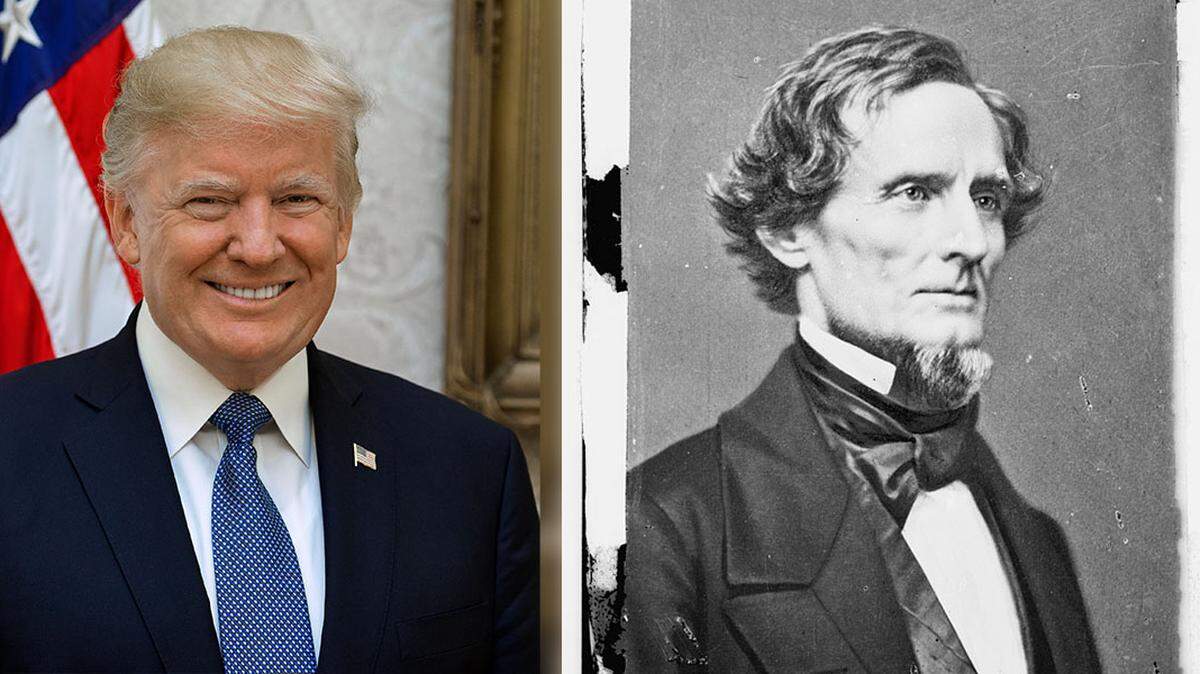
Before the U.S. Supreme Court is whether Section 3 of the 14th Amendment, which bars certain persons who have engaged in insurrection against the Constitution from holding office, applies to presidential candidates.
The matter is at the Supreme Court because the state court in Colorado found that the presidency was not an “office” and the president was not an “officer.” The Colorado Supreme Court reversed that decision, a finding that would keep Donald Trump off Colorado’s Republican primary election ballot.
The focus of both Colorado rulings was whether then-President Trump engaged in insurrection when the Jan. 6, 2021 Capitol rioting occurred.
If Section 3 does not apply to presidential candidates, the defeated Confederacy’s president, Jefferson Davis, was potentially eligible to be elected the nation’s president after the Civil War. Can this be right?
Section 3 states in relevant part, “No person shall … hold any office, civil or military, under the United States … who, having previously taken an oath … as an officer of the United States … to support the Constitution of the United States, shall have engaged in insurrection…against the same.”
If the presidency is not an “office” within the meaning of Section 3, or if the president is not an “officer” within the meaning of Section 3, Davis would not have been barred from being elected president after the Civil War.
The two main features of Reconstruction were: (1) presidential reconstruction between roughly 1865-67 that favored the ex-rebels and that Congress jettisoned, and (2) congressional reconstruction from roughly 1867-75 that favored civil rights. The history of how these two parts developed shows that Section 3 of the 14th Amendment did bar Davis and others who fit its terms from being elected president.
After Abraham Lincoln’s assassination, Andrew Johnson became president in April 1865. Congress had adjourned in March 1865, and did not reconvene until that December. While Congress was out of session, Johnson, a Tennessee Southerner seeking to lord over and curry favor with leading ex-rebels and other Southerners, offered a general amnesty to former rebels, except for high-ranking ex-rebels. The latter had to apply personally to Johnson for a pardon.
Once they were pardoned, they took control again of the former Confederate states with the exception that those states had to ratify the 13th Amendment that outlawed slavery, which they did, while adopting onerous Black Codes that were virtually as harsh, and even harsher in some respects, than slavery. They also promptly elected ex-rebel leaders to the U.S. House and Senate.
When the Republican-controlled Congress returned in December 1865, members were aghast. Congress refused to seat these ex-rebels, and enacted a sweeping law to protect Black civil rights. Congress readily overrode Johnson’s veto. Then in June 1866, Congress passed the 14th Amendment for ratification by the states. The amendment further protected civil rights and included the disqualification provision noted above.
Johnson’s ex-rebel state governments refused to ratify the 14th Amendment, which then fell short of ratification. In 1867, Congress adopted its first Reconstruction Act. This created five military districts over 10 ex-Confederate states. The military was to oversee state conventions to draw up new state constitutions and was empowered to abolish the Johnson-backed governments. Blacks would have the right to vote for delegates to the conventions; the state constitutions had to provide for black suffrage. Each state had to ratify the 14th Amendment.
Congress readily overrode Johnson’s veto of this Reconstruction Act. In his veto message, Johnson wrote: “The military rule which it establishes is plainly to be used…solely as a means of coercing the people into the adoption of principles and measures to which it is known that they are opposed….” The white South remained rebellious. Davis was unrepentant.
The ex-rebel leaders had generally dominated the national government before the Civil War. They would dominate it again if given the chance. Pre-war, many had given oaths to support the Constitution as officers of the United States government. Davis had been a representative, senator and secretary of war. He and the others then caused a calamitous insurrection and blood-letting that aimed to destroy that Constitution. They were militarily smashed, but unrepentant and again seeking dominance.
Congress was not about to let that happen. Section 3 of the 14th Amendment applied most emphatically to the presidency. In ratifying the 14th Amendment by 1868, the states, and especially the integrated state governments of the period of congressional reconstruction, which violent white supremacists later ousted, undoubtedly saw Section 3 as barring Davis from being elected president.