Once refugees seeking refuge, Armenians can relate to Ukrainians and their plight
There was always a spirit of whimsy in the breakfast conversations Dad and I had in my high school and college years, although there was, simultaneously, always something to ponder.
When he suggested one morning that I should become a psychologist because it was “like being a bartender, except you charge your customers $100 an hour,” I assumed he was kidding. When I eventually became an English major, he thought I should “Write a book about words.” And when I told him Webster had him beaten by 100 years, he said, “The history. The history of words.” I shared his interest in words and their history. I woke up this morning 48 years after that conversation thinking about a word I first encountered when I was 9 years old:
▪ Refuge (noun): A condition of being safe or sheltered from pursuit, danger, or trouble.
At the house I grew up in in Southern California, the scent of gardenias will follow you on your way to the front door, which faces north, on Verdugo Avenue, westbound cars heading to North Hollywood, eastbound cars to Glendale. The doorknob is worn smooth, the doorbell makes an ugly buzzing sound; don’t use it, just walk in. Go straight back past the oversized couch and Dad’s oversized chair with the ottoman, past the dormant fireplace, to the door that opens to the hallway on your right, and the kitchen on your left. Flick the light switch with the bright, echoing sound, and walk down the hallway, past the floor furnace and the linen closet with Chinese checkers and “Rules of Baseball, Illustrated” in the bottom cabinet.
There, opposite the hall closet hiding the Electrolux vacuum cleaner and emergency bottles of water, on the wall that separates the two bedrooms, is a vanilla-colored piece of hard plastic shaped like an open Bible, hanging on a golden string. On the left “page” is a decal of Jesus holding a shepherd’s crook, looking at sheep that are resting, positioned randomly around Him. On the right, a Bible verse, “God is our refuge.”
That’s me, halfway through 3rd grade, studying the image and the words. My big brother emerges from our room. I point to a word and say to him, “What’s that word?” He sleepily suggests I sound it out. “Ref, ref, f-f yugee?” But he’s already heading to the kitchen.
I thought of the word one recent morning while pondering the fate of Ukrainian refugees, present and future. Refugees seeking refuge. Running from danger and death to safety and life. Countries all over the world have taken in Ukrainian refugees.
▪ Refugee (noun): A person who has been forced to leave their country in order to escape war, persecution, or natural disaster.
If God is our refuge, isn’t that the model for us?
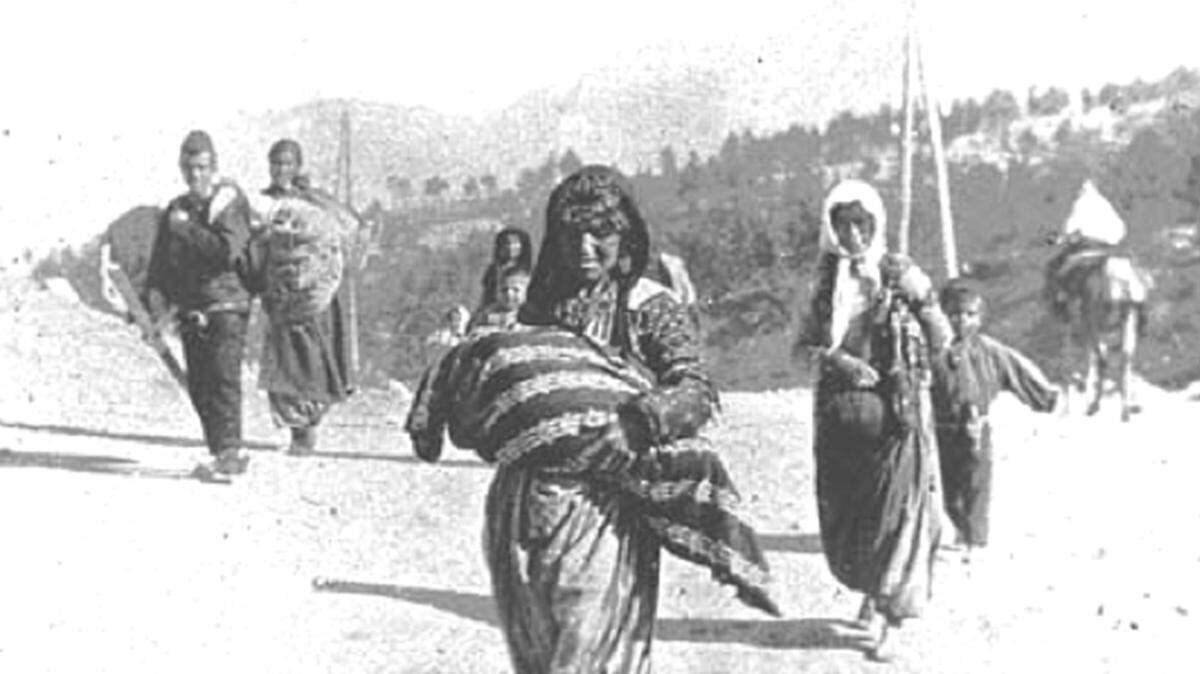
Armenian Martyrs Day, 2022 is an opportunity to see how things connect, and unfortunately, repeat. My great-grandmother was in her early 20s with a 5-year-old daughter when Turks attacked her town without provocation, the houses of Armenian families set on fire and the Armenian people murdered as they ran out. In my great-grandmother’s case, a Turkish neighbor offered refuge.
Here is what my Grandmother wrote in her journal:
“We were lucky in a way. My grandfather was well known and respected by the Turks. He was asked by a Turkish family to bring all his family and if he had valuable things to store them in his house. Thus we were protected and cared for by this Turkish family whom my grandfather had befriended.
“The day before the massacre my mother and other members of the family carried most of our household goods over to where we were to stay for two weeks.”
Ruminate, ponder, hold it in your mind and don’t forget, reflect, consider the outcome had that Turkish family accepted the social, political, governmental norms about who Armenians were, how they were considered a threat, a menace, an apostate to Turks. How did that family reach the conclusion that Armenians do not deserve to be abused, displaced, and murdered? How did that family come to reject the notion, “I will help my fellow human, but not you”? And how did they move from knowledge to benevolent action?
As of Friday, there are estimates of as many as 11 million Ukrainians, women, children, men, displaced out of house and home. On Sunday, Armenian Martyrs Day, let’s connect all the dots. We are, as it turns out, all on the same big blue marble. Surely positive things have been and will be done collectively, institutionally. What about individually? What’s in our heart, mind and soul? What can we think, say and do? On this Armenian Martyrs Day, let’s connect all the dots. Every soul is sacred.