
The fallout zone: Playing autumn sports in the San Joaquin Valley’s dangerous air

After 16 months of marching to the dictates of a pandemic, the San Joaquin Valley was eager to return to the rituals of fall: in-person school, pee-wee soccer, cross-country meets and, most cherished of all, Friday Night Lights. In late August, the boys put on their pads, the cheerleaders honed their halftime routines and the bands rehearsed their battle hymns. Parents and students took seats in the 5,000-watt stadium glow.
There was only one problem: the Sierra Nevada.
The forest was burning, releasing a bounty of ash and energy the equivalent to 1,500 Hiroshima bombs into the Valley air basin. PM2.5 particles — small enough to bypass the lung’s mucus membranes, enter the bloodstream and cross the blood-brain barrier — rose to a concentration that exceeded the EPA’s annual limit by 600%. The Valley, a headline in The Bee shouted, had the most polluted air in the world.
On that first Friday night, I pulled out my cell phone to look at the livefeed of the PAGMETER — Nick Papagni, the self-proclaimed Godfather of Valley Sports. I wanted to see if better heads had prevailed, if the air district or the school district or the athletic directors had canceled any games. It seemed obvious to me that the sky was too brown and the air too smoky to play. The AQI was hovering around 150, “unhealthy” for everybody. Yet not a single game that first Friday night was postponed or canceled.
The next week, as fresh wildfire smoke poured into the plugged-up basin, the air got even worse. But only a handful of games across the Valley were canceled.
The few cancellations in the name of public health sent Papagni, who has nearly 14,000 Twitter followers and his own weekly show on Fox Sports radio, into a tantrum. “What in the world is going on! Schools are letting people make decisions for our kids that were breast-fed until they were 4 years old. Soft and shouldn’t be in the kid business.”
Papagni wasn’t a lone voice in the diehard Valley. In fact, his was the dominant opinion. All the public watchdogs were on board. Neither the Central Section of the California Interscholastic Federation nor the San Joaquin Valley Air Pollution Control District nor Fresno Unified issued a statement or warning about the safety of playing outdoor sports in unprecedented smoke. Things passed like they were normal.
Cloudy decision-making
I played sports in the Valley all my life. I played in air polluted by mega-dairies, the almond harvest and the smog of sprawldom. But I never played in the shadow of wildfires. I’m only 23 now, but the air in my childhood was far less dangerous than what kids are facing today.
This summer, a 4,000-page report from the International Panel on Climate Change declared that the Holocene, the geologic era that humans have lived in for the previous 12,000 years, ended in 2020. In the gravest sense of the word, we have entered a new climactic age. The Valley, which already ranks as the worst air basin in the country, has now emerged as the primary fall-out zone for California’s rapidly deteriorating environment. Between June and September, the days when the air wasn’t polluted with wildfire smoke, were an exception.
What were the actual health risks that student-athletes faced by playing in a smoke cloud, day after day? Were these conditions being properly measured and monitored by the air and school districts? Were regulators and bureaucrats responding with sufficient alarm? Were there ways to mitigate the harm, or did the pattern of unrelenting wildfires require a fundamental rethinking of fall sports in the Valley?
These seemed to be questions we weren’t asking ourselves. Amid the worst of the smoke, it wasn’t uncommon to see young mothers and fathers walking down the block pushing their babies in strollers. One of my neighbors, a young graduate from UCLA, joined hundreds of others to run a half-marathon in the most hazardous conditions. As a community, we seemed to be sleep-walking through the haze. It was as if the smoke had struck us blind.
Monumental crisis
The San Joaquin Valley Air Pollution Control District was created 30 years ago by an edict of the state Legislature. In the words of the state senator who authored the bill that created the district, the eight counties of the San Joaquin Valley had to be dragged “kicking and screaming” into a new age of regulation. Since then, the air district has been a perennial toad to the egos and bottom lines of some of the most prolific power brokers and polluters in the Valley. It has the distinction of being the only air district in the country to never have met the EPA’s 1997 annual PM2.5 standard in a single year of its existence. After a decade of crawling improvement, last summer’s wildfires turned 2020 into the worst year for air quality on record for the Valley.
I called Jamie Holt, the district’s chief communications officer, who’s been at her role for the past 17 years. I wanted to know why the air district had largely sat on the sidelines and let others decide the safety of playing sports in wildfire smoke.
Holt said it’s the schools’ decision whether to rein in the games when wildfires are a problem: “You know, we encourage schools to look at the science, and that’s what they should do. But at the end of the day, it’s the schools who are making policy. And that’s their purview.”
She said the air district was thinking about updating its activity recommendations to lessen the health risks of wildfire smoke, but she provided no timeline. “We’re looking at a whole variety of things to incorporate into these guidelines” she said. “We want to base everything we’re doing on accurate science.”
But when it came to the well-established science of child lung development, Holt seemed fuzzy. The air district’s policy for PM2.5 pollution states that “sensitive individuals should avoid vigorous outdoor activity” when the concentration is over 35 micro-grams/liter. Who does the district consider a sensitive group, I asked Holt.
“We look at what the EPA looks at,” she said. “That is where we get that information to pass on to others.”
When I checked the EPA’s sensitive group definition, it included anyone under the age of 18. In other words, by the EPA’s own definition, by a standard that the district claims to follow, no player or cheerleader or band member or student should have been gathered outdoors for a football game that first Friday night when the PM2.5 pollution hovered around 55 micro-grams/liter.
Holt, however, seemed to think it was fine that football could be played in such air. She claimed that the findings of the American Lung Association — that lungs didn’t fully develop until the age of 25 — wasn’t accurate. “I don’t think they base that on any scientific or health studies,” she said.
“At the end of the day, really, it’s up to the schools to make the decisions,” she said. “To have a bright line in the sand that says a 220-pound football player is a sensitive individual, there’s got to be a little common sense that plays into this.”
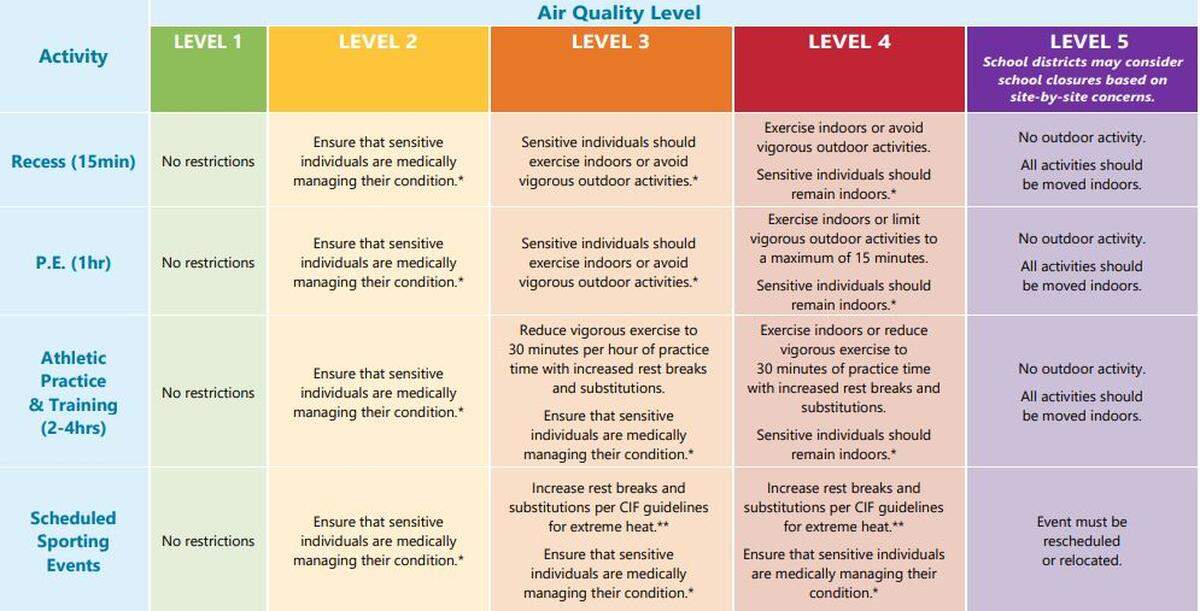
As I dug deeper into the district’s actual monitoring system that is designed to protect us all, I was surprised to learn that its deficiencies compromised the very mission of safety.
In 2010, the air district built a network of sensors to detect PM2.5 and ozone pollution and wrote a set of air standards — “healthy,” “moderate,” “unhealthy for sensitive groups,” and “unhealthy for all” — to guide residents in their daily activities. The result was called RAAN: the Real-Time Air Advisory Network.
Across the 6,000-square-mile expanse of Fresno County, RAAN has only 8 monitoring stations, which translates to one sensor every 750 square miles. Neighborhoods in north Fresno, for example, aren’t served by a PM2.5 sensor in their vicinity. Rather, they rely on a sensor that sits downtown. In essence, north Fresno is being asked to assume that their air is as polluted or as clean as downtown’s. It’s a request that stretches common sense when the eddies of wildfire smoke bear down on Fresno. The difference of 10 miles across town often means the difference of 40-50 air quality points. It’s not a stretch to say that people are being misled by RAAN when they choose to walk outside in conditions they believe aren’t dangerous.
A lack of sensors isn’t the only problem with the monitoring network. The district concedes a major deficiency in a 2019 addendum to RAAN: “In rare instances, thick ash or smoke from wildfires may bypass detection by the RAAN monitors due to the large particulate size. For this reason, the district always advises that if you can see or smell smoke, you are being impacted by it and should remain indoors.” With smoke’s near-constant presence from summer to fall, it would seem, “rare” is no longer rare. But the district literally leaves us to our own devices.
Whenever the public accesses the district’s sensor data, it assumes that the data is collected in real-time. But in fact, the data from the Real-time Air Advisory Network is not real-time data. It is an average from the previous hour, which then reaches the public 15 minutes after that hour. This doesn’t detect the dynamic and rapidly changing air conditions that smoke plumes often create in their uneven diffusion across the Valley. If the air happens to jump from a 70 AQI to a 140 AQI in the middle of the hour due to changing wind conditions, the air district believes that the most accurate estimate is to take the mid-point between the two — 105 — rather than reporting what we’re actually breathing in that moment.
Pile on the fact that the air district will now take another 75 minutes to average and report the next hour’s data, and you’re looking at a nearly two-hour delay to fully register a change in air quality. This would seem a recipe for a monumental health crisis.
Danger for the young
Dr. Mary Prunicki, director of Air Pollution and Health Research at the Sean N. Parker Center for Allergy and Asthma Research at Stanford University, is one of the world’s leading experts on the effects of wildfire smoke on human health. Air advisories like RAAN, she told me, fail to factor in the toxicity of this smoke. Recent studies have suggested that wildfire smoke is 10 times more toxic than the workaday air pollution produced by cows, cars and diesel trucks, she said.
The smoke’s enhanced toxicity causes a variety of health disorders, particularly in children. Last year, Prunicki sequenced teens and children’s DNA in Fresno who were exposed to wildfire smoke and found they had permanent DNA damage that would impair their immune system development. Smoke particles that enter the brain are particularly bad. A study from 2017 shows that adults exposed to concentrations of wildfire PM 2.5s as little as 15 micro-grams/liter — a mere quarter of what FUSD athletes were exposed to in their first week of games — temporarily lost a grade level of speech complexity.
Most disturbingly, Prunicki affirmed that PM2.5 pollution exposure is linked to an increased risk for Alzheimer’s before the age of 40. This is likely due to the cascading effects of chronic inflammation triggered by the brain’s immune response to the pollution that crosses the blood-brain barrier. A study based on autopsies of adults and children exposed to levels of pollution more mild than Fresno’s wildfire season found plaque — the hallmark of Alzheimer’s disease — in the brain stems of babies as young as 11 months old.
Conflicts of interest
There’s a reason why the Valley has been so derelict in reducing the hazards of pollution. In a thesis that was awarded Stanford’s top prize for undergraduate research, Cade Cannedy’s analysis of the air district board found a pattern of district board members maintaining ties to the Valley’s top-polluting industries while in office. In some cases, these same board members were actively hostile to the basic tenets of public health.
Harold Hanson, a board member between 2011 and 2016 who was fond of wearing a tie with $100 bills printed on it, had invested tens of thousands of dollars in Chevron, Exxon, Valero, Conneco, and Occidential Petroleum. Hanson served on the air board while sitting as the president of the Petroleum Club of Bakersfield.
Tulare County Supervisor Steve Worthley, one of the longest-serving members in the air district’s history, was a lobbyist for Sequoia Forest Industries. Worthley backed a 2002 lawsuit that tried to stop the creation of the Sequoia National Monument, alleging that the ancient Sequoias, one of the world’s most precious specimens, did not have sufficient scientific or historical interest to warrant federal protection from logging.
But no one seems more antithetical to environmental protection and the fight for clean air than Fresno County Supervisor Buddy Mendes, a longtime dairyman who has served multiple terms as the chair of the air district board. At a county board meeting in 2016, Mendes shouted down a woman who was holding up a sample of polluted tap water from her kitchen faucet. It was so rife with lead, arsenic, and other heavy metals that you couldn’t see through the other side of the clear plastic bottle. “I don’t want to see your water,” he said, pounding his gavel. “I can take you to Riverdale and show you shit water, too!”
Mendes also happens to be the chair of the Fresno County Transportation Authority — the agency overseeing the Measure C renewal process — where he is a loud voice for freeway expansion, the kind of infrastructure that further pollutes the air. When I asked Mendes why the air district’s guidelines allowed children to exercise in air that was more than six times the EPA’s annual maximum limit, he showed the same disdain.
“They just pick those numbers out of their ass … The EPA comes up with shit that doesn’t make any sense.” As for high school football played in the smoke, Mendes shrugged. “It’s the school’s job to decide what they want to do.”
What price tradition?
For three weeks, I called Fresno Unified School District and left messages with their public information office. I wanted to know why school administrators and athletic directors had green-lighted practices and games. When a PIO finally emailed me back, she said the district was too busy to answer my questions.
I got into my car and drove from school to school on a day when the smoke from the burning forests had settled over most of Fresno. My imagination strained to think about what the next decade would bring. The Valley had warmed 3 degrees Celsius this summer. Only the Middle East and the Arctic had warmed more. How warm will Fresno be by the time a kid in Pop Warner graduates to high school football — 4 degrees Celsius? 5C? 6C? Nobody 10 years ago would have imagined how bad things would have gotten already, how bad they were set to get in the near future.
Rather than take a Silicon Valley tech job out of college, I had come back to Fresno to start my adult life, partly because of the ties that came from relationships I had built in high school sports. Beyond the curtain of smoke, I knew that young athletes were also making lives of their own, playing with their own ambitions and within the expectations that had been put upon them by the adults in their world. Would I have wanted the experience of sports taken from me? Absolutely not. It is impossible to conceive of the person I have become, the people and things I have become attached to, had I shielded myself from the experiences and lessons that occupy some of the deepest trenches and troves of memory that Valley sports had created for me.
Yet, in the age of wildfire, were we really willing to accept the implications of the bodily compromises made for the sanctity of hidebound traditions?
I pulled up to a local high school and got out of the car. Football, cheerleading and tennis were in full swing. Fresno Unified had canceled outdoor activities in the morning, but walked it back a few hours later because the air had gotten slightly better. By the time practice began, however, this decision appeared woefully near-sighted. A tree 500 feet away from me was hazy. The football field was filled with players and coaches. Sounds of whistles and thumping pads and cheer skits filled the air. In one corner, boys in pads were lined up for drills. A coach blew a whistle and a pair of players went at it for 15 seconds. Even after the whistle signaled an end to their contact, the boys knew to sprint back to wait their turn again. In another corner, players with a 20-yard head start ran full tilt before leaping shoulder-first into a pounding sled.
The school’s athletic director was standing at the center. I asked him under what rationale had he decided to keep practices going on such a polluted day. On his iPhone, he pulled up the RAAN website, which showed that the PM2.5’s concentration was 55 micros, well below the Air District’s cancellation threshold of 75. “This is the air district’s reading for the school’s address” he told me. He had no idea that the air district’s monitoring system was shot full of holes.
I had a sensor in my pocket with a reading of the PM2.5 pollution right where we stood. It registered close to 80 micros. The AQI on the field was 161 — well above the guideline deemed safe by the air district. His eyes looked up from my device’s screen and back to me. “You don’t think I’d like to be at home right now?” he said. Before practice was over, the AQI would shoot over 212 and the PM2.5s would measure 160 micros. “We give them water and watch them for asthma attacks,” he assured me.
I reminded him of the see/smell test that was supposed to trump all the other advisories: . In the late afternoon, the sun pulsing an incandescent orange beneath a shroud of smoke, he said: “Well, we’d never play football here, then.”
Ignoring obvious conditions
“What was the kernel to be preserved?” I thought as I drove back home. Football season, and all fall outdoor sports, could be moved to winter and spring. This wouldn’t begin to solve the short-term and long-term causes and consequences of climate change, but something essential would be preserved in the act of playing games in a safer season.
The thing to preserve was the tradition that connected parents to their children, and children to their peers. This intimacy doesn’t happen automatically, in the mere pantomime of playing the sport. It happens through the lessons and structures exchanged between coaches and athletes that gives childhood sports its meaning. In affirming this basic premise of sports, what kind of lesson could coaches be claiming to teach their athletes by playing in a toxic cloud of smoke, if nothing else but to be blithely ignorant about what’s in front of their very eyes?
Everyday, these kids’ lungs, blood, and brains are being poisoned by ignoring the facts of the conditions they are playing in, scraping years off their lives and cheapening their horizons in the process. How could sports claim to be a pedagogy of accountability when it’s having kids swallow these kinds of risks?
From where I stood, it was a total debasement of the ethics of sports that I grew up with — a lesson in docility rather than responsibility. I always had the feeling that through sports, we get closer to some sort of comprehension of the communities we grow up in. We learn to act within this broader world, partly through the rehearsal of these games we find ourselves in. But climate change has overloaded the moral center of this social infrastructure.
Our community needs a certain courage to take a stand on behalf of what we love in the face of such obvious threats from a warming planet, but so far we haven’t even bothered to own up to the task. Instead, Fresno and the Valley are mired in its own anguish of flat-footed imaginations and institutions. Our lives are going to be drastically impacted one way or another by our changing climate. We are out of moderate futures. What comes next is up to us.