
Fresno woman recalls her second childhood school — the one that taught Armenian culture
I have always lived in two worlds, two cultures, two literacies, two groups of friends — my American school friends from my neighborhood, and my Armenian school friends from church.
Like me, this second group were young Armenian-Americans, descendants of immigrant parents and/or grandparents who escaped genocide in their homeland.
Based on both my parents’ experiences of learning English as a second language, they decided my siblings and I would learn English first and then Armenian. Thus, my formal Armenian language education did not begin until my mid-elementary years. Thereafter, every Saturday morning from the early to late 1950s, my father drove me to Holy Trinity Armenian Apostolic Church on M Street and Ventura Avenue for Armenian school.
In the church basement, portable walls on wheels enclosed three classrooms: one for elementary students where my journey began, one for upper elementary, and one for junior high, where my Armenian school journey ended. We sat in rows of well-worn, etched and initialed desks with attached seats, hand-me-downs from the demolished Emerson Elementary on the corner of K Street and Santa Clara.
From 9 in the morning until noon, our curriculum included reading stories, fables, and poems and practicing writing with the 39 letter alphabet. We also studied Armenian history and geography, the story of a lost, ancient homeland, a civilization with a recorded history of 3,500 years.
Maps displayed in our classrooms outlined the old territory of Armenia bounded by the Mediterranean, Caspian, and Black seas. In our history lessons we learned modern-day Armenians arose from a mix of two ancient peoples: indigenous Hayasa and Armens, an Indo-European ethnic group. We call ourselves Hay (pronounced “Hi”) and the old country Hayastan, but the Armenian my parents and grandparents spoke was that of the Armens.
We learned the kingdom of Armenia grew into the strongest state in Asia Minor under Tigran the Great. His empire stretched from the Caspian Sea to the Mediterranean Sea and Mesopotamia in the south to the River Kura in the north. When Tigran II died, King Trdat III declared Christianity the state religion in 301 AD, making Armenia the first Christian state in the world. Saint Gregory the Illuminator became the first bishop of the Armenian Apostolic Church, 12 years before the Roman Empire legalized Christianity. Additionally, ancient Armenia became the 10th nation to put language in print.
These Saturday School lessons were like the arms of history wrapping around us, cloaking us with pride for our dual identities as Armenian-Americans. My father’s old country had given birth to the language often spoken in my home, music I folk danced to, poems I memorized and recited, and meals gracing our table each evening. This old country also held the sorrows of my father and grandparents — an estimated 1.5 million killed — scattered bones of parents, brothers, sisters, aunts, uncles, nieces, and nephews. All my Armenian school classmates shared this history—stories of ethnic pride alongside unspeakable horrors of genocide.
We also shared a cuisine. The church basement housed a kitchen where most Saturdays the Women’s Guild prepared meals for weddings, funerals, and other community events. Our classroom dividers did not muffle the banging of pots and pans or prevent the aromas of pilaf, shish-kabob, souberag, and Armenian sweet breads from wafting through our lessons. Nor did they stifle our escalating voices as we read aloud in unison.
During lunch, we took our homemade peanut butter or tuna sandwiches and picnicked under a large pine tree in front of the priest’s house. Sitting on a cushion of pine needles, we played guessing games or just visited. As we grew older, some of us strolled along Ventura Avenue after eating, sharing stories of our American schools and school friends, melting our two worlds.
The path we took led to two family owned grocery stores. The Kazanjian Market on Ventura, owned by our friend Lucy’s family, and Arax Market on Santa Clara and L Street, around the corner from the church. Both carried soda, chips, cookies, candy — none of which our parents packed in our lunch bags. But one of us usually had enough change to buy and share a treat.
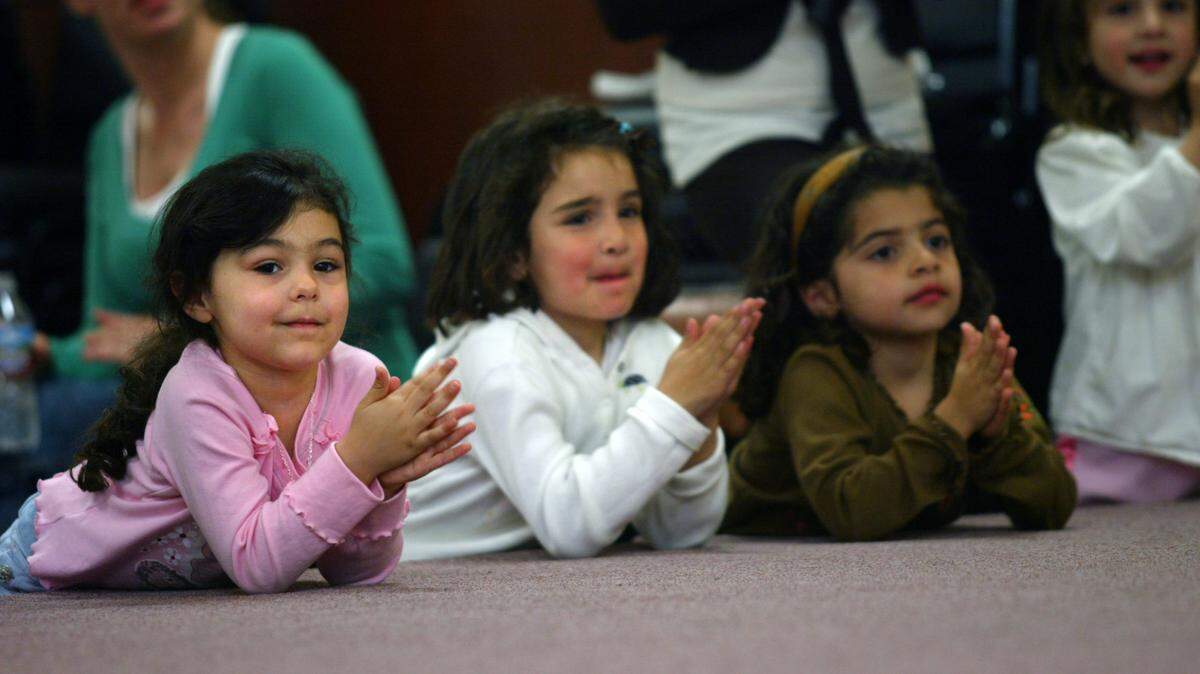
After lunch we reconvened in the church basement. Sitting in rows of folding chairs, we sang the Armenian alphabet song — all 39 letters, while one teacher directed, one played the piano, and one supervised. We also sang the Lord’s Prayer in Armenian. But my favorite song was about a dog named “Bingo.” Later, I learned the English version: “There was a farmer who had a dog and Bingo was his name-o /B-i-n-g-o, B-i-n-g-o, B-i-n-g-o/ Bingo was his name-o!”
We also memorized and recited Armenian poems and performed plays. Our parents attended these events after which the church ladies sold their pastries along with coffee, all profits going to the Armenian school we attended at no cost. These socials in the church basement brought our parents together, fostering their community as well as ours.
Not surprising, my ability to speak, read, and write in my second language has diminished over the years from lack of use. Yet, I still have my Armenian school books, the ones my father covered in oil cloth more than 65 years ago, and I can still sing the Armenian alphabet song. Perhaps most important is that I consider myself richer for growing up in two cultures, particularly one being survivors and thrivers after such unspeakable horrors as victims of genocide.