
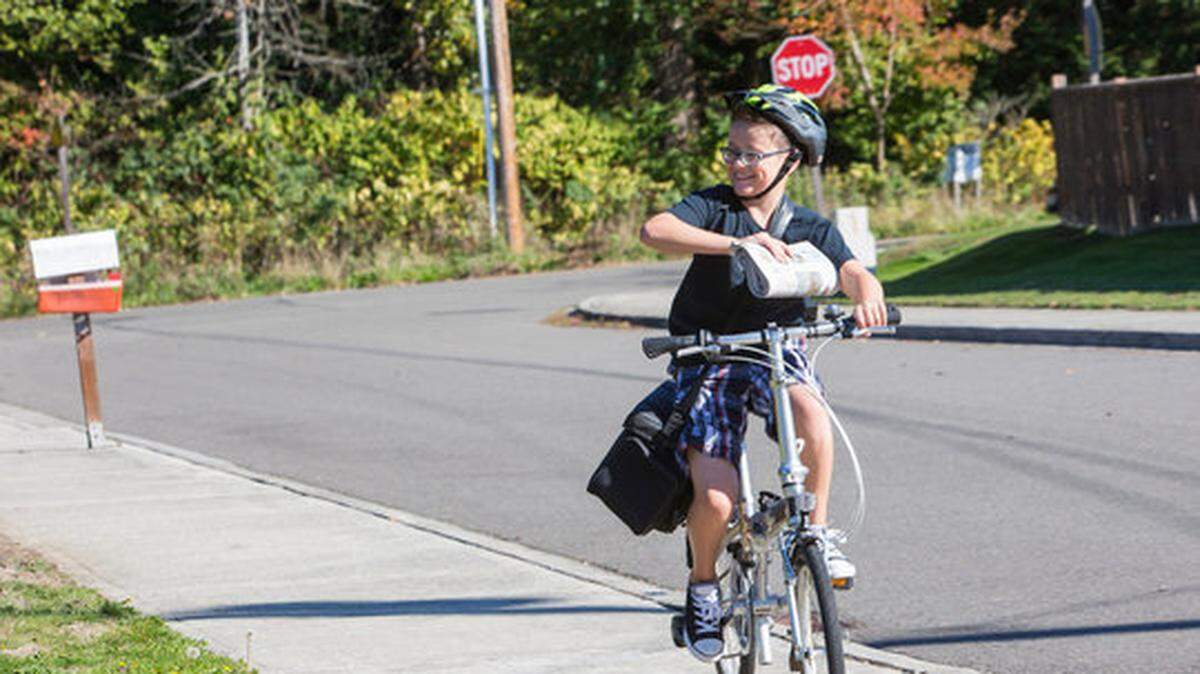
He was 12, weighed 90 pounds, and the Sunday Bee was almost too hefty for him to deliver
On the northwest corner of a vacant lot at 10th Street and Ventura was a corrugated metal building with a garage door that opened onto the alley. The building once served as a “district house” for distribution of The Fresno Bee, then an afternoon paper and a morning paper on Sundays.
Every weekday afternoon about 3:30, 50 or so teenage boys and their bicycles converged on this location. About the same time the Bee truck arrived in the alley and threw out dozens of bundles of freshly printed newspapers. I drove by recently and found the building was gone.
Inside were elevated rows of wooden “bins” where the carriers stood, counted and folded their papers, loaded them in canvas bags (Bee bags), then set out to deliver the news. For about 20 minutes, every day and Sunday morning, racket from teenage boys yelling epithets and pounding newspapers resounded throughout the area. The overseer of the daily ritual was the district manager; ours was a tall, 20-something, affable Mr. Goertzen. His job was to see that the newspaper was delivered on time to all the porches of subscribers in the district, while maintaining some sense of order at the Bee House.
Delivering the Fresno Bee was a good way for a teenage boy to earn income. My route had 64 customers on Woodrow and Sierra Vista avenues between Tulare Street and Huntington Avenue, and Laurel Avenue. Every day I rode my bike 1½ miles to the Bee House and folded my papers. I did this for 3½ years, until I was until I was 15½. If a boy continued delivering the Bee after the age of 15, there was something wrong with him; he was considered by the others to be a “Bee suck.”
Part of the job of a Bee Boy was to solicit new customers; this was done on Tuesday nights. Carriers met with Mr. Goertzen at the Bee House, then went out “soliciting” subscriptions. Actually, most of the Bee Boys went to a phone booth at the Fosters Freeze and randomly selected addresses from the white pages of the telephone book, wrote them down on a list given to Mr. Goertzen.
The end of the month was time to collect monthly subscriptions of a $1.25 from route customers, an evening activity that sometimes took a week to complete, calling on each customer, “collecting for the Bee.” When I collected enough, my mother would take the cash to the bank and deposit it in my checking account. On the tenth of the month she wrote a check to the Bee for a months’ supply of newspapers. The money she didn’t deposit was mine to keep and amounted to $32 a month (for a seven day a week job).
I began delivering the Bee in 1962 when I was 12 years old and 90 pounds; the enormity and heft of the Sunday morning newspaper overwhelmed me at the beginning. On Sunday mornings at 5, our mother would drive my younger brother Charles and me to the Bee House to pick up the bundles. At home we folded papers on the living room floor. Charles and I then loaded the papers into our mother’s Studebaker station wagon. She drove slowly down the streets, as Charles and I worked each side throwing papers on the porches. On cold, foggy mornings when we got home, mother would make hot chocolate for us before we went back to bed.