
Fresno’s Jerry Dyer joins San Jose’s mayor in supporting high-speed rail project
Despite the deep and widespread suffering of this pandemic, this crisis will pass. Other crises, however, will persist. An affordable housing shortage will continue to plague high-growth, coastal communities like the Bay Area. Many inland communities will struggle to recover from double-digit unemployment, and millions of California families will suffer on the wrong side of a deepening economic divide.
An environmental crisis will continue to afflict several Central Valley communities with some of the nation’s worst air quality, condemn millions more to wildfire smoke-filled skies in the fall, and subject our largest cities to the prospect of rising seas well into our future.
These three crises will challenge us as mightily as this pandemic. As our work transforms from pandemic response to recovery, California must not settle for anything less than a bold vision for a better future.
More than any other, one transformative project confronts this three-headed monster of challenges: High speed rail. A “valley-to-valley” connection — bringing abundant Central Valley housing within a 53-minute ride of Silicon Valley jobs — enables greater prosperity in Fresno, forges widespread access to affordable housing from San Jose, and takes the equivalent of 400,000 cars off the road annually.
In its recently released business plan, the California High Speed Rail Authority articulated a clear path to this brighter future. The plan calls for finishing construction of the line from Merced to Bakersfield, while continuing to advance the project toward construction across the rest of the state — starting with the Silicon Valley-to-Central Valley connection.
To implement this plan, the state Legislature must allocate the remaining voter-approved Proposition 1A funds to finish construction in the San Joaquin Valley so that high-speed trains will begin running in California this decade. The voters’ down payment of Proposition 1A funds will position California for the next major investment of federal funding, enabling a robust expansion in partnership with a new federal administration and regional leaders across the state.
With President Joe Biden — who spent four decades commuting to work by train — in office, climate-centric economic recovery has become a top federal priority. California’s high-speed rail project uniquely rises to this moment, enabling many more cities to build back better, with a zero-emission, electrified, high-speed trains that can run on 100% renewable energy. It will reduce our auto emissions by taking the equivalent of every vehicle in San Francisco off the road, while moving us to a cleaner future beyond polluting diesel trains and particulate-spewing jet engines.
In a moment when unemployment exceeds 9% statewide, California’s high-speed rail has already become the largest infrastructure project in the nation, providing thousands of Californians with well-paying construction jobs, and supporting more than 570 local small businesses. Building out the entire Phase I system would support the equivalent of employment of 60,000 construction workers for 10 years. Without continued funding, however, those new jobs won’t materialize.
While any massive capital project poses daunting fiscal challenges, we need not eat this elephant in one bite. We must bring high speed rail from Bakersfield all the way to San Francisco, but merely reaching downtown San Jose will enable millions of riders access to five major regional transit systems connecting all of Northern California’s largest cities — Bay Area Rapid Transit, high speed rail, the Capitol Corridor, the Altamont Commuter Express, and Caltrain — along with local connections to Silicon Valley’s transit networks.
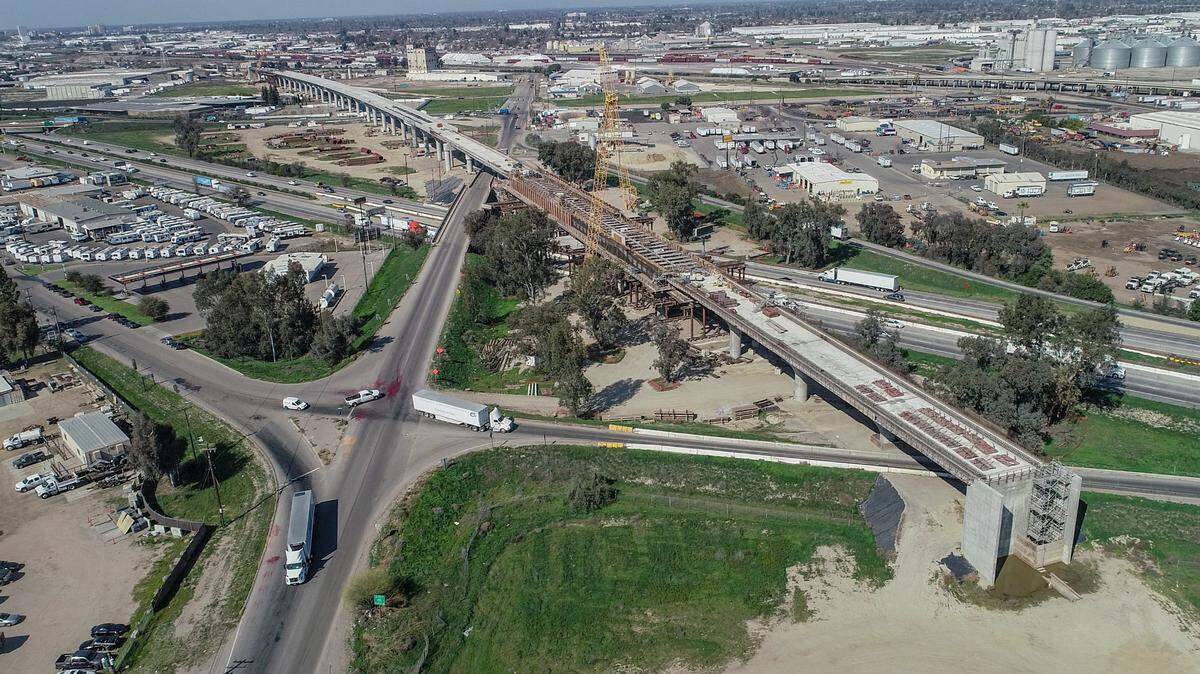
While high-speed rail has long provided superb service throughout Asia, Europe, and much of the world, it doesn’t exist in the United States, except for one construction project called the “California High Speed Rail.” Right now, this project has active construction sites from Kern to Madera counties, including a swath running the length, north to south, through Fresno. Let’s finish what we started. Secretary of Transportation Pete Buttigieg vocally supports high-speed rail, and publicly has questioned why we should ask our citizens to settle for less.
We shouldn’t. Let’s urge our federal legislators to prioritize high-speed rail funding as part of the nation’s economic recovery. Let’s push state legislators to help us attain the vision of high-speed rail by approving the Proposition 1A funding. Let’s demand more of our leaders in plotting a bold path for recovery. Californians must not settle for less.