
Limbaugh fueled the hate speech, Trump took it to new heights, Americans must end it
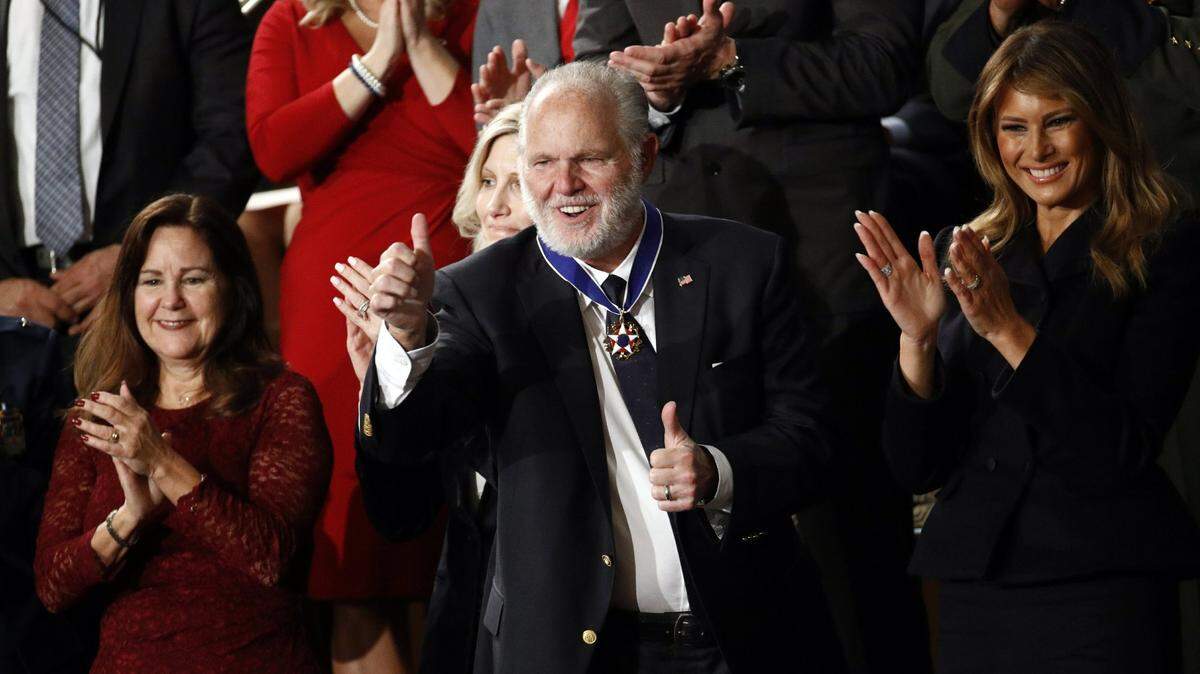
While the current lack of civil discourse and distrust between our two political parties is disheartening, such acrimony has plagued our republic from the beginning.
Indeed, in 1804, Vice President Aaron Burr, a member of Jefferson’s Democratic-Republican party, shot and killed his longtime political antagonist Alexander Hamilton in a duel. Hamilton was a member of George Washington’s Federalist Party.
A half-century later, Massachusetts Sen. Charles Sumner, an anti-slavery Republican, was nearly beaten to death with a cane in the U.S. Senate chamber by a pro-slavery Democrat from South Carolina, Rep. Preston Brooks.
More recently, in the early 1950s, we were subjected to McCarthyism, an anti-communist crusade waged by Wisconsin’s Republican Sen. Joe McCarthy, who charged Democrats with being guilty of “twenty years of treason” during the Roosevelt and Truman administrations.
McCarthy’s unceasing verbal onslaughts against numerous Americans serving in the State and Defense Departments cost many of them their jobs. He even called our Army Chief of Staff during World War ll, and later distinguished Secretary of State, George Marshall, a traitor. Eventually, in 1954, the Republican Senate decided “enough is enough,” stripped him of his Senate chairmanships and banished him to the back row of the chamber. Three years later he drank himself to death. McCarthy’s reckless charges created chaos in our body politic not witnessed until the present time.
In the decades following the 1950s, the tension between our two major parties reverted to more normal standards, the dialogue focusing more on serious policy differences and less on character assassination. Given the fact that this period included the Vietnam War, the civil rights revolution and, in the ‘70s, the Watergate scandal, the lack of vitriol exhibited by both parties is something to admire.
In the late 1980s, however, the advent of talk radio, and in particular, Rush Limbaugh, transformed our political dialogue to a degree sufficiently monumental that its consequences today threaten the very fabric of our democracy.
Prior to Limbaugh, everyone pretty much got their information from the same sources: the three major broadcast networks, PBS, a variety of local stations and hometown newspapers. By the early ‘90s, with more than 20 million daily listeners, Limbaugh, with incendiary rhetoric, changed our political landscape. He convinced his listeners that the media at large was involved in a conspiracy to elect liberals, all of whom hated America, and that, in his words “the lame stream media” constantly lied and only he could be trusted.
He was particularly relentless in attacks lodged against NBC, calling it the “DNC,” (Democratic National Committee) as if they were one and the same, and he regularly mimicked anchor man Tom Brokaw in a manner that suggested he was a buffoon.
It’s not much of a stretch from Rush Limbaugh’s attacks on the media to President Trump saying, “Believe not what you hear or say, but only what I tell you,” and “The press is the enemy of the people.”
Limbaugh’s comments over the years have been racist, (“Barack the Magic Negro” to the tune of “Puff the Magic Dragon”); misogynist, (“I admire the woman’s movement from behind”) ;and homophobic (“There’s a lockdown in San Francisco because all the gay guys are there.”) Prior to the recent election, he said that a Biden victory would result in our becoming a communist state.
Our problem is obvious: Millions of Americans have been listening to hateful, anti-liberal diatribes for so long that it’s become an acceptable norm. Whether his listeners were laughing or angry at what they heard, they were entertained and, for the most part, believed every word uttered on Limbaugh’s daily three-hour, 5-days-a-week show that’s been on the air since 1988.
The acceptance of hate speech and its pervasive influence over our political landscape today is not, of course, entirely the fault of Limbaugh. But it started with him, with the eventual assistance of Fox News, an unfiltered Facebook and other social media outlets such as Twitter. More than 70 million people voted for a president whose public persona has been defined by hate, retribution for all who oppose him, and total disrespect for his opponents, whom he labels “the enemy.”
Our two parties must somehow agree to cool the rhetoric, for the alternative is unacceptable. The current chaos, largely the result of distrust due to the demonization of political adversaries, threatens our very future as a democracy.
The lessons from history are clear — when chaos cannot be contained, democracies descend into dictatorships.