
One thing must happen for school sports to resume, longtime Bullard coach Don Arax says
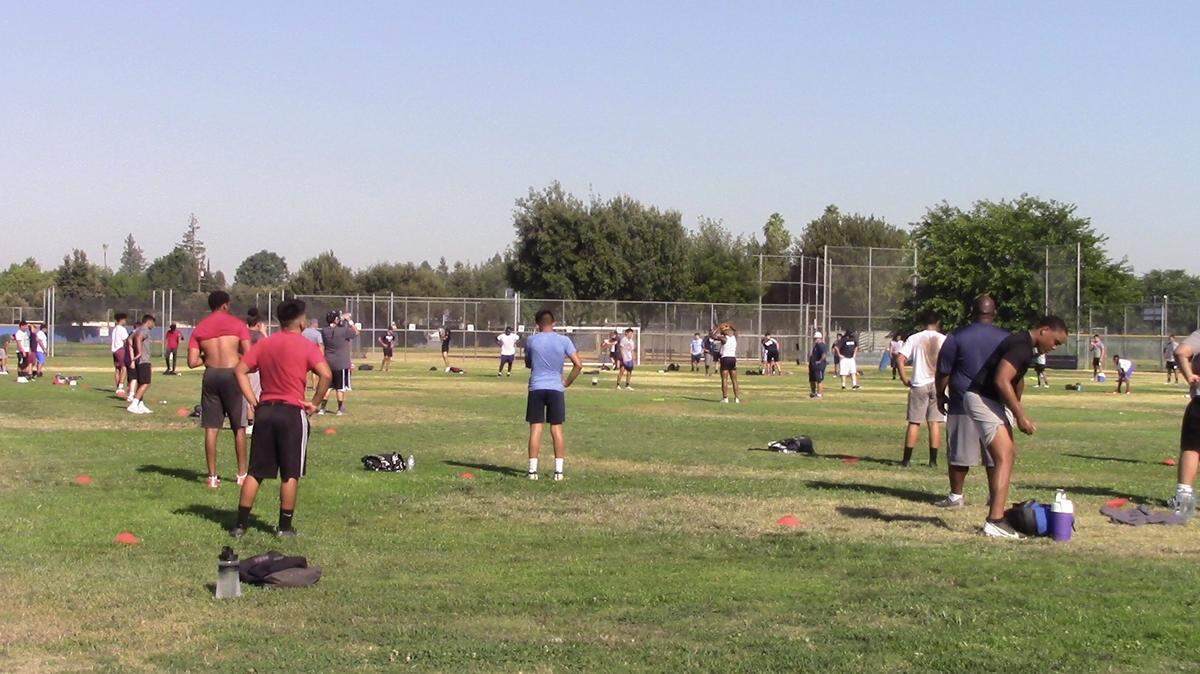
On a summer morning before the heat wave hit, 81 football prospects split into groups of nine across the expanse of the Bullard Bowl. Taking no chances, my staff and I spaced cones 10 feet apart, the physical distance between each player. This would be the safe zone, the bubble, to begin training for a season that may never come.
Welcome to the brave new world of high school football in the age of COVID-19.
In my 21 years as the head coach at Bullard High, I had learned a thing or two about preparing a team for the grind of a season. Starting in January, every weightlifting session, conditioning drill, spring practice and summer workout had been meticulously planned, so that our team would be in peak condition when fall camp convened in August. This, however, was something altogether different.
In my best imitation of TV’s Jack LaLanne training housewives in the late 1960s, I designed a modern version of those total body movements. Of course, I dialed it up a bit to show our players that three months of isolation hadn’t softened my touch. The young men in front of me bore little resemblance to the fit and chiseled group that went into quarantine three months prior. In spring, our players had the look of a team that was being talked about as a Valley Championship contender. Twelve weeks of sloth — endless video games, marathon cell phone conversations, social media treks — had taken its toll. Good thing for us that muscle has memory. Give me six weeks, I vowed, and we can get it all back.
This June, high school football programs across the Valley resumed workouts that in most cases were anything but traditional. Most districts followed the guidance of public health officials and moved cautiously. Others thumbed their nose at the risks, conceding little to a pandemic. Fresno Unified, to its credit, took a more measured approach. Blocking bags, sleds, balls and indoor activity were all restricted. At Bullard, we were committed to running a model program of compliance. Then, as we were about to enter a second phase, which would allow players to perform drills and lift weights and use footballs, cases in the Valley spiked. The bubble had burst.
We decided to stop workouts for the time being. A few days later, as I drove along Browning Avenue to my office inside the Bullard weight room, I spotted several of my players on the football field. I parked and watched as the boys tossed the ball around in a carefree spirit that reminded me of the days before helicopter parents and personal trainers took over. Seeing them liberated for a few hours from their cell phones and video screens took me back to my senior year, in 1981, when our Bullard team organized player-only practices on summer evenings.
I made my way down to the field to chat with them. They talked briefly about their dreams for the upcoming season and the brotherhood that existed among the senior class. They talked about winning Bullard’s second Valley Championship. That’s when one of them looked me in the eye and asked, “Hey coach, are we even going to have a season?” I wasn’t sure how to answer him. I wasn’t sure about anything. As it turned out, the federation that governs high school sports in California pushed back the fall season to January. Will it happen then?
Sports have been part of the fabric of American high schools for more than a century. At its best, athletics have the capacity to break down social and racial barriers in a way that’s unmatched. I’ve witnessed this play out repeatedly in my 36 years in the profession. A few years back I was sitting on the patio of a neighborhood restaurant when I saw four of my football players pass by on a golf cart. Two white country club kids were side by side with two black teammates from the other side of town. I turned to my friends and told them they had just witnessed the beauty of Bullard football.
I suspect it was no different 70 years ago when my father and uncle, both standout athletes at Fresno High, were invited to join — as the first Armenians — the exclusive Cambridge club. This was in an era of redlining in Fresno, when “Armenians, Blacks, Mexicans and Orientals” were barred from living in the fancier neighborhoods. Then, as is now, sports served as the great equalizer.
If our leaders in Washington fail in the coming months to take a long overdue Marshall Plan approach to the virus, it is unlikely youth and high school sports will return any time soon. There is little question that the suspension of sports will have grave consequences for youth. The social costs would likely resonate for years. Obesity, depression and drug use, which have long plagued the disengaged, will only grow. The screen that has turned a generation into zombies will snare greater numbers of young people.
If we accept the premise that athletics is an indispensable part of our educational experience, then it is essential that our school leaders develop a plan that establishes protocols to ensure a safe return to competition. Pushing back the start date for games, buying a few months of time, isn’t that plan. Instead, it offers false hope for players and coaches, and is certain to fail. At a time when school districts are forced to make tough budgetary decisions, more resources will have to be allocated to athletic programs to provide the equipment and manpower needed to maintain a safe environment. Units to disinfect balls, blocking sleds, and bags will have to be purchased. Personnel must be added or redirected to ensure that weight rooms are disinfected throughout the day. High school trainers must be given the tools to assist in providing the safest possible environment.
In the age of COVID-19, a return to the playing field for millions of American youth will require an “all hands on deck” approach. The question is, do our leaders have the will to see it through.
This story was originally published August 26, 2020 at 12:05 PM.