
Commentary: Valley’s Dick Telles has been a great farmer-ambassador for the United States
A century ago, the San Joaquin Valley was recovering from the ravages of another pandemic — the Spanish flu. And from the ravages of a three-year drought that’s difficult for us to imagine. The Valley was primarily cattle land controlled by a few ranchers like Miller and Lux.
No Interstate 5. Not even a Highway 99. Only a few had the imagination to dream what might be: That with water and wisdom and mule-stubborn persistence, this Valley might clothe and feed a great nation. Fewer still had the courage to make that dream a reality.
But there were a glorious few: names like Russell Giffen, Jim Boswell, Jack Harris, Dick Telles, and Jack Woolf.
Dick Telles is one whom I — along with countless others — am lucky enough to call friend. He began lease farming as a 20-something in the early 1950s. He was farming 920 acres when drafted into the Army at age 25. Upon discharge, having lost most of the leases, he started all over. He began with a 45-acre purchase that produced 104 bales of cotton that first year. Eventually he farmed over 100,000 acres in California and Arizona, producing over 100,000 bales of cotton — a thousand-fold increase is not a bad yield. Plus lettuce, and cantaloupes, wheat for America’s breadbasket and strawberries for the queen.
Initially row crop farming was the mother’s milk that transformed these formerly parched cattle land soils into fiber, like cotton, so that people could be clothed. Cotton was the economic cornerstone of the Valley. This in turn led to the growing of foods, vines, and trees, so that people could be fed. Shortage of food and fiber are what revolutions are about. Today over 200 money making crops — 15% of America’s agricultural production — are grown here; a legacy of those glorious few.
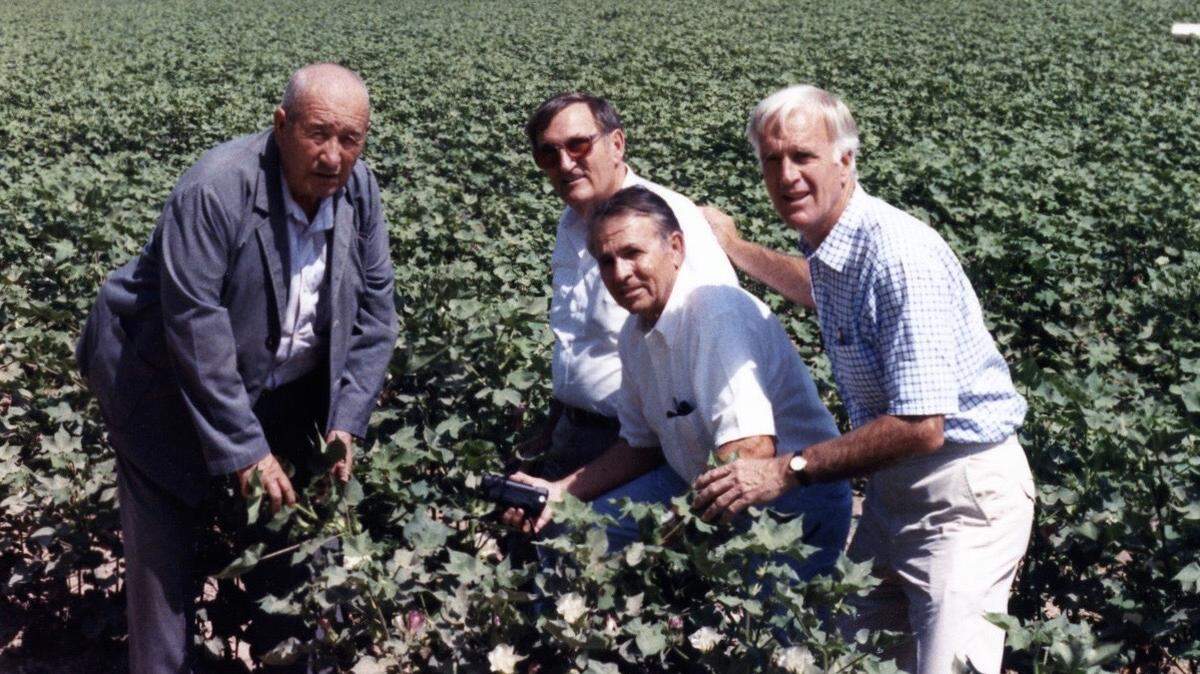
In the process, Dick became an authority on soil qualities, usage and economics. Like his crops, Dick was always growing and learning best practices not just nationally, but globally. He, Jack Woolf and I pursued these answers on trips to Brazil in 1987, Uzbekistan in 1989, and Australia in 1990.
Farmers are an international and time-honored fraternity; I have watched farmers from around the world gratefully sit at the feet of and learn from generous co-laborers like Dick and Jack. They all shared together love of earth and sun and soil and water; they knew the unique humility and persistence of those whose work is bounded by weather and forces beyond our control.
In the fall 1980, a Chinese cotton buying delegation, led by Mr. Mao who was head raw material buyer for Chinatex, came to America for the first time. The delegation was hosted by various cotton merchants, the U.S. Department of Agriculture, the U.S. Secretary of Agriculture, and the State Department. First stop: San Joaquin Valley.
The delegation knew of Telles cotton from the bale tags of hundreds of thousands of bales of Telles cotton, which my company, Dunavant Enterprises Inc., had shipped to China over the years. They asked to spend a day on his California farms. They were astounded to see mechanical cotton pickers for the first-time. Four row. Modules. Irrigation. Yields. Row crop farming at its ultimate.
The dialogue between Dick and the Chinese delegation was non-stop. Their questions were many: Cost of land? Employees? Wages? Yield? Price? More than his methods, they were captivated by Dick, and his transparency in meticulously answering every question. That night, and long into the night, at a Chinese restaurant on Shaw Avenue in Fresno, Dick Telles received many, many, many Ganbei toasts.
Seasons and farming are connected. Farming is about preparation, planting, tilling and harvesting. Seasons are about heat and cold, light and dark, deluge and dryness. Seasons are unchanging but also ever-changing, with untimely rains, withering drought. searing heat, dense fog. Or worse, a dreaded freeze leaving potatoes blackened. There are thoughts of bankruptcy, discouragement, fear.
To farm is to be vulnerable, but pioneers are not born of safety. They are born of hope and courage, and faith in a better tomorrow.
Dick has been one of these glorious few: A farmer-ambassador for the United States. His incredible memory was the well for history and stories. He remembers stories about others who valued them.
He was highly successful. But better than that, he’s deeply loved: From farm workers to business titans. From Catholic priests to the nurses at the Nazareth House who so wonderfully have been caring for him over the past six months.
Throughout human history there have been two great revolutions; only two that really changed the world. One was the discovery that when a grain of wheat falls into the ground, it is not buried, only planted. This was the agricultural revolution. The human race could transcend tribal nomadism; could be rooted. Cities and cultures and universities and civilizations were now possible.
The other was the discovery that the human spirit works the same way. A life is like a grain of wheat. People who are willing to die to their own egos and invest their lives in serving others are the transcendently fruitful among us. No matter the setback they face — the pandemic, the drought — they are never buried. Only planted.
For me, Dick was a poster child of what a friend looks like: Caring, loyal, understated, encouraging, and sharing. Thank you, Dick, for the decades of love and hope you have been planting. The full harvest has yet to be measured.
This story was originally published May 18, 2020 at 12:15 PM.