
Military use of burn pits is maiming the next generation of veterans
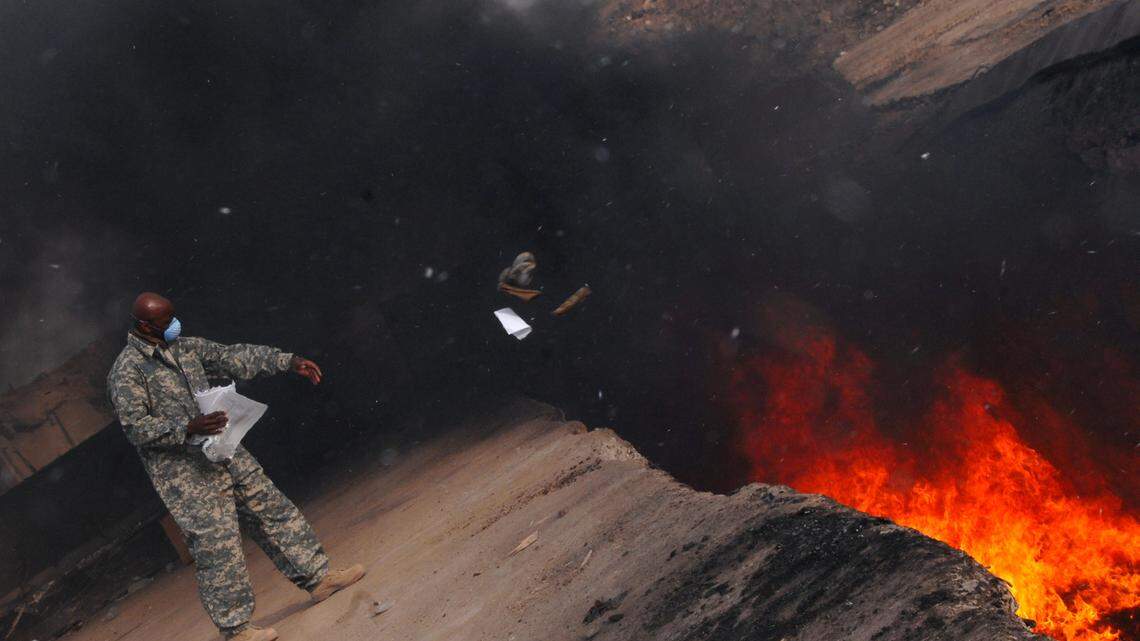
The fires surrounding us recently revealed, once again, how valuable clean air is to our life pursuits.
Do you remember going outside to get the mail and suddenly your throat seizes up and your eyes begin to burn, and tear uncontrollably from the smoke?
Now imagine that smoke contained the residue of blood-soaked clothing, chemicals, paint, medical and human waste, metal/aluminum cans, munitions and other unexploded ordnance, petroleum and lubricant products, plastics, rubber, batteries, wood, and discarded food.
Sometimes the smoke hangs in the air like a haze; other times it becomes a thick, enveloping fog.
Military burn pits, areas designed for the destruction of refuse by fire, can be as small as a backyard swimming pool or as large as a football field. They are used to destroy anything and everything in the military inventory that is no longer serviceable.

Just as exposure to Agent Orange has become synonymous with veterans of the Vietnam War, so too has exposure to the clouds of toxic fumes that pour out of burn pits become another symbol of the War on Terror.
By design, the military is hazardous duty, with a real chance of being killed or injured by an enemy of our country. No one who joins the military and takes the oath is under any illusion that the job is safe, but no one expects to be injured or killed by the injudicious decisions of our own government.
Now a new generation of servicemen and women are being exposed to another kind of toxic hodge-podge that is affecting their health in the immediate term, and no one yet knows about the long-term.
It’s not enough that our current (and future) generations deal heroically with such painful reminders of their war-service as traumatic brain injury, multiple amputations, Post-traumatic Stress Disorder (PTSD), and military sexual trauma; now they have to deal with the health issues resulting from exposure to the lethal fog hanging over them.
Toxins in burn-pit smoke affect the skin, eyes, respiratory and cardiovascular systems, gastrointestinal tract and internal organs. The kind of waste being burned, weather conditions, proximity and length of exposure all affect the outcome. Veterans who were closer to burn pit smoke or exposed for longer periods may be at greater risk. Most of the irritation is temporary and resolves once the exposure is gone. This includes eye irritation and burning, coughing and throat irritation, breathing difficulties, and skin itching and rashes.
Burn pits are commonplace in military installations where U.S. forces wage the battle against terrorism. Somalia, Djibouti, Afghanistan, Syria, and Kuwait are just a few of the forward postings of American forces where unserviceable items are routinely thrown into pits to be burned, aided by the addition of diesel fuel.
Nearly 28 percent of the 112 service members and Defense Department contract employees who served at both Camp Victory, located on the perimeter of Baghdad International Airport, and Joint Base Balad, in the Sunni Triangle 40 miles north of Baghdad, suffered from different forms of cancers and brain tumors. Burn-pit use was extensive at these bases.
It’s been reported that the smell from these burn pits, combined with temperatures sometimes in excess of 120 degrees, was overwhelmingly pungent. The air has also been tortured by smoke from burning oil wells and the blinding sandstorms that occur with some frequency. All can cause long-term health effects.
If you served in Operation Enduring Freedom/Operation Iraqi Freedom/Operation New Dawn, Djibouti, Africa on or after September 11, 2001, Operations Desert Shield or Desert Storm, or Southwest Asia theater of operations on or after August 2, 1990, you are eligible to record your service and exposure and health issues at the VA’s Airborne Hazards and Open Burn Pit Registry.
If there is any doubt as to the serious health implications of burn pits, listen to the testimony of veterans affected by them.
The registry was mandated by Congress and became available to veterans of the Gulf War Era in June 2014. The Gulf War Era encompasses all operations in the Southwest Asia theater since August 1990, which includes the wars in Afghanistan and Iraq after 9-11 The registry gives veterans and service members who may have been exposed to toxic chemicals information on what research is being done and the opportunity to get an exam.
The registry can be accessed online.
This story was originally published August 23, 2018 at 12:39 PM.