Fresno must fix city’s crumbling streets, even if that means extra debt | Opinion
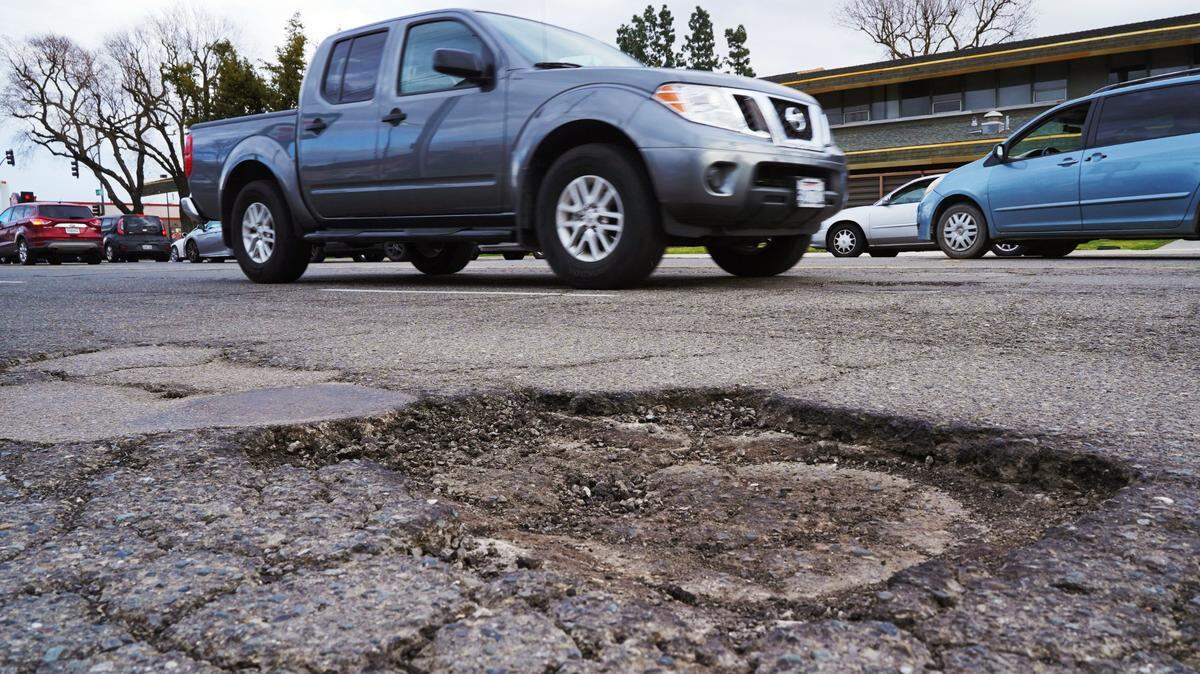
Fresno’s crumbling streets have reached the point where the can cannot be kicked down the road any further.
Not without it disappearing into a giant pothole.
By taking the expensive but necessary step in advocating for a $100 million bond for paving and street repairs, Fresno Mayor Jerry Dyer deserves a thumb’s up. A scheduled Fresno City Council vote Thursday to sign off on the paving bond concept, but not the exact amount, was postponed until the June 19 meeting.
Unveiled last month, Dyer’s “Pave More Now, Pay Less Later” initiative aims to make a dent in the deferred maintenance backlog for city streets that swelled from $505 million to $1.2 billion over the last three years according to Public Works Director Scott Mozier.
During that time, Fresno’s Pavement Conditions Index (a standardized ratings system that assesses road conditions on a 0 to 100 scale) dipped from 60 in 2022 to an estimated 55 this year, Mozier said. Scores between 41 and 55 are classified as “poor.”
Fresno residents don’t need a ratings system to tell them city streets are in rough shape. Their loose tooth fillings are proof enough.
Dyer’s plan includes a list of 51 street paving projects split over a two-year period, proposed by the Department of Public Works and individual council members, and their cost estimates. Nearly all involve major arterial roads. The most expensive, projected to cost $7 million, calls for repaving 1.92 miles of Clinton Avenue between Weber and Maroa.
The mayor’s aim is to start repaving at an accelerated pace during the final years of his second term and for the bond repayments to begin in 2029. While Dyer proposed a $100 million bond, Thursday’s postponed council agenda item indicated the debt obligation could range from $75 million to $150 million.
“I definitely don’t want to leave a future administration in debt, but at the same time I don’t want to leave a future administration with all this maintenance,” he told the council June 5. “I think that’s all of our dilemma here. We want to do what’s right (during) the time we’re in these chairs.”
Here’s the unfortunate reality: During the same period Fresno’s citywide PCI rating went from “fair” to “poor” the price tag to repave those crumbling streets doubled due to rising construction costs and inflation.
For example, Mozier said the city in 2021-22 paid $1.9 million (or $273,700 per lane-mile) to repave Chestnut Avenue between Herndon and Bullard and $879,984 ($293,300 per lane-mile) to repave Abby Street between Divisadero and Olive.
Compare that to the current fiscal year, when the city paid $1.93 million ($663,300 per lane-mile) to repave Peach Avenue from McKinley to Highway 180 and $992,655 ($501,300 per lane-mile) to repave Herndon between Valentine and Marks.
Meaning the longer city officials wait to address the problem, the worse Fresno’s roads will get and the more they’ll cost to fix when that day finally arrives.
Property taxes, Measure C misconceptions
Don’t residents pay for street paving with their property taxes? That’s a common misconception. But for the city’s older neighborhoods (i.e. anything built before the 1990s) the answer is “not really.”
Very little of the city’s property tax revenues is allocated to road maintenance. (Most of it funds public safety, code enforcement, salaries and pensions.) Rather, Fresno depends on outside sources for street paving and repairing curbs, gutters and sidewalks. The largest of these is SB1, the state gas tax.
Another common misconception is that Measure C pays to repave and repair existing neighborhood roads. That isn’t true either – at least not in the version that’s set to expire – a fact that was exploited by opponents of the renewal effort in the 2022 election.
At the same time Fresno takes on additional debt to repave streets, several of the city’s existing lease revenue bonds (including Chukchansi Park and the Exhibit Hall expansion) will sunset over the next five to 10 years. In addition, the city’s $12.8 million annual Pension Obligation bond comes off the books in 2029 according to Dyer and City Manager Georgeanne White.
Unless the economy tanks, future residents should be able to tolerate the extra debt. More so than they’d tolerate Fresno’s rapidly deteriorating streets if today’s city leaders don’t act.