MLB’s strong-arm tactics killing minor-league baseball in Central California | Opinion
Minor-league baseball has been woven into the fabric of the San Joaquin Valley of California since the 1940s.
Those days are likely numbered, and Major League Baseball’s corporate greed and strong-arm tactics are to blame.
When it comes to the minor leagues, history, tradition and community ties mean zilch to MLB. It’s all about how much money the $12 billion enterprise can coerce out of small- and medium-sized cities struggling to address real-world problems such as housing shortages, homelessness and crime.
Folks in Modesto already know the drill. The 2025 season will serve as a curtain call for the Modesto Nuts following an 80-year run in the California League, 70 of them at venerable John Thurman Field.
Visalia, Stockton and yes, even Fresno, could all be in similar straits. Perhaps not next year or before the end of the 2020s, but I wouldn’t wager a box of Cracker Jack that any of these cities will have minor-league baseball a decade from now – or that the California League will continue to exist.
It’s been five years since MLB, under cover of the pandemic, commandeered the minor leagues and culled the number of affiliated teams from 160 to 120. The survivors were required to sign non-negotiable Professional Development League contracts with MLB clubs that included facilities standards that are far above and beyond what was previously deemed acceptable, particularly at the lower levels.
The new standards include climate-controlled batting cages for both home and away teams; pitching tunnels; clubhouses that must be of a certain size and include coach’s offices, dining rooms and workout facilities; lighting and field specifications; padded outfield walls; and a devoted locker room for women, who are increasingly coaching and umpiring in the minor leagues.
Taxpayers absorb renovation costs
MLB’s goal with the new stadium standards, MLB senior vice president Peter Woodfork told the Sports Business Journal, was “greater stability, greater spaces for the players and staff members to develop, do their jobs and become major leaguers.”
That all sounds perfectly reasonable. But since most minor-league ballparks (including those in Fresno, Visalia, Modesto and Stockton) are municipally owned, those costs must be absorbed by taxpayers even though many of the MLB-imposed standards have little benefit outside of baseball.
In Modesto, the cost of improving John Thurman Field to meet MLB’s new standards – a reported $32 million – proved too much. City leaders and the Seattle Mariners (the Nuts’ parent club and owners, prior to the team’s December 2024 sale to Diamond Baseball Holdings) couldn’t agree over who would pay the tab, so the Nuts are bound for San Bernardino despite winning back-to-back California League titles in 2023 and ’24.
Meanwhile in Fresno, Visalia and Stockton, city officials and team owners managed to placate MLB – for now – with the pledge to make millions of dollars worth of stadium upgrades.
In Fresno, where Chukchansi Park was designed for Triple-A baseball, city leaders agreed to $7 million in improvements that are above and beyond the $5.4 million spent since 2019 on a new scoreboard, sound system, LED lights and remodeling of the club level and two outfield social areas.
“We gave an influx of general fund dollars in order to make all the improvements required by Major League Baseball,” Fresno City Councilmember Miguel Arias said. “Those were not paid for by the Grizzlies. They were paid for by city taxpayers.”
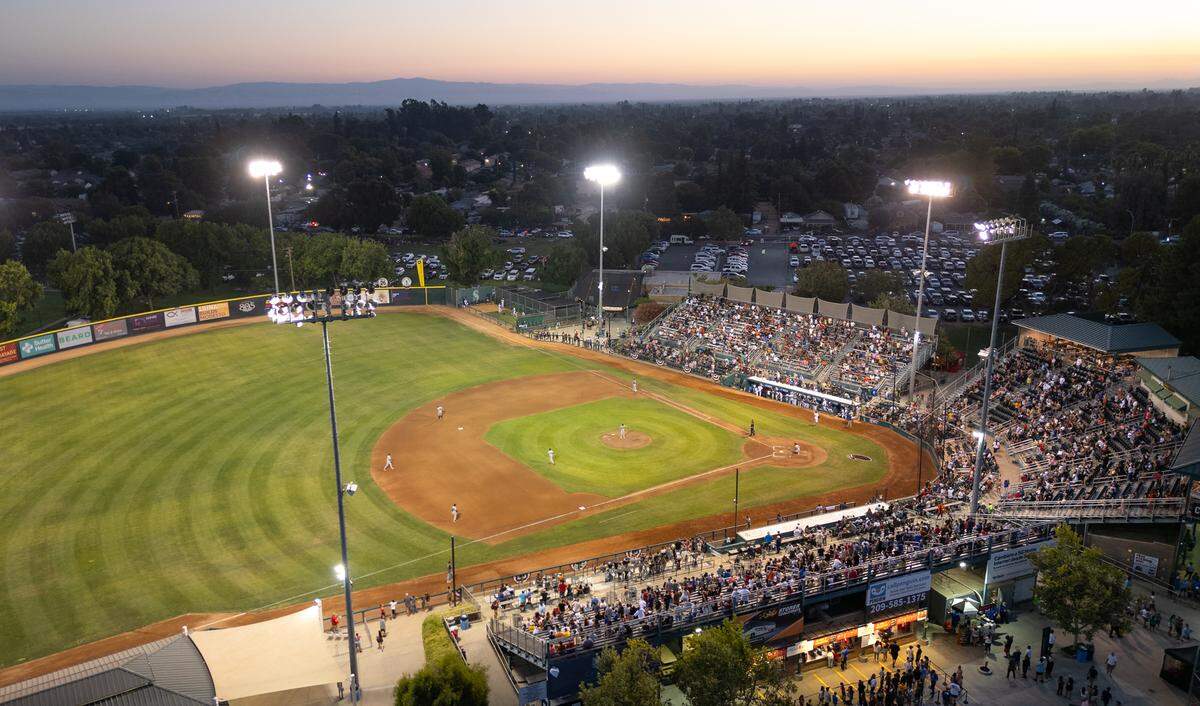
Taxpayers are similarly on the hook in other San Joaquin Valley cities. In December, the Stockton City Council approved $6.1 million worth of upgrades to bring 20-year-old Banner Island Ballpark into MLB compliance. Last August, the Visalia Rawhide announced it had reached an agreement with the City of Visalia to make roughly $7 million upgrades to Valley Strong Ballpark – months after the city unsuccessfully sued the team over who should bear those costs.
No assurances beyond 2030
What did Fresno, Stockton and Visalia get for their acquiescence? Besides MLB’s assurance that those cities will have affiliated minor-league baseball through 2030, not a darned thing.
In fact, the assurance letter Fresno received specifically states MLB “will use its best efforts” to have affiliated baseball at Chukchansi Park from 2031 to “at least” 2036 unless the stadium falls out of compliance or “the California League or any successor thereto ceases to exist.”
How might the California League cease to exist? As it did with the two short-season rookie leagues, MLB could opt to relocate the entire Low Class-A level to spring training complexes in Arizona and Florida.
If that happens, minor-league baseball in the San Joaquin Valley, and perhaps California, is toast with the exception of the Triple-A Sacramento River Cats. Who are being treated like second-class citizens for as long as the (Insert City Name) Athletics occupy Sutter Health Field.
While it’s fine for MLB to insist on basic amenities for their developing players (i.e. comfortable travel and clubhouses, air-conditioning, padded outfield walls), the demand placed on municipalities to make multi-million dollar stadium renovations is not. Nor is MLB’s underlying threat to relocate those teams, which makes city leaders look like the bad guys when in reality it’s a multi-billion monopoly being cheap.
“By placing unfunded mandates on cities like Fresno, MLB is acting more corporate-minded than community-minded,” said Arias, who represents downtown. “There’s no concern about the community. In the long run it’s a failing formula.”
It’s a failing formula for cities, taxpayers and the future of minor-league baseball in the Valley. Enjoy the 80-year tradition while it lasts.
This story was originally published April 9, 2025 at 5:30 AM.