San Joaquin River Parkway effort returns to its roots with reopening of Ball Ranch | Opinion
In the 1980s, citizen outcry over a proposed housing and golf course development on the river bottom outside Fresno led to the idea of a San Joaquin River Parkway.
The property that caused all the hubbub – Ball Ranch – can once again be utilized as a hub for public fishing, hiking, biking, horseback riding and bird watching. Hopefully this time for perpetuity.
Located on Friant Road two miles north of Copper River, Ball Ranch and Ledger Island, its across-the-river neighbor, were open on an informal basis for three years when the pandemic exposed the glaring need for more trails and recreation areas near Fresno.
But in June 2023 the San Joaquin River Conservancy, the state agency created to assemble the 22-mile ecological and recreation greenbelt between Friant Dam and Highway 99, ordered both properties closed due to liability concerns.
Over the last 18 months, using operations and maintenance funding shepherded through Sacramento by Assemblymember Joaquin Arambula in 2021, the Conservancy hired outside contractors from Big Sandy Ranchería to bring Ball Ranch into safety compliance and entered into a management agreement with the San Joaquin River Parkway and Conservation Trust. The nonprofit Parkway Trust also operates Sumner Peck Ranch, the fruit orchard bordering Ball Ranch, in addition to Sycamore Island Park in Madera County.
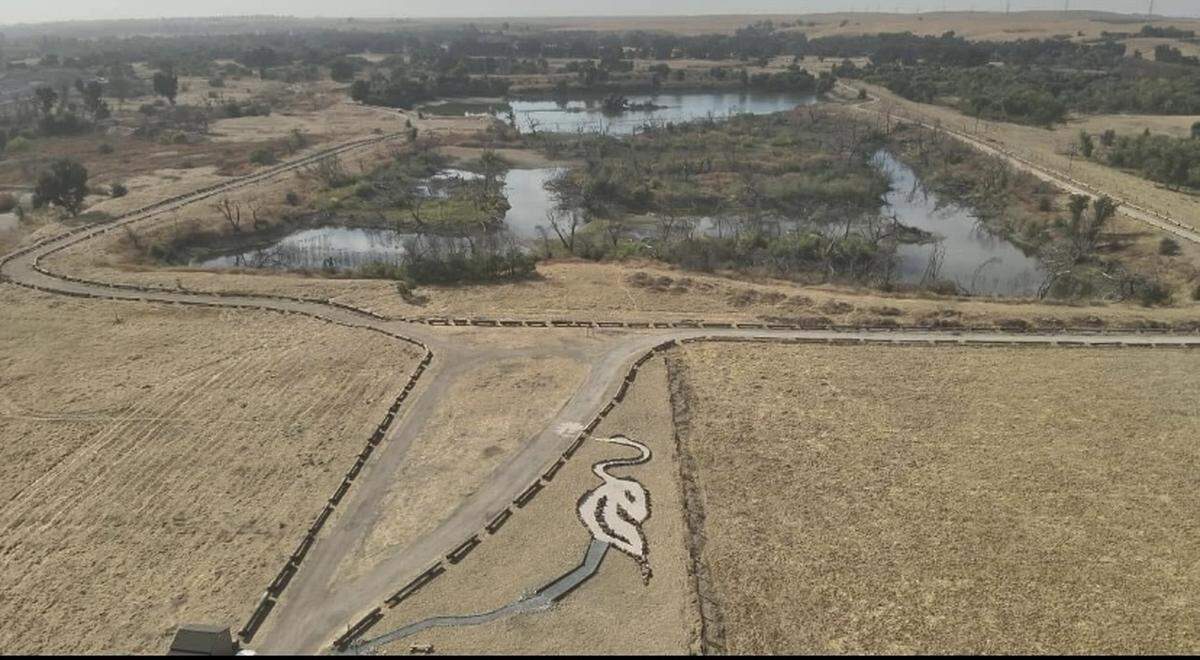
The most obvious improvements are new parking areas (one inside the main entrance, the other at the main pond) and disappearance of several log decks. Instead of posing a potential hazard, the hundreds of logs – Sierra National Forest trees killed by bark beetle infestation and transported to the site – now line roads or sit in giant piles of woodchips.
A few aesthetic touches have also been made. None nicer than the 142-foot-by-135-foot “log maze” in the form of a snowy egret created by Cheryl Moxley, the Conservancy’s recreation officer, and volunteers.
Costa: Some places ‘irreplaceable’
Congressmember Jim Costa, author of the 1992 legislation that created the San Joaquin River Conservancy, recalled the country club development proposed for Ball Ranch during a Friday news conference.
“It would’ve changed this place dramatically – and I don’t think for the better,” Costa said.
“There are some places that are just irreplaceable and the San Joaquin River is irreplaceable. It is a crown jewel for our region and for our nation.”
The 358-acre park is free to the public, open seven days a week and staffed during operational hours. In winter those hours are 6:00 a.m. to 5:30 p.m. and will vary depending on the season.
Ball Ranch, which sits north of CEMEX’s production plant, used to be the site of a gravel quarry. Its ponds, whose levels fluctuate seasonally depending on inflows from Little Dry Creek, is a reclaimed gravel mine.
Across the river, however, lies a 162-acre state-owned property where the scars of industry aren’t as apparent. Where majestic oaks more than a century old still grow and much native riparian habitat remains.
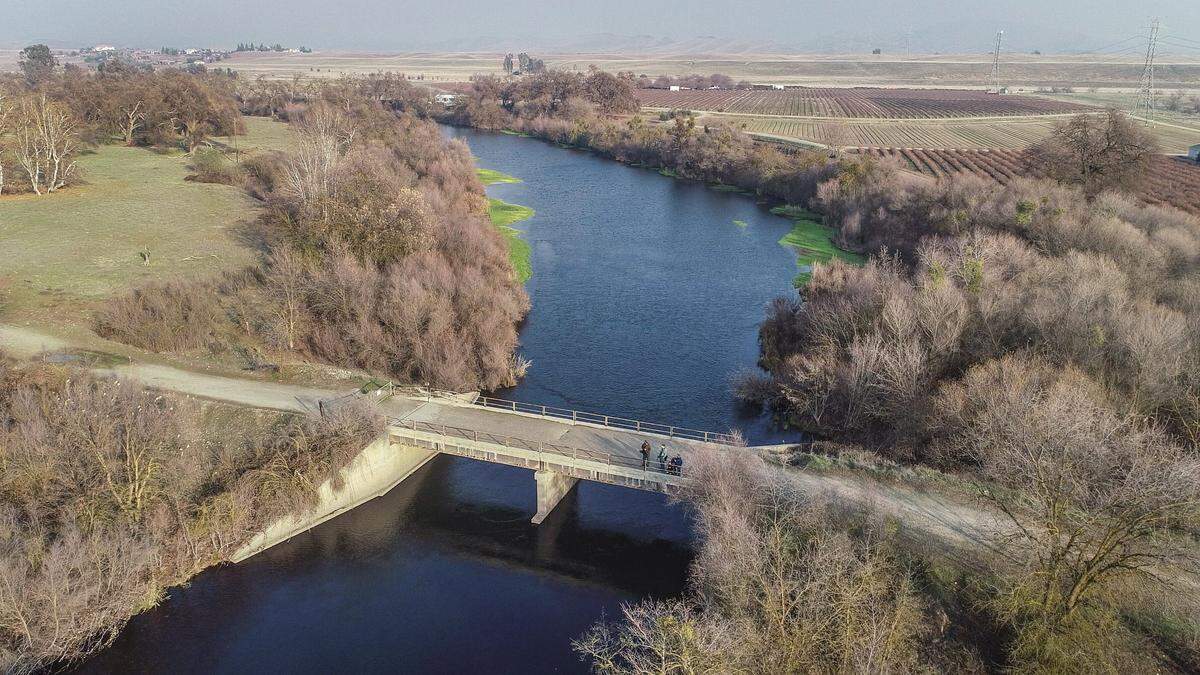
That place is Ledger Island, which is connected to Ball Ranch via a bridge built to transport gravel trucks across the river. Its center pile deemed structurally unsound by a 2015 seismic report, the bridge is now off limits to the public.
For the time being (two years is a good guess) Ledger Island is accessible only from Tesoro Viejo in Madera County – or by those who boat or wade across the river.
During her turn at the podium, Sharon Weaver, the Parkway Trust’s plain-spoken executive director, said she sympathizes with park visitors who want to ignore the fencing and warning signs erected on the condemned bridge.
“I am No. 1 in that frustration,” Weaver said. “I want to walk across that bridge as much as anybody else does.”
Funding for bridge replacement
Both Weaver as well as Kari Daniska, the state Conservancy’s recently appointed executive officer, both say they are committed to finding a solution.
The 2015 report estimated a replacement bridge would cost an estimated $6 million, meaning the current price tag could be double that amount.
A less expensive option, one mentioned by Weaver and others, would be to erect a prefabricated bridge for pedestrians and cyclists over the existing span. Then worry about a replacement that can bear the weight of emergency vehicles.
This sounds like a sensible approach. And thanks to the voters of California, who last month passed Proposition 4, the San Joaquin River Conservancy can expect an $11 million share of the state climate bond.
Some of that money could be used to pay for the new bridge, Daniska said, provided the Conservancy’s growing governing board agrees. Last month, Gov. Gavin Newsom appointed Fresno-native Stephanie Ruiz to serve as the board’s youth representative – leaving tribal representative as the only vacancy on what’s supposed to be a 16-member body.
Daniska, who joined the Conservancy in March, also confirmed Wildwood Native Park (on the Madera side of the river near the old 41 bridge) will reopen to the public Jan. 10 following recent improvements. It too has been closed since the summer of 2023.
Progress on the San Joaquin River Parkway has been frustratingly slow, but these are tangible steps.
This story was originally published December 16, 2024 at 10:16 AM.