Fresno got sued over ‘secret budget committee.’ Is there more transparency now? | Opinion
The last-minute deal-making that typically precedes the adoption of Fresno’s next budget will be less opaque this year than in the recent past.
For that, residents partially have Fresno City Council President Annalisa Perea to thank. Perea, and an investigation by the local news nonprofit Fresnoland into a backroom council subcommittee in existence since at least 2018 that resulted in a lawsuit by the American Civil Liberties Union and First Amendment Coalition.
The biggest change implemented by Perea was to disband the subcommittee that formerly met with the mayor and his administration to reconcile council amendments (“motions” in City Hall parlance) to the proposed budget, a process Mayor Jerry Dyer likened to making sausage “in the back room.”
In its place is … nothing. Perea opted not to appoint a budget committee or set up an informal work group.
Instead of being hashed out behind closed doors, each council budget motion will receive a public airing during Wednesday’s meeting.
“This is something new,” Perea said. “Last year after (department) budgets were presented, there was no more opportunity for the public to discuss motions or to say, ‘I like 1, 2 and 3 but please reject 4 and 5.’
“This will be the chance for the council to discuss motions, to make motions and to vote on motions, but only after having heard from the public. This is also an opportunity for the mayor to hear from the community in regards to what their thoughts are on the motions.”
Another change is all council budget motions must be verbally presented. Last year, Perea’s first on the council, she said some were submitted to the clerk’s office “after the fact.”
“In this budget process every motion that a council member wants to make will need to be voiced publicly,” Perea added.
Keep in mind that under Fresno’s strong-mayor system, Dyer has final say in which tweaks to his proposed budget get adopted and which get orphaned before the $2 billion spending plan goes before the city council for final approval.
Last year, the seven council members put forth a combined 120 budget motions of which 75 (with a price tag of nearly $30 million) wound up being either entirely or partially funded in the final version.
Not as much budget ‘sausage’
During this year’s belt-tightening, there isn’t nearly as much sausage to be made. In a show of austerity, council members submitted 24 combined motions that would require a $9.4 million outlay. (Seven motions did not contain specific dollar amounts.)
The most expensive tweak to Dyer’s budget — $3.5 million — was proposed by Councilmember Mike Karbassi for the realignment of Beechwood Avenue in northwest Fresno. Followed by Councilmember Tyler Maxwell’s $2 million allocation to fund the Eviction Protection Program.
The smallest? Karbassi wants an extra $25,000 for a boat so Fresno firefighters can respond to calls on the San Joaquin River.
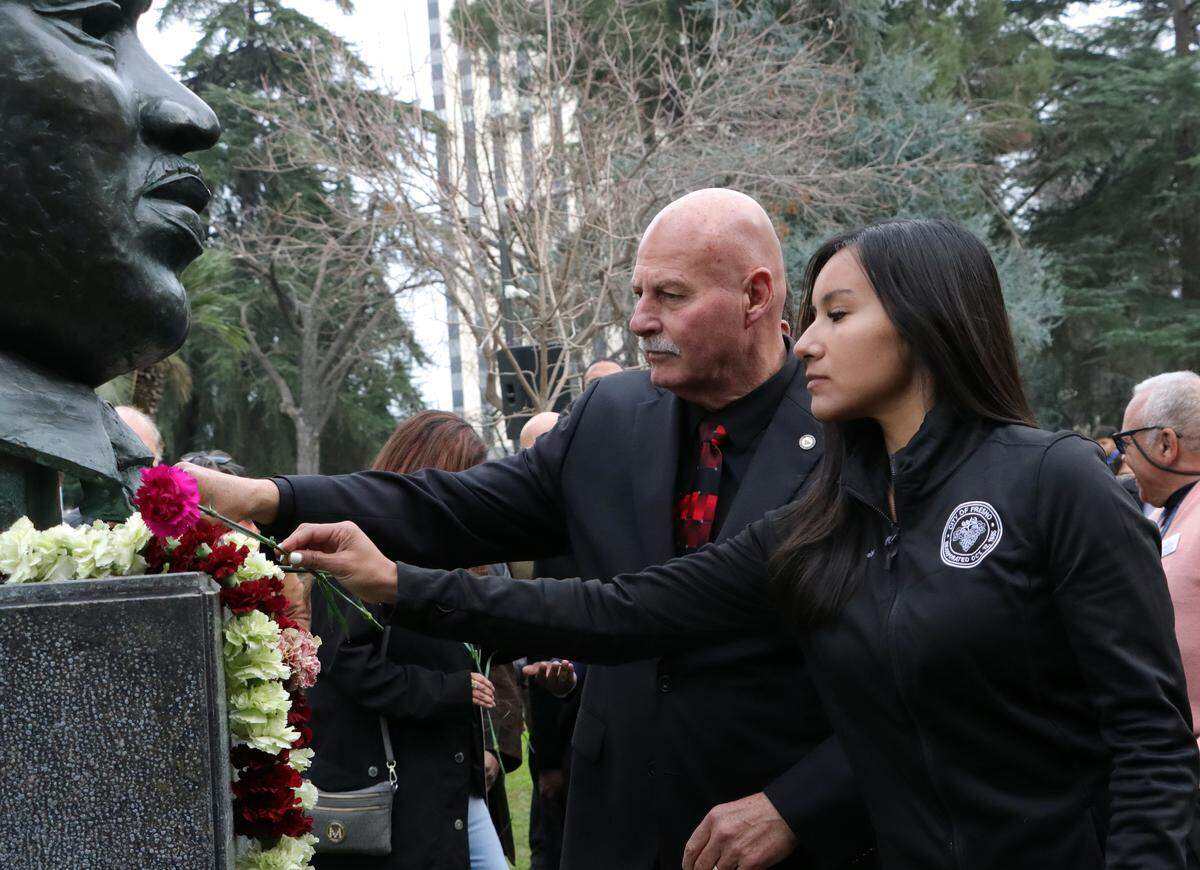
After listening to public comment during Wednesday’s meeting, council members will have the chance to alter existing motions, or propose new motions, before they all get voted upon by the seven-member body. Those that get at least four votes are submitted to the mayor.
Since there’s no longer a subcommittee, I asked Dyer how his administration will discuss and negotiate council budget motions.
“Based on the reduced number of motions made this year as compared to recent years, I plan on meeting with council members individually and collectively when needed in order to prioritize the needs of council members while maintaining a balanced budget,” Dyer responded via email.
The council’s final budget vote is scheduled June 20, with June 27 held in reserve just in case the sausage-making hits a snag.
Fresno adopts San Jose model
The lawsuit filed by the First Amendment Coalition and American Civil Liberties Union against the city for the “secret budget committee” that met during the previous five budget cycles remains in the discovery phase.
David Loy, the First Amendment Coalition’s legal director, said it is permissible for Dyer to meet with individual council members since the mayor is not subject to the Brown Act. However, the information discussed cannot be distributed to or talked about among a council majority.
“If one council member talks to the mayor, that’s not a Brown Act violation,” Loy said. “But if one council member talks to three other council members and says, ‘Hey, I’m going to talk with the mayor. What should I tell him?’ that is a problem because you’ve got a majority of the city council conversing about city business outside of an open and noticed meeting.”
By hashing out budget motions before the entire council, Fresno is adopting the San Jose model. Out of California’s 10 largest cities, the other eight appoint a budget subcommittee that holds public meetings.
“Just convene a committee, hold a meeting and open it to the public. Why is that so hard?” Loy asked.
“That is how it’s done in other cities. Other cities with strong mayors do it that way, and I don’t see any reason why Fresno can’t.”
I asked both Perea and Dyer that question, framed a little differently due to their respective roles. Perea didn’t answer directly; Dyer didn’t answer at all. (The lawsuit might have something to do with that.)
“That’s more or less what we do right now,” Perea said, “and I do believe the city of Fresno has the most robust budget process in the Central Valley, if not beyond.”
Fresno certainly has a more robust budget process than Clovis or Fresno County. No argument there. This year, it’s also a shade or two more transparent.
This story was originally published June 11, 2024 at 5:30 AM.