Fatal shooting by Fresno police left a nagging question. Here are the answers | Opinion
A recent column about the fatal shooting of Maximiliano “Max” Sosa Jr. by Fresno police in November 2023 posed a provocative question (Why wasn’t a clinician called to the scene?) without providing the answers.
That bothered me, so I decided to learn more about what types of services besides the standard law enforcement response are available locally for people experiencing a mental health crisis. To better separate policy and political will from reality.
Then I wanted to determine why those resources weren’t deployed in Sosa’s case.
To do so, I interviewed Fresno police chief Paco Balderrama, a firm believer that mental-health experts should respond to those types of calls, as well as Fresno County Department of Behavioral Health deputy director Emma Rasmussen. (Assistant city attorney Tina Griffin sat in during my interview with Balderrama. Likely to ensure he didn’t respond to questions about Sosa, whose family is suing the city for wrongful death.) I also reviewed a bevy of materials and studies related to mobile crisis response.
Here’s what I found: While the city of Fresno as well as Fresno County have contracted clinicians available for mental-health calls — even more of them since Jan. 1 — they would not have been called to the scene during the law enforcement response that resulted in Sosa’s death.
Why not? Three primary reasons:
▪ Sosa was carrying kitchen shears, which police consider a weapon.
▪ The episode occurred inside the apartment of Sosa’s estranged wife with her present, meaning a third party may have been in danger.
▪ The initial 9-1-1 call came during the early morning hours on a Saturday.
Since 2018, Fresno police and the Fresno County Department of Behavioral Health have co-sponsored a Crisis Intervention Team made up of a sergeant and four officers that have completed a 40-hour course on mental health response and de-escalation techniques. These officers work alongside clinicians provided by Kings View, the county’s private contractor for such services.
However, due to the sheer volume of calls, these CIT officers are rarely involved in the initial response. Rather, they get called in after it is determined (usually by the first officer on scene) that the individual is experiencing a mental health crisis. It is then up to the CIT officer to summon a clinician.
“They will not call the clinician there if there’s a weapon or if it’s still an ongoing situation with the potential for a crime,” Balderrama said. “They can’t put that clinician in danger. We have to render that scene safe before we can call them in.”
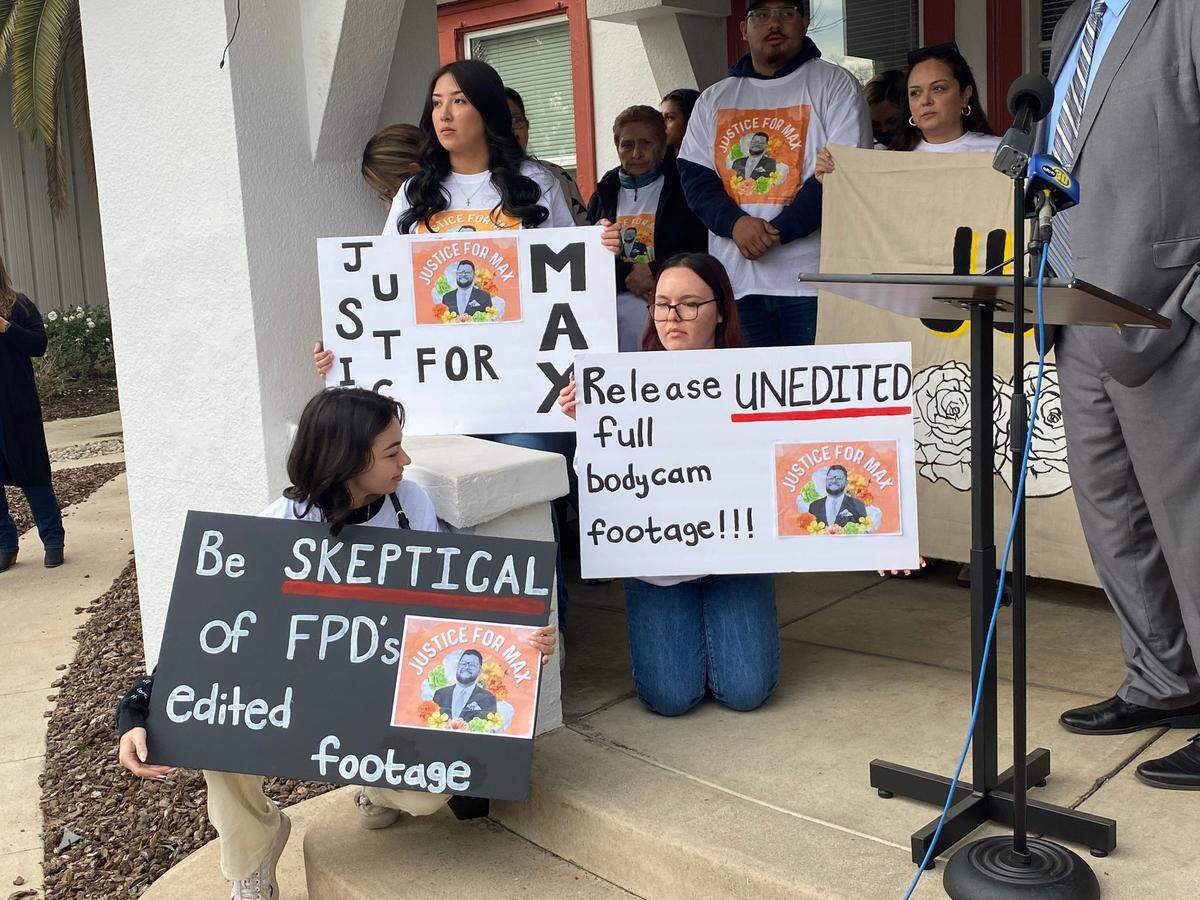
The other aspect that applies to Sosa’s situation is that the CIT unit (both officers and clinicians) works Monday through Friday from 6 a.m. to midnight. Meaning they weren’t on duty at 5 a.m. on a Saturday.
Why do CIT officers and clinicians work those hours? Because that’s when the bulk of mental health-related calls come in, Balderrama and Rasmussen said.
“Surprisingly, it’s true,” said Rasmussen, who oversees the county’s mental health services and mobile crisis response. “Even I was surprised at that data. The volume of calls is higher in the daytime compared to the nighttime.”
In 2023, according to Balderrama, Fresno police responded to 21,106 mental health calls when no crime was being committed and placed 5,036 people on 5150 holds. (That’s nearly 14 per day.)
Those are staggering figures. And with that much volume, the CIT unit ends up spending less time on initial responses and more on follow-up visits.
New service for non-violent situations
Starting Jan. 1, California counties have also been required to provide community-based mobile crisis services that don’t involve law enforcement. Fresno County’s Mobile Crisis Response Team is staffed by Kings View clinicians and case managers and is available 24/7. The direct number is (559) 600-6000.
The Mobile Crisis Response Team is only for non-violent situations where there’s no immediate threat of harm. To ensure that is the case, emergency dispatchers throughout Fresno County are being trained to ask specific questions to ensure the scene is safe for an unarmed clinician.
“We’re civilians and we have nothing on us besides our pen and paper,” Rasmussen said. “It’s quite different from what we’re used to.”
According to Rasmussen, counties that previously implemented mobile crisis response have achieved decreases in both emergency room visits as well as psychiatric hospitalizations.
“There’s cases when law enforcement presence is necessary and there are cases when it isn’t,” she said. “When it is determined that it isn’t, we have different work that we can do.”
Added Balderrama: “If a person is going through a mental health crisis and needs a clinician, we don’t want to add a gun to the situation.”
In addition to mobile services, the county also has mental health professionals available via 988 — the national suicide and crisis hotline — that provide a supportive voice and helpful connections.
In its first two months, Fresno County’s Mobile Crisis Response Team responded to 58 calls. Rasmussen expects that number to increase as more people become familiar with the new service.
“It’s going to take time for the community and for everyone involved to get used to the options we have and how to best utilize them,” she said.
To be clear, this wasn’t about whether Fresno police acted properly when they fatally shot Sosa, who told officers he was suicidal. That’s a different question altogether. This was about why no mental health professionals were called to the scene.
The answers (Sosa had scissors, his estranged wife could potentially have been in danger and the call came in at 5 a.m. on a Saturday when the CIT unit is off duty) aren’t great, nor entirely satisfactory. But at least we have them.