Put food scraps into the green bin? Absolutely. It helps the environment and farmers | Opinion
Separating food scraps from the rest of your trash may seem like a pain at first.
But look at it this way: Every chicken bone, banana peel and egg shell that doesn’t wind up in a landfill benefits not only the environment, but also local farmers.
In Fresno, the heart of California’s agriculture-rich San Joaquin Valley, that should be more than enough reason to alter our garbage-disposing habits.
Right?
Think of it not as another intrusion by big government, but as help to small farmers who struggle to afford the high cost of getting compost delivered.
SB 1383, the state law that requires Californians to recycle their food scraps and other leftovers into the green waste bin, went into effect in 2022. However, municipalities that did not have the necessary systems in place weren’t susceptible to fines of up to $10,000 per day until 2024.
Which explains why Fresno, Clovis and dozens of other cities are finally getting around to implementing organics recycling and notifying residents about the change. (Fresno County began enforcement in unincorporated areas last fall.) Some cities, including San Francisco, Berkeley and Costa Mesa, have been doing it for more than a decade.
Why bother? Because organic waste — including food scraps and soiled paper products — generates methane as it decomposes in landfills, and methane is a powerful greenhouse gas. In fact, it is 28 times more impactful on global warming than carbon dioxide over a 100-year period. My source: the Environmental Protection Agency.
Landfills are the state’s largest stationary source of methane pollution. Thirty-two landfills surveyed by the California Energy Commission produced more methane (43% of total emissions) than the oil and gas industry and animal feed operations (both 26%).
That’s why California is taking this groundbreaking step with its garbage. And farmers should be among the main beneficiaries.
High cost to haul compost
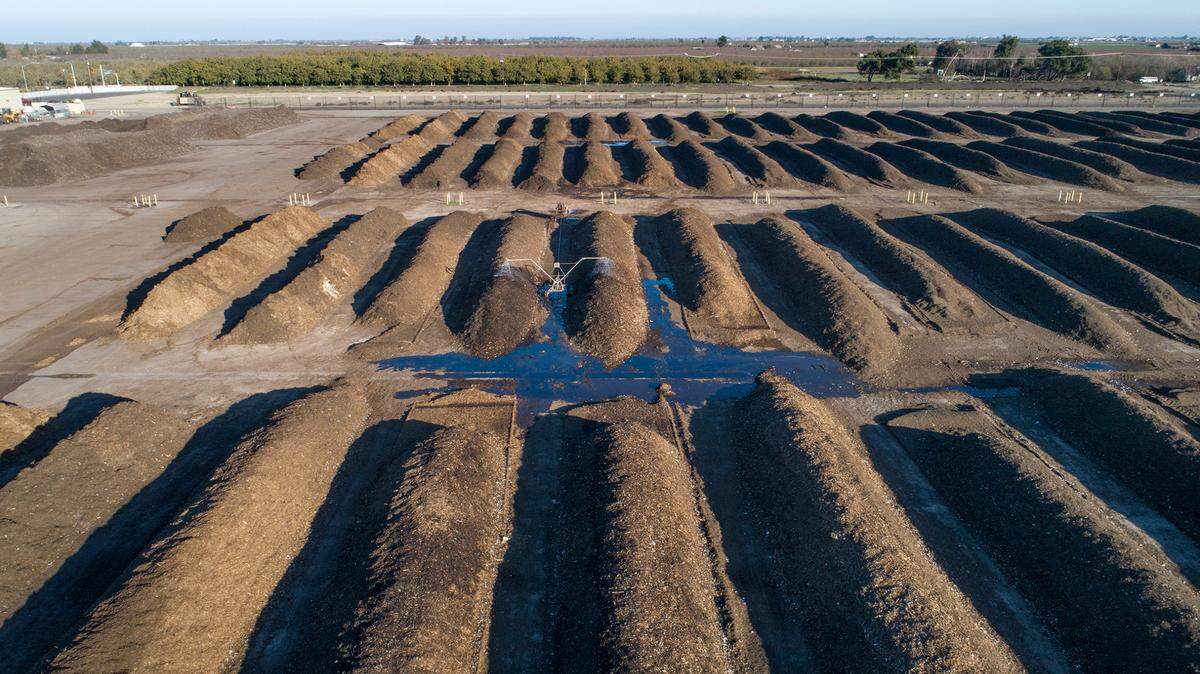
Organic waste has several uses. Chief among them is the production of compost — decayed organic material long valued by organic farmers and backyard gardeners, and increasingly so by mainstream farmers, to replace minerals and trace elements in the soil that the previous crop took out.
The problem with compost, at the type that meets standards for organic farms, is that it’s quite expensive. Tom Ford, who has been producing organic compost since 1994, said he charges about $50 per ton on site and $75 per ton when delivered within 50 miles.
Central Coast Compost is located near Hollister, but has customers in Fresno and Madera counties willing to pay $300 per ton to cover the extra hauling costs.
“It can get to the point where you’re paying as much to haul (compost) as you are to having it delivered and spread,” said Tom Willey, a retired Madera vegetable farmer and host of the “Down on the Farm” podcast. “I know people who don’t buy it because it’s so expensive.”
Robert Rundle, who farms 30 acres of organic vegetables and fruits outside southwest Fresno, needs between six to eight tons per acre for his soil to reach the sufficient nitrogen level. Each bill can run thousands of dollars, which is why he doesn’t get compost delivered every year.
“It’s not just the product,” Rundle said. “You’ve got to pay to get it spread, too.”
Willey’s hope is that SB 1383 will result in increased compost production and in more locations nearer to farms.
“If every county started producing good compost, we won’t have to haul it as far as people do now,” he said. “That’s where the real savings will come in.”
Green waste in Fresno, Clovis
Every year, Fresno produces approximately 75,000 tons of organic green waste. Ahmad Alkhayyat, the city’s assistant public utilities director, expects that figure to potentially increase by 18% now that residents are recycling their food scraps and waste.
Fresno trucks that green waste to one of two organic processing facilities — Kochergen Farms Composting on North Avenue and West Coast Waste on Golden State Boulevard — and pays a tipping fee.
In Clovis and other Fresno County areas, Republic Services also transports organic materials gathered from residents and businesses to Kochergen Farms’ plant in Avenal, where it is composed and sold to farmers, growers and landscapers.
Clovis also gets compost back from Kochergen for use in parks and trails, city spokesman Chad McCollum said.
CalRecycle, the state agency that oversees such matters, estimated California would produce 5.5 extra tons of compost by 2025. Enough to apply to an extra 27 million acres of cropland.
SB 1383 appears to be falling short of its goal to reduce organic waste in landfills by 75%. There are those who contend the measure doesn’t do enough to ensure newly created compost ends up on farmland. Still, it’s a step in the right direction.
“Anytime you add supply to the equation it definitely helps,” said Ryan Jacobsen, CEO of the Fresno County Farm Bureau. “The cost of fertilizing materials skyrocketed during the pandemic, and while that has stabilized it’s still not back to what it was. So the availability of more compost should be hugely beneficial.”
For Fresno-area residents wishing to demonstrate support for farmers, that should be reason enough to put their food waste in the green bin.