Artist’s rendering depicts a better future for one of Fresno’s worst streets | Opinion
Not every day does one gets a sneak peek at a better future.
A better future for one of Fresno’s signature — and depressingly archaic — boulevards.
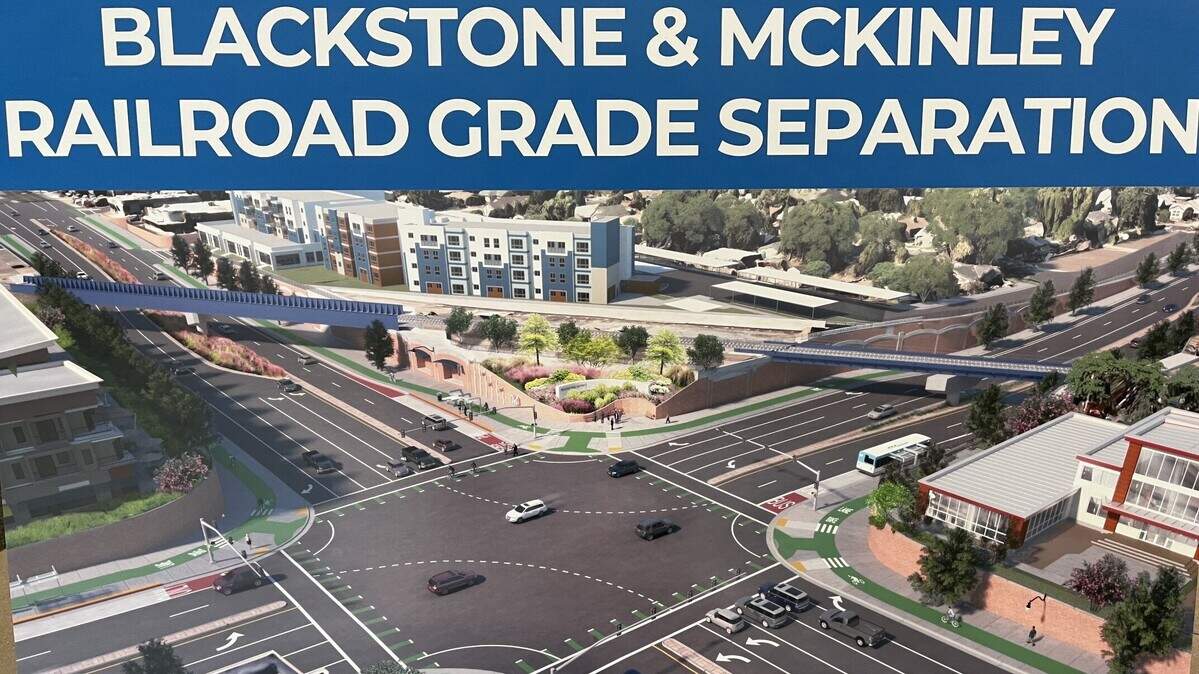
The other day, when city officials unveiled an artist’s rendering of the new railroad crossing coming soon to the bustling intersection of Blackstone and McKinley avenues, most eyes were drawn to the elevated tracks that will make all those frustrating delays around Fresno City College a thing of the past.
Not mine. I peered at the beautifully landscaped sidewalks, the green-painted bike paths and mixed-use developments dotting all four corners. And I couldn’t help but wonder if this is how this dreary intersection will actually look once the $151 million project is completed, or if we are being sold a fantasy.
A little of both, as things turn out.
According to Scott Mozier, the city’s public works director, the project is “approaching the 60% design milestone.” Specifically, that means the bridge’s structural design, roadway design and striping, traffic signal components and a stage construction plan are nearly complete.
All the cycling and pedestrian infrastructure depicted in the rendering will be incorporated into the project, Mozier said. That means off-street bike paths at all four corners of Blackstone and McKinley — a first for Fresno — that extend underneath each segment of the elevated railroad tracks.
Finer details, such as landscaping and aesthetic treatments, will be designed over the next year.
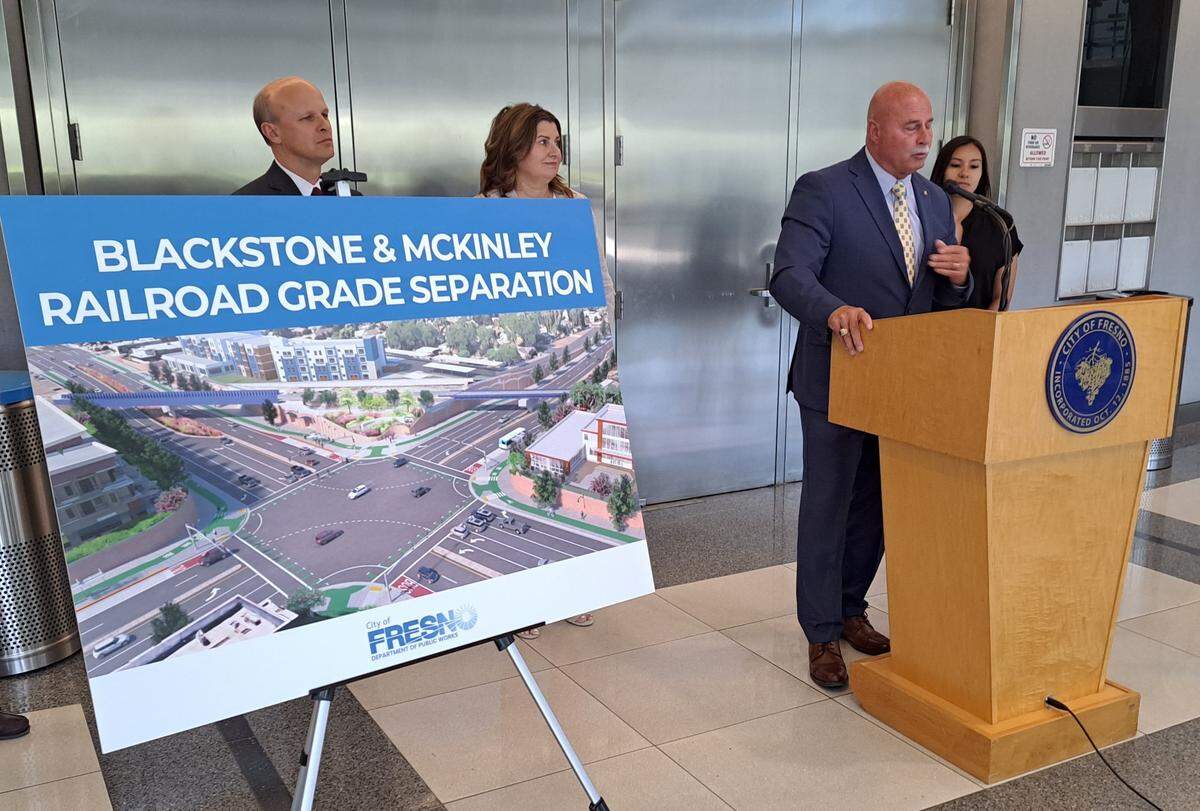
The rendering presented Thursday at City Hall by Mayor Jerry Dyer and other city officials contained another imaginative curiosity: mixed-use developments at all four corners of the intersection.
In 2023, only one of those developments (The Link @ Blackstone) actually exists. The 88-unit affordable housing community with a senior center and medical clinic sits near the southwest corner. (On the actual corner is a smog repair shop that will be acquired by the city for the right of way and demolished.)
The other three corners contain two fast-food restaurants and a gas station strip mall. Typical Blackstone Avenue, but hardly the sort of infill housing along major corridors Fresno desperately needs.
“These future mixed-use developments are not a direct part of the Blackstone and McKinley Grade Separation Project, but the rendering depicts how these land uses would interact with the streets and sidewalks,” Mozier said in an email.
In other words, this is what city planners want the intersection to look like. After the surrounding properties are (cross fingers) redeveloped.
Ambitious Blackstone plan shelved
The reimagining of the Blackstone Avenue corridor, specifically the 2.5-mile segment between Dakota Avenue and Highway 180, began in earnest in 2019 when the City Council adopted the Southern Blackstone Avenue Smart Mobility Strategy.
The ambitious plan, a result of extensive public engagement, called for wider sidewalks with bike paths, better crosswalks and reduced speed limits in order to make the six-lane road safer for pedestrians and cyclists. Supporters marched from Blackstone to City Hall, carrying signs.
Unfortunately, the plan’s estimated $50 million price wasn’t included in the city budget. Nor did it have an attached outside funding source. So the 146-page document, filled with good intentions, has sat on a shelf for the last four years.
Hopefully the grade-separation railroad project, with its detailed depiction of a new and improved Blackstone, can serve as a catalyst to transform one of Fresno’s most run-down and underutilized streets.
Tear down the fast food restaurants, smog shops and dilapidated strip malls and build attractive mixed-use housing where residents can easily hop on a bus and feel safe to walk or to ride their bikes.
That should be the future of Blackstone. It’s all right there in the rendering.