Flood releases from Friant Dam ‘a blessing’ for San Joaquin River salmon restoration | Opinion
Prolonged flood releases into the San Joaquin River from the Friant Dam aren’t necessarily great news for farmers whose fields are underwater. Nor for residents of cities and communities along the river.
But for spring run Chinook salmon being reintroduced into the river system following a 60-year absence, conditions are practically ideal.
“It is a huge blessing, not only for San Joaquin salmon but all over the Central Valley,” said Don Portz, program manager for the San Joaquin River Restoration Program. “These are the years when salmon do really well.”
Over the last few weeks, biologists and technicians involved in the multiagency effort released about 200,000 juvenile salmon raised at the interim hatchery below Friant Dam. In a typical year, to circumvent impasses in the river, that process involves trucking them 1½ hours away.
This year, with dam operators maximizing river discharges to make room in Millerton Lake for the record-setting southern Sierra snowpack, those impasses are little more than speedbumps. No need for trucks. The juvenile salmon set out straight from the hatchery.
“There’s so much water that even if there are impediments underneath those fish are just going right over the top,” Portz said. “Nothing is going to stand in their way all the way out to the Pacific Ocean.”
In its January initial allocation, the Bureau of Reclamation projected salmon restoration flows of 560 cubic feet per second in March, 600 cfs in April, 640 cfs in May for a total 2023 water year allocation of 556,542 acre-feet. But after repeated atmospheric rivers slammed California, actual flood releases from the dam were raised to 2,000 cfs on March 10 before climbing above 8,000 cfs during the last two weeks. That equated to 328,075 acre-feet in March alone.
High, turbid flows create more feeding habitat for the baby salmon during their journey to the ocean. They’re also able to camouflage themselves in the murky water and better avoid predators.
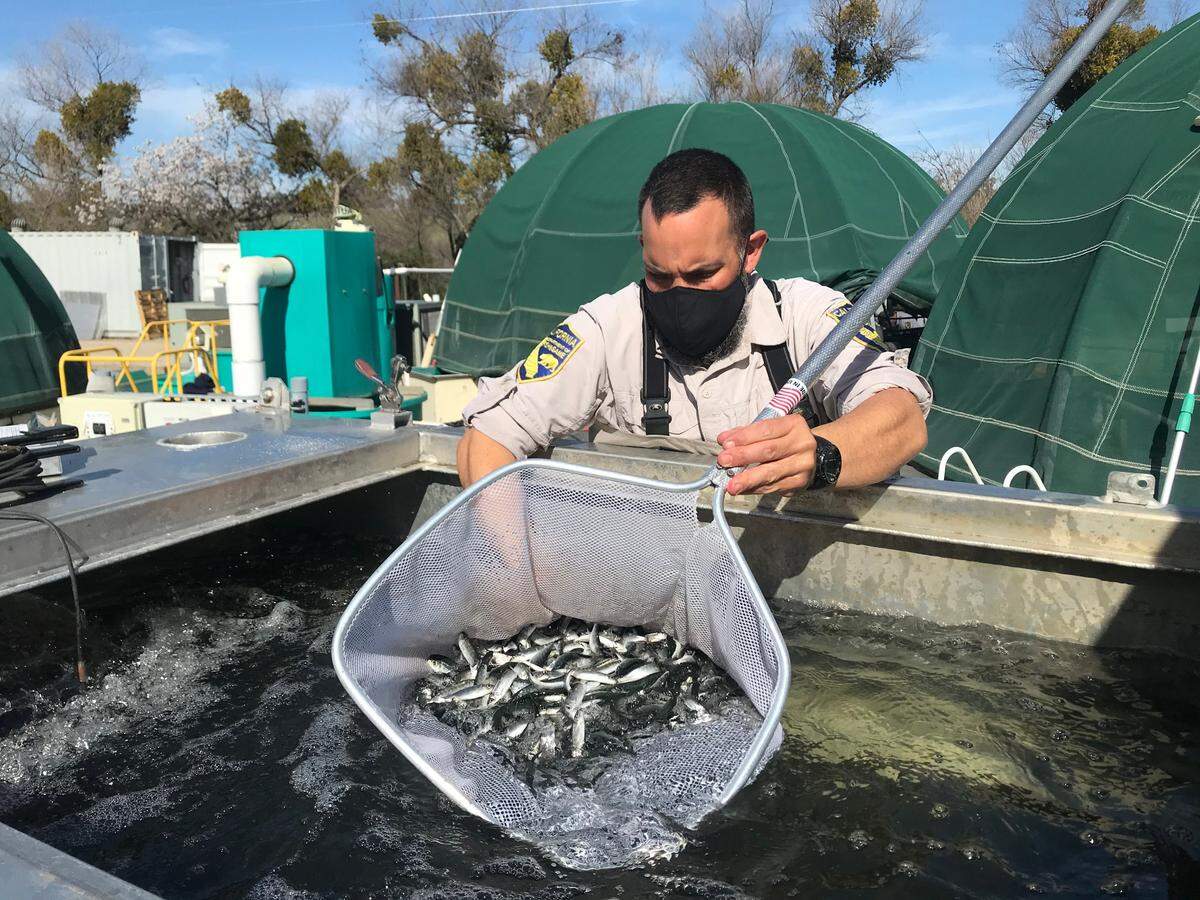
Adult salmon swimming upstream
As juvenile salmon are pushed downstream on the San Joaquin, adult salmon are starting to make their way upriver at the end of their 2- and 3-year life cycles.
Since those fish were released during drought conditions, their odds of survival aren’t as good as recently released juveniles. But adult salmon that do return should be able to reach their spawning grounds unimpeded.
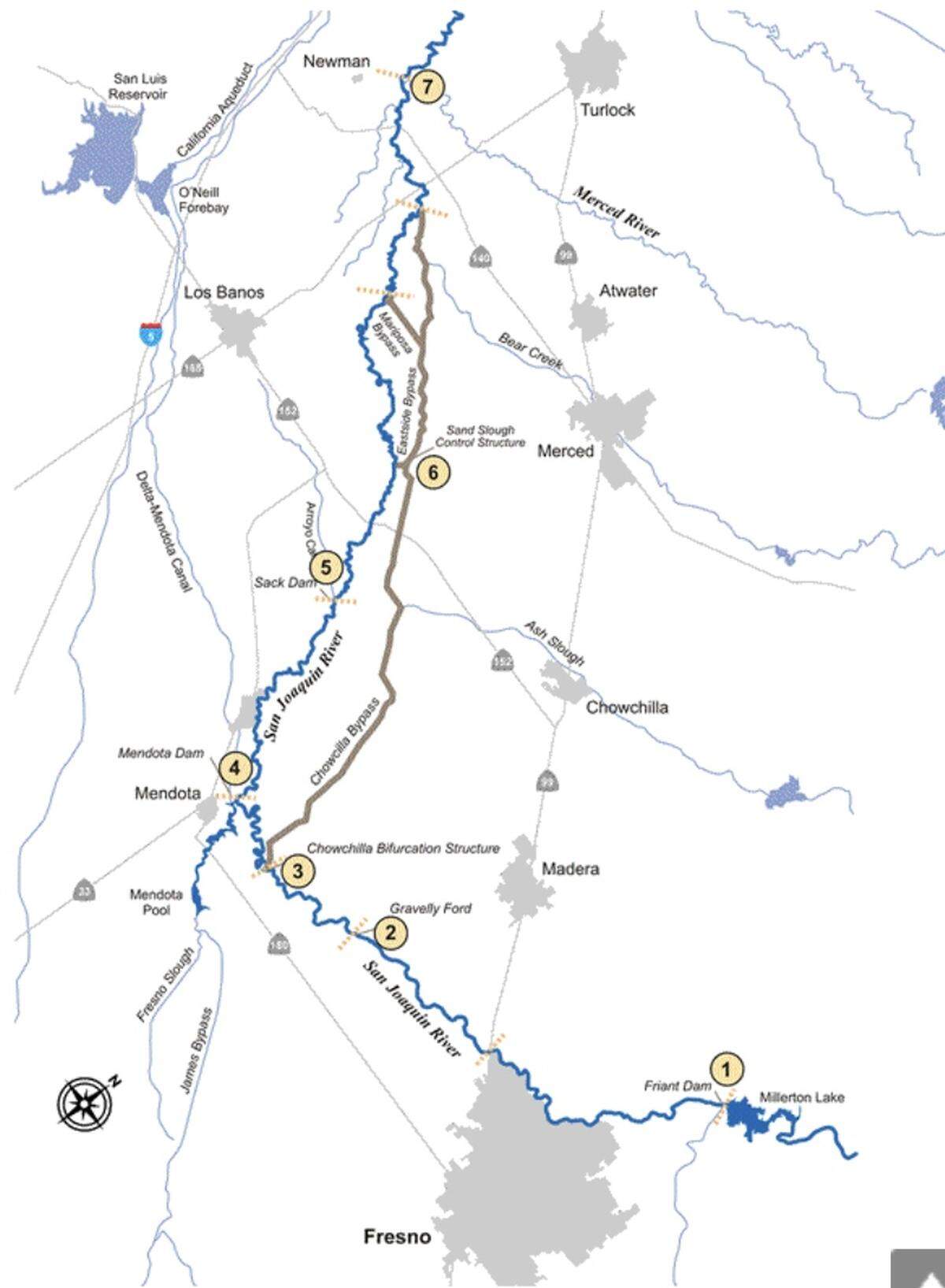
In a normal spring, salmon would not be able to swim up the Eastside Bypass flood control channel, the most direct route, due to a sheer 5-foot drop on the downstream end. This year, Portz believes ascending the channel won’t be a problem. And if fish stay in the river, neither will obstacles further upstream.
“Sack Dam is underwater, so that’s no longer an impediment, and Mendota Dam has got all their stop logs pulled” allowing water to flow over, Portz said. “Those fish have two ways to get to Friant Dam currently: up the river channel and the Eastside Bypass.”
Because high flows are treacherous to work in, program staff won’t monitor how many adult salmon have returned until this fall when they count the number of redds (gravel spawning beds). The highest number in program history — 209 — came during the last wet year in 2019.
“We’re just going to let them swim up on their own to the base of Friant Dam and hang out all summer long,” Portz said. “We won’t know until September, October when they start making the redds if we were successful or not. So we’ve got to just be patient and hang on.”
Program’s successes and setbacks
Launched in 2009 following an 18-year legal tussle between environmental groups and the U.S. Bureau of Reclamation and Friant Water Authority, the San Joaquin River Restoration Program faced enormous odds. Some doubted it was even possible to return a sustainable salmon population to a river that’s been re-plumbed (both for agriculture in the Valley and hydroelectricity in the Sierra) and almost completely dry since the 1950s.
Hatchery-raised adult salmon have been returning to the San Joaquin in limited numbers to spawn since 2017. From that measure, the program has been a success. However, those successes have been stifled by the lack of settlement-guaranteed restoration flows (except in dry years, which have been the norm) as well as costly seepage issues onto neighboring orchards.
Critical upgrades to allow for the safe passage of salmon during normal years, including a ¾-mile channel to circumvent Mendota Pool, remain in the design and land acquisition phase. Portz expects to have that and other passage projects completed by 2026. Meanwhile, construction of a permanent hatchery, capable of producing 1.5 million juveniles per year, should be completed by late spring.
Besides being beneficial to fish, the historic flood flows help program managers better understand the 152-mile stretch of river from Friant Dam to the Merced River confluence. Including which levees are weakest and what areas are most prone to seepage.
“I would never be able to put 4,000 cfs of restoration flows because I would be impacting farmers and cities and there would be so much liability with that. Right?” Portz said. “But we’re able to use this current situation and get real data.”
Good to know that multiple species — salmon and fish biologists — are thrilled by all this water.