Seismic shift in college sports foreseen long ago by certain Fresno State football coach
As the tectonic plates beneath college sports continue to shift ― further separating the haves from the have-nots ― Fresno State can’t say it wasn’t warned.
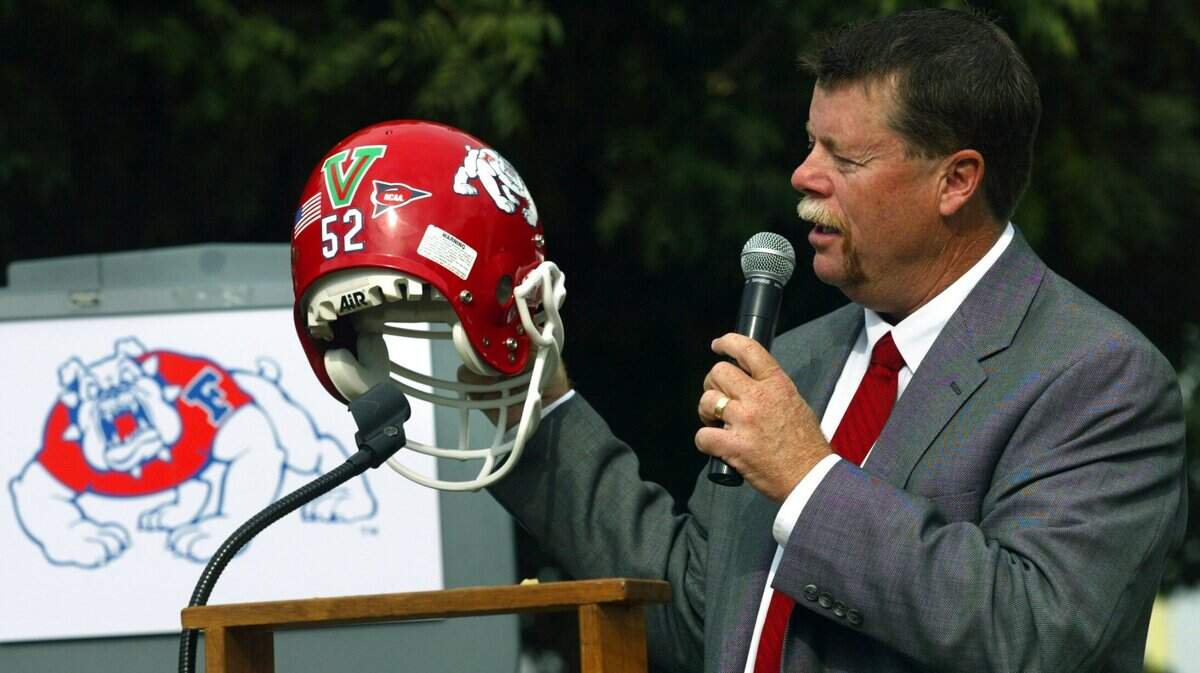
Even before coaching his first game at Bulldog Stadium, Pat Hill was convinced the power conferences would split off from the rest of the FBS (then known as Division I-A). And when that happened, Fresno State needed to be on the right side of the divide or else be relegated to the kiddie pool.
“I really believe in three to five years, if you want to play at the table with the big boys, you’re going to have to ante up in different ways,” Hill said in an August 1997 interview. “That’s what we have to be prepared to do.”
Hill’s timetable may have been off, but his intuition was on spot on. The big boys are indeed breaking away from the pack, as evidenced by USC and UCLA jumping ship from the Pac-12 to the Big Ten (in 2024) as well as Texas and Oklahoma joining the SEC (in 2025, for now). If more moves follow, college football may indeed be left with two or three mega-conferences (made up of 16-20 schools each) that hog all the network television revenues and major bowls.
Which is precisely the future a certain Bulldogs coach known for his Fu Manchu mustache and “Anybody, anytime, anywhere!” mantra used to foretell. To anyone willing to listen.
Hill’s chief concern in those days was expanding Bulldog Stadium to 65,000 or 70,000 seats. In retrospect, totally unnecessary. But the path school officials chose instead ― making only minimal investments to facilities in the two decades since Save Mart Center opened ― all but sealed Fresno State’s fate.
I know that’s not what Bulldogs fans want to read. In their eyes, the Pac-12 has at least two openings with USC and UCLA both on their way out. They want Athletic Director Terry Tumey making the case to every Pac-12 administrator in his iPhone contacts that Fresno State merits strong consideration if the conference adds new members.
Tumey, by several accounts, is doing that very thing. Meanwhile, the athletic department’s marketing team started touting Fresno State’s television reach on Twitter, claiming 2.3 million households if you conveniently include Sacramento and several Central Valley counties outside the Fresno market. At the same time, proponents of a Fresno State facilities tax initiative (one-third of which can be spent on athletics) are pushing for the November ballot.
While these efforts are worthwhile ― except arguably the tax measure ― they’ll almost certainly end up being futile.
Pac-12 dream seductive to Red Wave
The idea of Fresno State joining the Pac-12 is seductive to Bulldogs fans, and over the years I’ve heard many arguments (some sound, others not so much) about why the Pac-12 should choose Fresno State in any future expansion.
Dreaming big and aiming high. That’s what Fresno State fans and administrators ought to be doing. However there is a point where dreams and aims smack into harsh realities. And the reality is the Pac-12 isn’t about to welcome Cal State University, Fresno, into its exclusive fraternity. Not even in its diminished state.
The reasons for this have little to do with competitiveness, market size or geographic footprint. It’s about the fact that these types of decisions aren’t made by coaches or athletic directors. The ultimate authority rests with university presidents and chancellors that place academics above all else.
This is where Fresno State’s comparative shortcomings get exposed. Unlike the majority of Pac-12 schools, it is not a member of the Association of American Universities. It is not a research institution, nor does it offer doctorate degrees in a wide array of academic fields. (Fresno State offers three doctorates; UC Berkeley offers 93.)
There’s no shame in any of this because research and conferring PhDs isn’t Fresno State’s mission. Nonetheless, that fact will always be used as an excuse by Pac-12 presidents for keeping the Bulldogs out.
Besides, there’s no guarantee the Pac-12, the self-proclaimed “Conference of Champions” even survives. If ESPN decides it needs West Coast programming and coughs up enough dough for the TV and streaming rights, maybe the 10 remaining members stick together. If not, it’s possible the most desirable schools bolt to the Big Ten and Big 12 leaving the least (likely Oregon State and Washington State) to get scooped up by the Mountain West.
What happens next, both for college sports as a whole and Fresno State’s place in it, no one knows for certain. But credit should be given to a certain football-coach-turned-radio-analyst who foresaw these seismic shifts.